
Instead of repeatedly checking damage photos and chasing approvals, use a vacant property inspection board up workflow that turns each exposed opening into an authorized securing task. Inspect from a safe position, record the damage, approve the scope, arrange board-up and glass cleanup, then verify the work before closing the request.
- Use a vacant property inspection board up workflow to connect damage records, authorization, emergency board-up, and verification.
- Bestboardup serves Los Angeles owners needing emergency window and door board-up, glass cleanup, and property securing.
- Stop the inspection when you encounter unsafe conditions; board-up does not replace emergency response or structural assessment.
- Keep the securing request open until completion photos and unresolved hazards are recorded.
Why this matters
A vacant building needs more than a photograph of its broken window. The person inspecting, the person approving work, and the person securing the opening need the same location, access instructions, and damage record. Otherwise, a reported problem can remain an exposed opening.
Bestboardup is best for Los Angeles property owners needing 24/7 emergency board-up, glass cleanup, and property securing. Its services cover residential and commercial properties; this workflow explains how to organize the handoff, not how to install boards yourself.
Start with the vacant property board-up guide when choosing the securing scope. For your 2026 inspection register, keep emergency securing separate from permanent repairs so closing one task does not accidentally close the other.
Before you start
- Confirm authority and access. Identify the owner or authorized property representative, the person who can approve work, and the person controlling keys or access codes. Have the property address, unit identifiers, and emergency contacts ready.
- Prepare a shared record. Use a phone or camera, an inspection checklist, and a work-order system or shared document. Record observations from a safe position; do not enter merely to collect better photographs.
- Check occupancy and exit requirements first. A property described as vacant can still contain people or require access for authorized occupants and workers. Do not assume every door can be sealed: identify required exits and have uncertain access or fire-safety requirements resolved before authorizing full board-up.
If you see an active intrusion, fire, immediate danger, or a suspected structural failure, stop. Move to safety and contact the appropriate emergency service; call 911 for an emergency. An inspection checklist is not permission to enter an unsafe building.
Inspection record
Establish the property baseline
- Open one property record. Enter the complete address, building or unit identifier, inspector, inspection date, and owner contact. Use a consistent identifier across photographs, messages, and work orders.
- Walk the accessible perimeter. From safe, authorized areas, identify damaged windows, unsecured doors, accessible openings, loose panels, and visible glass debris. Record areas you cannot inspect rather than marking them clear.
- Label each finding. Use location descriptions such as front entrance or rear ground-floor window. Separate what you observe from what someone else reports.
For your 2026 inspection checklist, distinguish existing damage from newly observed damage. A photograph without a location or date is difficult to use when a property changes between visits.
Expected result: You have a dated property record with identifiable openings, photographs, access limitations, and an inspector contact. Another authorized person can understand the findings without repeating the entire inspection.
Capture evidence without disturbing the site
Take 2 photo views per damaged opening when you can do so safely: a wider view showing its location and a closer view showing the damage. This is a documentation recommendation, not a reason to approach unstable glass or cross a restricted area.
Record visible frame damage, hanging glass, and whether the opening exposes the interior. Do not test loose panes or force a damaged door to determine whether it still works. Note the uncertainty and pass it to the securing crew.
If a break-in is suspected, preserve the scene and follow law-enforcement instructions before disturbing potential evidence. Record any incident reference supplied to you; do not invent one or wait for paperwork while ignoring an immediate safety emergency.
Scope and authorization
Define what must be secured
- List the affected openings. Describe each window, door, or other exposed area separately. Include accessible photographs and any known obstacle to reaching it.
- Separate securing from repair. Request temporary closure, glass cleanup, and property securing as needed. Record permanent glazing, frame repairs, water-damage work, or structural assessment as separate follow-up tasks.
- Obtain explicit approval. Identify who approves the scope and record that approval in the same property file. Assign 1 accountable owner per securing request so responsibility does not disappear between messages.
Full board-up means the agreed securing scope is complete; it does not mean every opening must be covered. Have the contractor assess exposed or vulnerable openings while preserving required exits and authorized access.
Expected result: The request specifies what needs securing, who authorized it, what access must remain, and which repair tasks sit outside the board-up scope.
Choose targeted or broader securing
Use the inspection findings to choose the scope. Do not authorize broader coverage merely because the building is vacant, and do not limit the job to the first broken window when other openings remain exposed.
| Securing scope | Best for | Advantage | Limitation |
|---|---|---|---|
| Targeted board-up | Documented damage limited to identified openings | Keeps the request focused on the observed exposure | Leaves other openings outside the agreed work unless assessed and added |
| Broader board-up | Multiple damaged or exposed openings across a vacant property | Addresses the documented openings within one coordinated scope | Requires more access planning and careful review of exits and inspection needs |
Recommend targeted board-up when the inspection supports a limited scope; recommend broader board-up when the documented exposure requires it. Neither approach repairs structural damage or replaces a permanent window or door repair.
Bestboardup provides emergency board-up and glass cleanup, but the securing request still needs defined boundaries. State whether cleanup involves only accessible debris or whether additional hazards require another qualified contractor.
Contractor handoff
Send an actionable request
- Send the complete location package. Include the address, opening labels, photographs, authorized contact, and safe access instructions. Identify gates, locked areas, or access restrictions without putting sensitive codes into a broadly shared message.
- Flag safety and evidence restrictions. Report suspected intrusion, unstable frames, visible fire damage, or areas that have not been cleared for entry. State whether police, fire personnel, or another responsible authority has restricted access.
- Confirm the assignment. Ask the contractor to acknowledge the requested scope, site contact, access arrangement, and exclusions. Record the actual response rather than treating a sent message as an accepted job.
For a 2026 dispatch record, use separate fields for request sent, contractor acknowledgment, access confirmed, and work completed. These are suggested record labels, not instructions for an unnamed software interface.
Expected result: The contractor has enough information to assess the securing work, and the property representative knows whether the request has actually been accepted.
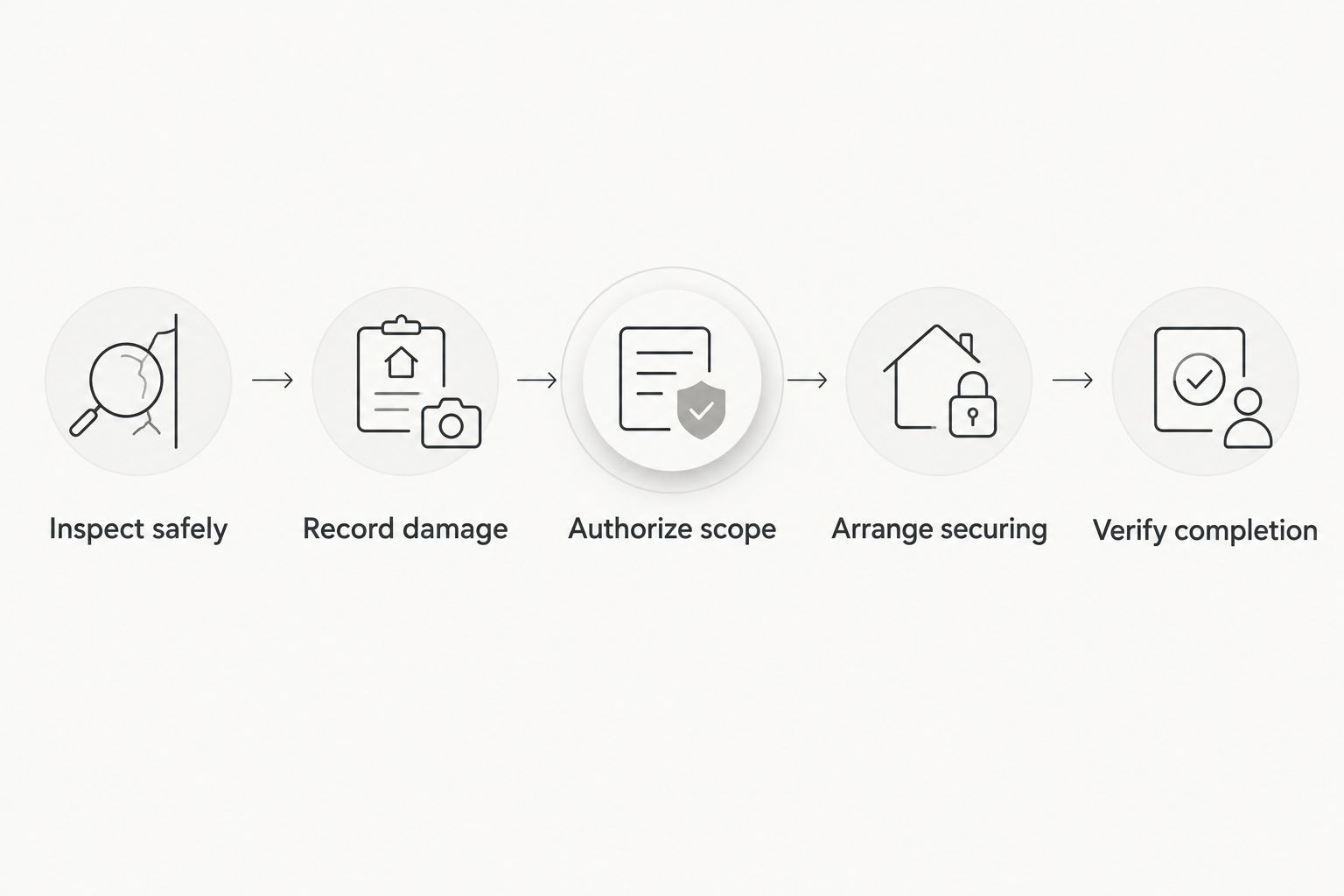
The handoff follows a clear sequence: Inspect safely, Record damage, Authorize scope, Arrange securing, and Verify completion. A request stays open until the final checkpoint is satisfied.
Protect access information
Share keys, codes, and alarm instructions only with the authorized people who need them. Keep the main damage record readable without exposing credentials to everyone who receives an inspection summary.
Name a site contact who can resolve access problems. If that contact changes, update the contractor directly and record the change; editing an internal note alone does not tell the crew who will meet them.
Completion and follow-up
Verify before closing the request
- Match completion evidence to the opening list. Ask for photographs showing the completed securing work at each agreed location. Confirm that the images identify the same windows and doors recorded during inspection.
- Record exceptions explicitly. Note inaccessible openings, incomplete cleanup, changed conditions, and additional damage. Keep unresolved items open with an assigned owner rather than burying them in a general completion note.
- Confirm access and next actions. Check that authorized access arrangements remain usable and required exits have not been obstructed. Schedule the next inspection and assign permanent repairs separately.
Use 3 completion checkpoints: agreed openings addressed, cleanup scope documented, and unresolved hazards assigned. These checkpoints organize verification; they do not certify structural safety or guarantee that another intrusion cannot occur.
Expected result: The property file shows what was secured, what remains unresolved, and who owns the next action. The board-up request can close without losing the permanent-repair task.
For your 2026 completion record, preserve the original inspection photos alongside the completion photos. Replacing the originals removes the evidence needed to understand what changed.
Request emergency property securing
Bestboardup provides 24/7 emergency board-up, glass cleanup, and property securing across Los Angeles.
Repeat the workflow when conditions change
An update-based workflow serves properties already boarded up. Use it after a new damage report, an alarm-related inspection, a reported intrusion, or an inspection that finds a loose or missing panel.
- Reopen the property record. Add a new dated inspection entry without overwriting the previous completion evidence.
- Compare the same locations. Identify whether the report concerns an existing opening, a changed condition, or a newly exposed area.
- Authorize the changed scope. Do not assume the previous approval covers additional openings or a different type of work.
- Verify the new work. Repeat completion checks and update the next inspection date.
The existing board-up is the baseline, not proof of current security. Preserve the old record so the authorized representative can distinguish a failed or disturbed panel from a problem that was never included in the original scope.
For recurring inspections in 2026, assign responsibility for reviewing updates. A new photograph in a shared folder is not an escalation unless someone receives and acts on it.
Troubleshooting
The contractor cannot enter the property
Confirm who controls the gate, keys, and alarm instructions. Arrange authorized access and ask the contractor to acknowledge the revised plan. Do not ask the crew to bypass locks or enter through damaged openings.
The photographs do not identify the opening
Add a wider location view from a safe position and a clear opening label. Match that label in the inspection record and request. If you cannot safely obtain another photograph, describe the limitation instead of entering.
The damage changes after approval
Document the new condition and contact the approving representative. Request assessment of the changed scope before treating the original job as sufficient. Escalate immediate danger through emergency services.
The job is marked complete but an opening remains exposed
Compare the agreed opening list with the completion evidence. Identify the missing location and keep the securing request open until the contractor and authorized representative resolve it. A general message saying the job is done is not location-specific verification.
Cleanup is complete but another hazard remains
Separate loose-glass cleanup from unstable glazing, damaged frames, or structural concerns. Record the remaining hazard and arrange assessment by the appropriate qualified professional. Do not describe the property as safe solely because debris was removed.
Customize your workflow
Start with a shared checklist if you manage a single property. For multiple properties, use consistent opening labels, approval records, and completion fields so each request follows the same handoff without copying sensitive access information everywhere.
Use the guide to connecting property management software to board-up requests when planning that record structure. Confirm the actual capabilities of your system before depending on notifications or automatic task creation.
Automate reminders, not assumptions. An overdue approval should notify the responsible person; it should not silently authorize extra work. A completion upload should prompt verification, not automatically declare every hazard resolved.
FAQ
What is a vacant property inspection board up workflow?
A vacant property inspection board up workflow connects a safe damage inspection to documented authorization, contractor handoff, temporary securing, and completion verification. Keep permanent repairs and unresolved hazards as separate assigned tasks.
Should I enter a vacant property before requesting board-up?
Do not enter when conditions are unsafe or access is unauthorized. Record what you can observe safely and tell the contractor which areas have not been inspected.
Does full board-up mean covering every window and door?
No. Full board-up should complete the agreed securing scope while preserving required exits and authorized access. Base the scope on documented exposure and a qualified assessment, not vacancy alone.
What should I send with a board-up request?
Send the complete address, labelled damage photographs, authorized contact, scope approval, and access instructions. Flag hazards, restricted areas, and any evidence-preservation requirements.
Can Bestboardup help with a vacant property in Los Angeles?
Bestboardup provides 24/7 emergency window and door board-up, glass cleanup, and property securing for residential and commercial customers across the Los Angeles area. Confirm the property’s specific scope and access arrangements when requesting service.
Can I close the request as soon as boards are installed?
Close the securing request only after checking the agreed opening list against completion evidence and recording unresolved items. Keep permanent repairs and follow-up inspections assigned separately.
What should I do if a boarded opening is damaged again?
Record the changed condition safely and reopen the securing workflow. Obtain approval for the new scope and verify the new work without overwriting the earlier inspection record.
One last thing
Record what you could not inspect. An inaccessible rear window, locked room, or obstructed exit needs an explicit follow-up owner. Otherwise, a completed checklist can hide an unfinished inspection—and the next person will have no reason to check it.
