
Instead of manually coordinating weather alerts, damaged-window reports, and contractor calls, use a storm damage board up response workflow that assigns one decision-maker, records hazards, and requests help before anyone approaches broken glass. Move people to safety first, then arrange temporary securing of damaged windows and doors when conditions permit safe access.
- Bestboardup provides 24/7 emergency window and door board-up, glass cleanup, and property securing across Los Angeles.
- A storm damage board up response workflow starts with occupant safety, not plywood installation.
- Use one incident record for weather alerts, damaged openings, access instructions, and emergency board-up updates.
- Board-up is temporary protection; damaged glass, frames, and water entry still need separate assessment.
Why this matters
A weather alert, a broken window, and an unsafe building require different actions. Treating them as the same event sends people toward damage before anyone has checked the hazards.
Bestboardup is best for Los Angeles homeowners and commercial property contacts who need emergency window and door board-up and glass cleanup. Bestboardup provides these services around the clock; that does not establish an arrival time or make unsafe access acceptable.
Your 2026 storm-response plan needs a clear handoff: the property contact reports conditions, the service provider assesses the securing work, and emergency responders handle immediate threats to life. Keep those responsibilities separate. A board-up request is not an evacuation decision, structural clearance, or authorization to enter a hazardous building.
Before you start
- Prepare access and authority. Identify the person authorized to request work, the property address, a reachable callback contact, and any gate or building-entry restrictions. For rental or commercial premises, identify the owner or manager responsible for approval.
- Prepare the incident record. Keep weather notifications, safely obtained photos, affected-opening descriptions, and contractor communications together. Use the written fields below; they are a record template, not settings in a particular app.
- Resolve the exit-route gotcha. A damaged door can also be a required exit. Tell the provider before work starts; temporary securing must not create a trapped occupant or block required escape routes.
You do not need an automation platform to follow this workflow. A shared document or paper log works, provided the responsible contact can access it during an outage and changes do not disappear into separate conversations.
Alert intake and safety gate
Build the incident record
- Name the incident. Record the property address and the date of the alert or damage report. For a 2026 event, keep the event date separate from the date you last updated the response plan.
- Assign the response owner. Write down one primary coordinator and a backup contact. Route contractor updates through the primary coordinator so different occupants do not issue conflicting instructions.
- Capture the alert source. Record which official weather or local emergency source issued the notice and what it instructs people to do. Check the current notice rather than relying on a forwarded screenshot.
- Record observed conditions. Separate confirmed damage from unverified reports. A weather warning alone does not confirm that a window has failed.
- Apply the safety gate. Stop property inspection when there are downed power lines, suspected structural instability, rising floodwater, or other immediate hazards. Call 911 for an immediate threat to life and follow evacuation instructions.
Use these field names consistently: Property address, Response owner, Alert source, Observed damage, Occupancy, Access restrictions, and Last update. Put unknown information down as unknown rather than asking someone to approach danger to complete the record.
Expected result: You have one incident record, an accountable coordinator, and a clear decision about whether anyone can safely approach the affected area. No one starts boarding windows simply because a notification arrived.
Separate preparedness from damage response
An intact window during a warning is a preparedness issue. A broken window with exposed glass is a damage-response issue. Use the distinction to choose the next action, not to guess how severe the next weather event will be.
| Workflow | Best for | Advantage | Limitation | Next action |
|---|---|---|---|---|
| Pre-storm preparation | Properties with intact openings before conditions become dangerous | Lets you organize contacts, access, and protection needs before damage occurs | Does not establish that board-up is necessary or suitable for every opening | Review alerts and discuss protection needs before unsafe weather arrives |
| Post-damage response | Properties with broken windows or damaged doors | Focuses securing work on confirmed openings and glass hazards | Inspection and work must wait when access is unsafe | Isolate the area, report damage, and request assessment |
Do not turn pre-storm preparation into a rushed installation during active hazardous weather. The safety gate applies to both workflows.
Damage report and board-up request
Document the affected openings
- Keep people away. Prevent occupants, customers, children, and pets from entering the glass-strewn area. Do not reach through a broken opening or pull loose glass from a frame.
- Describe each opening. Record its location, whether it is a window or door, and what you can see from a safe position. Use descriptions such as front ground-floor window or rear entry door rather than an ambiguous message about broken glass.
- Take safe photographs. Capture the opening and surrounding area only when doing so does not require crossing debris or approaching unstable materials. Do not delay urgent safety measures to obtain photographs.
- Report access hazards. Include standing water, loose overhead materials, damaged frames, restricted entrances, and occupied areas. Do not enter a wet area with electrical hazards to improve the report.
- State the immediate objective. Ask for assessment of damaged openings, glass cleanup, and temporary property securing. Identify continuing water entry separately so it is not mistaken for a problem that boards alone will solve.
Avoid guessing dimensions from a photograph or promising that the frame can support a particular attachment. The securing method depends on the actual opening and its condition. Leave technical installation decisions to the person assessing the site.
Expected result: The service provider receives an opening-by-opening damage report with hazards and access limits, rather than a vague request that requires repeated clarification.
Send a usable service request
Send one consolidated message with the address, callback contact, observed damage, occupancy status, and safe access instructions. For example, describe a broken rear door pane and an occupied building without inventing measurements or telling the provider how to fasten the board.
Ask Bestboardup to confirm the request and discuss access conditions for its emergency board-up services. Record the confirmation, the agreed scope, and any arrival information actually provided. Do not substitute a website's around-the-clock service description for a confirmed appointment.
For your 2026 contact sheet, put the authorization contact beside the property contact. A provider needs a clear answer about who can approve the work; an occupant's report does not automatically establish that authority.
Expected result: A named provider has acknowledged the request, the approval contact is reachable, and the property coordinator knows what remains unresolved.
Site handoff and completion record
Prepare the site handoff
- Confirm current conditions. Tell the provider about changes since the original report, including new breakage, worsening water entry, or an evacuation instruction. Earlier access information does not override a newer hazard.
- Arrange safe entry. Explain the usable entrance, gate arrangements, and who will meet the crew if meeting is safe. Do not send access credentials to a broad group message.
- Identify protected routes. Point out occupied rooms, required exits, and areas people must avoid. Make the damaged-door issue explicit before temporary securing begins.
- Confirm the work boundary. Identify the openings included in the request and any glass cleanup needed around them. Ask which conditions require another specialist rather than assuming board-up covers structural damage or permanent repairs.
Expected result: The crew has current information, an authorized contact, and a defined scope without relying on an occupant to enter an unsafe area.
Record completion and remaining risks
- Review the completed scope. Ask which openings were secured and which conditions remain unresolved. Do not describe an entire property as safe based only on a completed window board-up.
- Record the handoff. Keep the service documentation and any safely obtained completion photos with the original damage record. Note access restrictions and instructions provided after the work.
- Assign permanent repairs. Identify the contact responsible for arranging glass, frame, or door repairs and for addressing water damage. Temporary securing is not the endpoint of restoration.
- Set the next check. Decide who will report renewed water entry, loosened material, or additional breakage when conditions allow safe observation. Do not ask occupants to climb, touch boards, or test damaged frames.
Expected result: You know what was secured, what remains open as a task, and who owns the repair handoff. Your 2026 incident record distinguishes completed board-up from completed restoration.
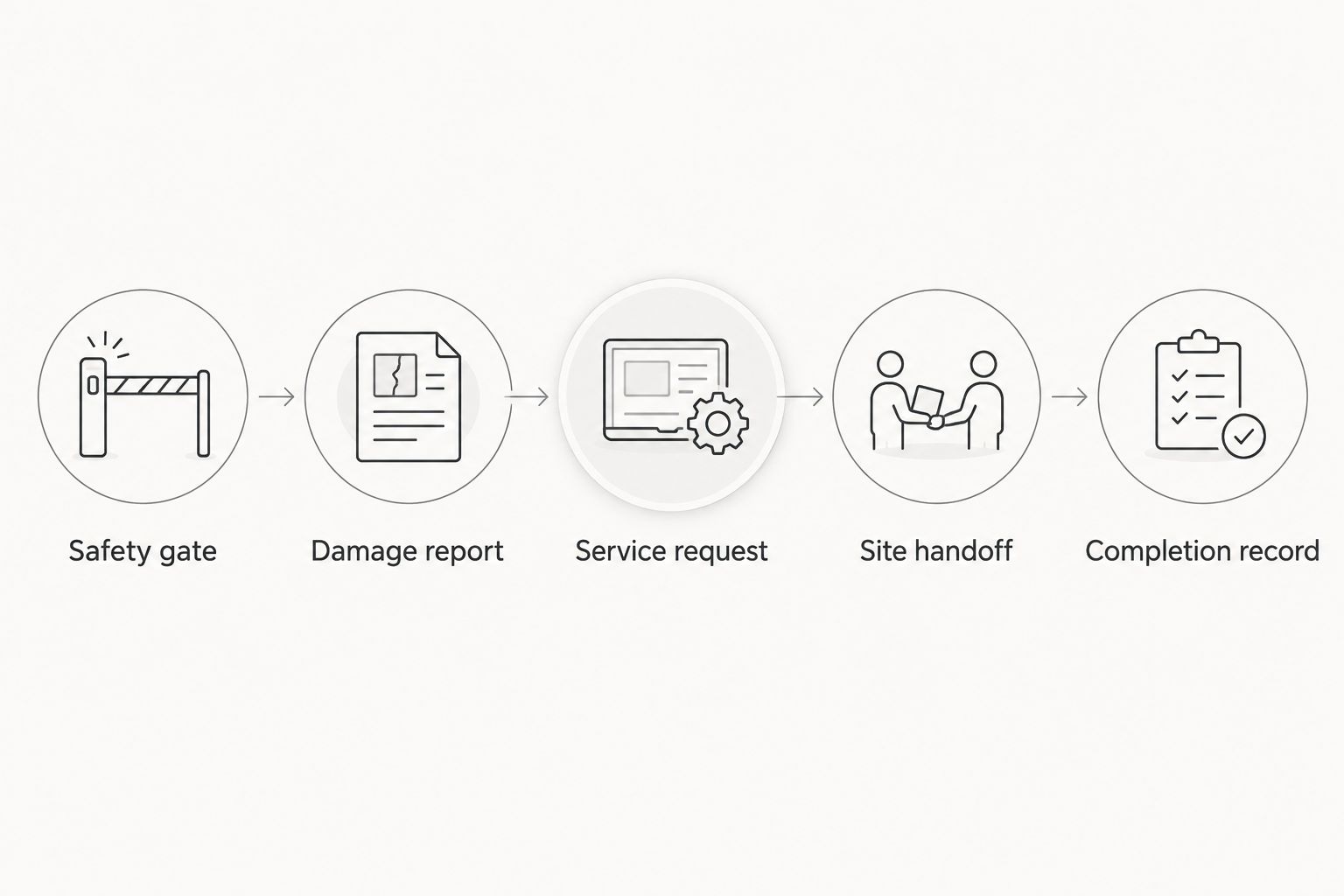
The workflow is a sequence of decisions, not a race to install material. Stop at any stage when conditions become unsafe, and resume only after the relevant safety issue has been addressed.
Repeat the workflow when damage changes
Use the same record when another window breaks or an existing opening worsens. Do not silently replace the original report; add the new observation and its time so the provider can distinguish the first request from a changed scope.
Best for: Properties with damage reported in stages, including buildings where different occupants report different openings. The advantage is a single current record; the limitation is that someone must keep it updated.
- Before dispatch: Send the updated opening list and ask the provider to acknowledge the change.
- While work is underway: Tell the site contact immediately about newly reported hazards. Let the crew assess whether the work boundary needs to change.
- After completion: Treat additional breakage or failed temporary securing as a new assessment request. Keep people clear; do not attempt to tighten or refasten material during hazardous conditions.
For the 2026 repeat-event procedure, retain the original completion entry and add the new incident update beneath it. That keeps previous work from being confused with the latest damage.
Troubleshooting
The provider has not acknowledged the request
Do not assume a sent message means dispatch is underway. Contact the provider again, confirm the address and callback details, and ask for acknowledgment. Continue occupant safety measures while you establish whether the request has been accepted.
Nobody can authorize entry or work
Contact the owner, manager, or other authorized person and record the approval route. Do not invent permission or bypass a locked entrance. If there is an immediate threat to life, call emergency services rather than treating contractor access as the solution.
Water continues entering after board-up
Report the location of the water entry and avoid electrical hazards. Window and door securing does not resolve every roof, drainage, frame, or envelope problem. Arrange assessment of the remaining source instead of assuming more boards will stop it.
The damaged door is also an exit
Stop and identify an alternative safe route with the responsible site contact and provider. Do not approve a closure that traps occupants or blocks required egress. Escalate unresolved life-safety concerns to the appropriate emergency authority.
Different people report conflicting damage
Ask the response owner to consolidate observations by opening and observation time. Keep uncertain details marked as unverified. Send the provider one corrected scope rather than several competing versions.
Customize your workflow
For a home, focus the record on occupant safety, pets, access, and the affected openings. For a commercial property, add the responsible site manager, occupied areas, public access restrictions, and the repair contact. Keep the core safety sequence unchanged.
Use the storm and rain damage board-up guide to extend the planning discussion to weather-related securing needs. Bestboardup's emergency board-up services cover windows and doors; confirm the actual site scope rather than assuming every storm-damage task is included.
Keep the trade-off explicit: temporary securing addresses damaged openings, but it does not replace permanent glass repairs or a separate assessment of structural and water damage. A clear boundary prevents the completion message from closing tasks that still need attention.
Arrange emergency property securing
Discuss damaged windows, doors, glass cleanup, and safe access in the Los Angeles area.
FAQ
What is a storm damage board up response workflow?
A storm damage board up response workflow connects occupant safety, damage reporting, a service request, site access, and a completion record. It assigns a responsible contact and keeps temporary securing separate from permanent repairs.
Should I board my windows as soon as a storm alert arrives?
A storm alert is a reason to review preparedness, not proof that every window needs boarding. Discuss protection needs before conditions become hazardous and follow official safety instructions.
Can I clear broken glass before the board-up crew arrives?
Keep people away from broken glass rather than reaching into damaged frames or handling loose shards. Bestboardup provides glass cleanup alongside emergency window and door board-up across the Los Angeles area.
Does 24/7 board-up service guarantee immediate arrival?
No, 24/7 service does not establish a specific arrival time. Confirm that the provider has accepted the request and record the arrival information actually provided.
Will boarding a broken window stop all stormwater entry?
No, temporary window securing does not resolve every source of water entry. Report continuing leakage and arrange assessment of roof, frame, drainage, or other affected areas as needed.
What information should I give an emergency board-up provider?
Give the property address, callback contact, damaged-opening descriptions, occupancy status, hazards, and safe access instructions. Identify who can authorize the work and explain whether a damaged door is a required exit.
When should I call 911 instead of a board-up company?
Call 911 for an immediate threat to life. Follow emergency instructions for unsafe structures, dangerous electrical conditions, floodwater, or other urgent hazards; a board-up company does not replace emergency responders.
One last thing
Do not close the incident just because the openings are boarded. Close the temporary-securing task, then leave permanent repairs, remaining water entry, and access restrictions visible in the same record. The most useful completion note states what still needs attention.
