
Instead of repeatedly calling your adjuster and board-up contractor, connect the inspection and securing work through one shared job record, a named access contact, and confirmed appointment windows. Request same-day board-up explicitly, but do not leave a damaged opening exposed just to keep an inspection appointment first.
- Insurance adjuster inspection board up scheduling needs separate confirmations for inspection access and emergency securing.
- Bestboardup provides emergency board-up and glass cleanup for Los Angeles residential and commercial properties.
- Document damage safely before covering openings; ask the adjuster what inspection access is needed.
- A same-day request is not a confirmed appointment; obtain the contractor’s acceptance directly.
Why this matters
An adjuster appointment and a board-up appointment serve different purposes. The adjuster assesses the claim; the contractor temporarily secures damaged openings. Neither appointment automatically books the other.
Bestboardup is best for Los Angeles property owners who need emergency window or door board-up and glass cleanup. Its emergency board-up service operates 24/7, but that does not establish a particular arrival time or an insurer’s coverage decision.
Use the board-up services for insurance claims in Los Angeles guide for the claim-related service context. The workflow below connects the people and appointments without assuming a software integration, insurer partnership, or automatic dispatch.
For your 2026 claim file, keep the sequence simple: identify immediate danger, document safely, confirm access, and secure the property. If there is an active threat, suspected structural instability, or an electrical hazard, stay clear and contact the appropriate emergency authority before arranging ordinary access.
Before you start
- Gather the claim and property details. Have the property address, claim number if assigned, adjuster contact, damaged-opening descriptions, and the person authorized to approve work. Keep claim documents restricted to the people who need them.
- Identify the access contact. Choose someone who can lawfully admit the adjuster and contractor, explain site restrictions, and remain reachable. An appointment does not grant permission to enter a tenant’s space or bypass a restricted area.
- Resolve the inspection-access problem early. Ask whether the adjuster needs to view an opening before it is covered. If immediate securing comes first, ask what documentation and later access will support the inspection; do not promise panel removal or leave the building exposed without a plan.
Set up the shared job record
Use a document, email thread, or existing work-order system that the responsible people can access. You do not need a new application. The bold labels below are suggested record fields, not buttons or settings in a particular platform.
- Create Property and claim. Enter the address, unit or suite, claim reference, and the date of loss as reported. Keep the inspection appointment separate from the loss date.
- Add Site condition. Describe each affected window or door, visible glass hazards, and whether the opening is accessible from outside. Report what you can see without entering an unsafe area.
- Add Access contact and Work authorizer. Include the relevant names and contact methods. Identify who can approve the contractor’s scope rather than assuming the adjuster fills that role.
- Create Inspection window and Board-up window. Mark each as requested or confirmed, and record who supplied the confirmation. Include the date and local time zone.
- Add Inspection access needed. Record the adjuster’s instructions about photographs, viewing damaged components, or returning after temporary protection is installed.
Expected result: You have 1 shared job record with distinct appointments and clear ownership. Nobody has to infer whether a requested time is an accepted booking.
For a 2026 scheduling record, write the full appointment date rather than only “today” or “tomorrow.” Forwarded messages and overnight changes make relative dates unreliable.
Keep these decisions separate
Do not combine permission to enter, permission to perform work, and an insurance coverage decision in one approval field. They answer different questions.
A property representative can arrange access without confirming coverage. A contractor can accept a securing job without confirming reimbursement. Ask the insurer about policy obligations and claim documentation, and ask the contractor about the proposed work.
Confirm the inspection and securing sequence
Choose the sequence according to site safety and the adjuster’s access needs—not calendar convenience. These are scheduling options, not competing services.
| Scheduling option | Best for | Advantage | Limitation |
|---|---|---|---|
| Inspection first | A site that can remain safely controlled until the inspection | The adjuster can view openings before temporary covering | Waiting leaves the securing work unfinished; reassess if conditions change |
| Securing first | An exposed opening that needs prompt protection | Temporary protection does not wait for the inspection | The adjuster needs documentation and an agreed plan for later viewing |
- Ask the adjuster what must be inspected before covering. Describe the actual condition instead of asking only whether board-up is permitted.
- Ask the contractor what information is needed to assess the securing job. Send safe photographs and describe access restrictions, damaged frames, and affected doors.
- Request the intended sequence in writing. State whether board-up should follow the inspection or whether emergency securing needs to happen first.
- Obtain 2 appointment confirmations: one from the adjuster and one from the contractor. Include the address, appointment window, access contact, and any dependency on the other visit.
- Assign a person to communicate changes. Do not rely on the adjuster and contractor receiving identical updates unless both are included and acknowledge them.
Expected result: Each party knows whether its visit depends on the other, and the property contact knows what to do if the sequence changes.
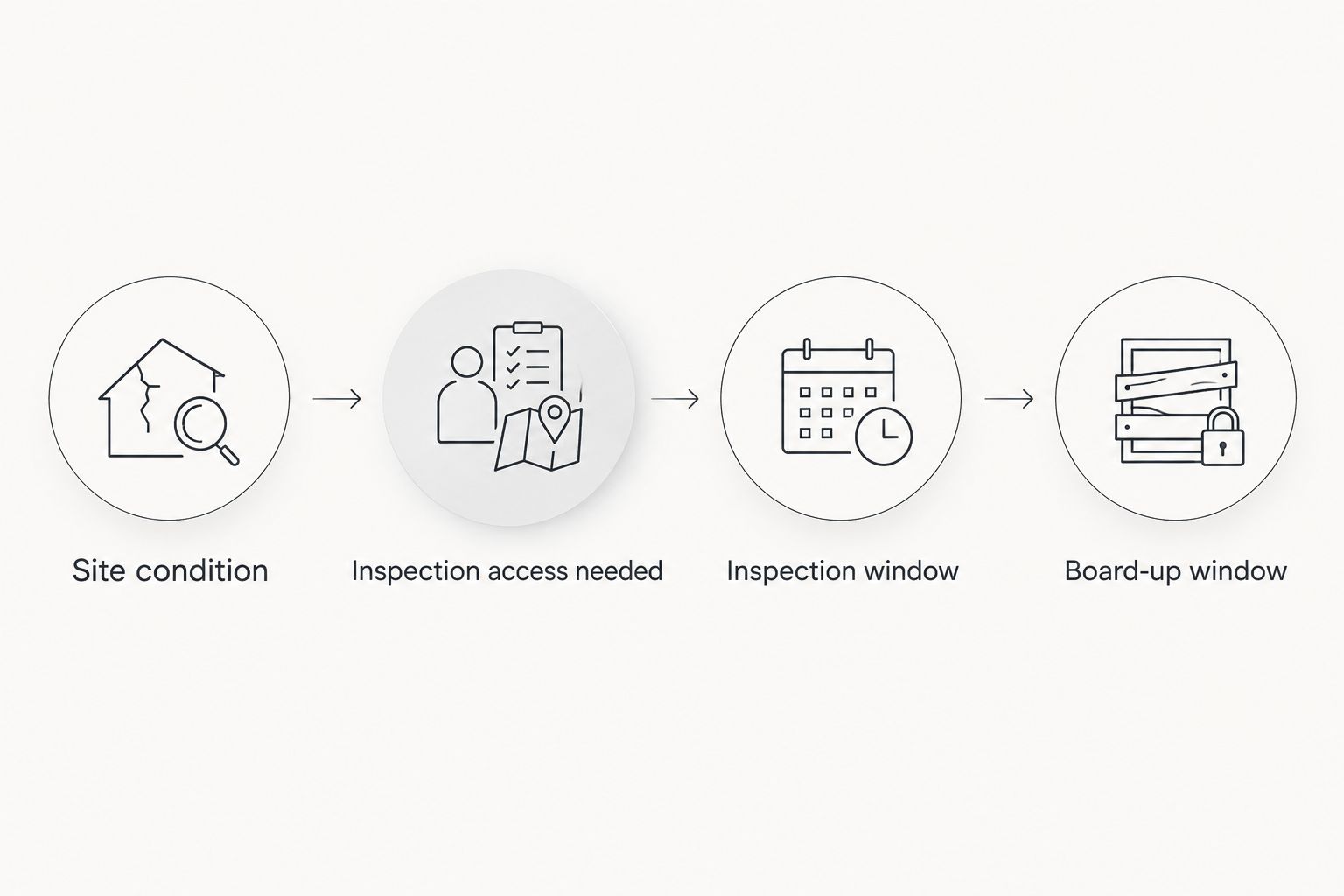
What to send with the scheduling request
Use this message structure: property address; affected openings; immediate hazards; requested inspection window; requested board-up window; access contact; work authorizer; and required inspection access. Attach only relevant records through an appropriate channel.
Ask each recipient to confirm their own appointment and flag conflicts. Silence is not acceptance. Avoid sending entry codes to a broad email list; give access instructions directly to the people authorized to use them.
Prepare the evidence and access handoff
Photographs help preserve the visible condition, but they do not replace an adjuster’s inspection or determine coverage. Take them only from a safe position. Never handle unstable glass just to improve a photograph.
- Capture 3 photo views where safe: the surrounding area, the complete opening, and a closer view of visible damage. These are suggested documentation views, not an insurer’s universal requirement.
- Label each opening consistently. Plain descriptions such as front entrance door or rear bedroom window are more useful than an unlabeled collection of images.
- Record what happened before the contractor arrived. Distinguish existing damage from temporary securing work, and retain the original image files.
- Confirm the access route. Tell both parties about locked gates, occupied units, restricted areas, and any authority-imposed entry restrictions.
- Ask how later inspection access will work. If viewing requires changing temporary protection, arrange that with the contractor and adjuster rather than removing boards yourself.
Expected result: The adjuster receives an understandable record, and the contractor receives access instructions without being asked to make coverage decisions.
Keep original photographs and subsequent work photographs in separate groups in your 2026 claim folder. That distinction makes the sequence easier to explain without implying that a photograph proves the cause of damage.
Close the board-up handoff
The job is not complete merely because someone reports that a crew arrived. Confirm what was secured and what remains unresolved.
- Ask the contractor to identify the openings covered and any glass cleanup performed. Match that description to the shared record.
- Obtain completion photographs where appropriate. Ask for images that show the temporary protection without exposing sensitive access details unnecessarily.
- Record Remaining issues. Include damaged locks, unsafe areas, openings outside the agreed scope, or inspection access still to be arranged. Do not treat temporary board-up as permanent repair.
- Send the adjuster the relevant completion records and ask whether additional inspection access is required. Retain the work authorization and invoice for your claim records.
- Assign responsibility for the next visit. State who will arrange permanent repair and who will coordinate any change to the temporary protection.
Expected result: You have a documented securing handoff, a list of unresolved conditions, and a named owner for the next action.
Bestboardup provides emergency window and door board-up, glass cleanup, and property securing. Treat those services as temporary protection, not confirmation of insurance coverage or permanent restoration. Ask directly about the work needed at your property and the appointment you are requesting.
Arrange emergency property securing
Discuss damaged windows, doors, glass cleanup, and access for your Los Angeles property.
When the adjuster changes the appointment
Best for: an inspection that moves after securing has already been arranged. Update the dependency, not just the calendar entry. The advantage is clear ownership; the limitation is that revised timing still requires direct acceptance from everyone affected.
- Record the revised inspection window and who supplied it. Keep the earlier appointment in the record as superseded rather than deleting the history.
- Check the property’s current condition. Do not automatically postpone necessary protection because the adjuster rescheduled.
- Tell the contractor whether the securing visit should proceed independently. If the work has already been completed, discuss later inspection access instead of creating another board-up request.
- Obtain fresh confirmation from the access contact and any party whose visit changes. Update calendar invitations only after the revised arrangement is accepted.
For 2026 appointment changes, put the revised date in the message subject and body. A clear subject helps prevent someone acting on an older thread.
Expected result: A changed inspection does not silently cancel property protection or create a duplicate dispatch request.
Troubleshooting
The adjuster has not replied
Separate the unresolved inspection question from the immediate site condition. Contact the insurer through its established claim channel, document your attempts, and ask the securing contractor about protecting the exposed opening. Do not enter a dangerous area while waiting for a reply.
The crew arrives before inspection is finished
Have the access contact coordinate with both parties. Identify which openings the adjuster still needs to examine and ask the contractor what work can proceed without interfering. Do not direct either party into an unsafe or restricted area to preserve the schedule.
Temporary protection blocks the required view
Tell the adjuster what is covered and provide the available pre-work photographs. Arrange any necessary change to the protection with the contractor, including how the opening will be secured afterward. Do not remove protection and leave the property unattended.
Nobody on site can authorize the work
Contact the designated work authorizer before asking the contractor to proceed. Update the record with the authorized scope and access instructions. An adjuster appointment is not a substitute for permission from the responsible property representative.
A same-day request was never confirmed
Contact the contractor directly and ask whether the job has been accepted and what appointment window is confirmed. Update the shared record immediately. A submitted form, forwarded email, or calendar invitation alone does not establish a booking.
Customize your workflow
For recurring property incidents, reuse the field structure but create a separate record for each event. Do not copy an old claim number, access code, or approval into a new job without checking it.
Keep your 2026 template focused on exceptions: inspection access, authority restrictions, tenant access, and who can approve changes. More fields do not improve coordination if nobody maintains them. The property management software to board-up requests guide covers the adjacent workflow for organizing requests through property-management systems.
FAQ
How do I handle insurance adjuster inspection board up scheduling?
Keep one shared job record, confirm inspection access requirements, and obtain separate appointment confirmations from the adjuster and board-up contractor. Decide the sequence according to site safety and the inspection needs.
Should I wait for the adjuster before boarding up a broken window?
Do not leave an unsafe opening exposed solely to preserve the inspection sequence. Document the damage safely, contact the insurer about its requirements, and coordinate temporary securing and later inspection access.
Can Bestboardup coordinate directly with my insurance adjuster?
Confirm any direct coordination arrangement with Bestboardup before relying on it. Assign a property contact to manage the shared record unless the parties explicitly agree to another arrangement.
Does requesting same-day board-up confirm an appointment?
No. Obtain the contractor’s acceptance and appointment window directly; a submitted request or calendar invitation is not a confirmed booking.
What photographs should I take before board-up?
From a safe position, photograph the surrounding area, complete opening, and visible damage. Keep original files and ask the adjuster whether additional documentation is required.
Will insurance cover emergency board-up work?
Coverage depends on your policy and the insurer’s claim decision. Ask the insurer about requirements and retain the work authorization, photographs, and invoice without treating them as a coverage guarantee.
What should I do if the adjuster reschedules after board-up?
Keep necessary temporary protection in place and coordinate any required inspection access. Update the shared record and obtain fresh confirmations from anyone whose appointment changes.
One last thing
A completed board-up and a completed inspection are separate milestones. Close each separately in your job record, and leave any unresolved access or repair task assigned to a named person. That prevents a secured opening from disappearing from the repair schedule.
