
Board up windows as soon as police permit work at the scene and the opening can be approached safely. Request emergency help immediately; do not wait overnight for permanent glass replacement when a broken window leaves your property accessible, and do not disturb evidence or enter an unsafe building to cover it.
- How soon after a break in should windows be boarded up? As soon as police permit safe work.
- Bestboardup provides 24/7 emergency window board-up and glass cleanup across the Los Angeles area.
- Arrange emergency property securing while officers finish their work; confirm when cleanup and installation can begin.
- Board-up is temporary protection, not a replacement for glass, damaged frames, or working locks.
Why this matters
A broken window leaves a physical opening. An alarm, a police report, and an insurance claim do not close it. Your immediate job is to keep people away from the damage and arrange safe, authorized protection.
For a break-in in 2026, separate the emergency response from the repair project: secure the opening first, then coordinate permanent repairs. Follow the break-in, police report, and board-up workflow if you need to organize those handoffs without disturbing the scene.
How soon after a break-in should windows be boarded up?
Start arranging board-up immediately; installation starts when police release the affected area and safe access is available. There is no single elapsed time that makes every damaged property safe to work on. An active crime scene, unstable glass, or a damaged frame changes what must happen first.
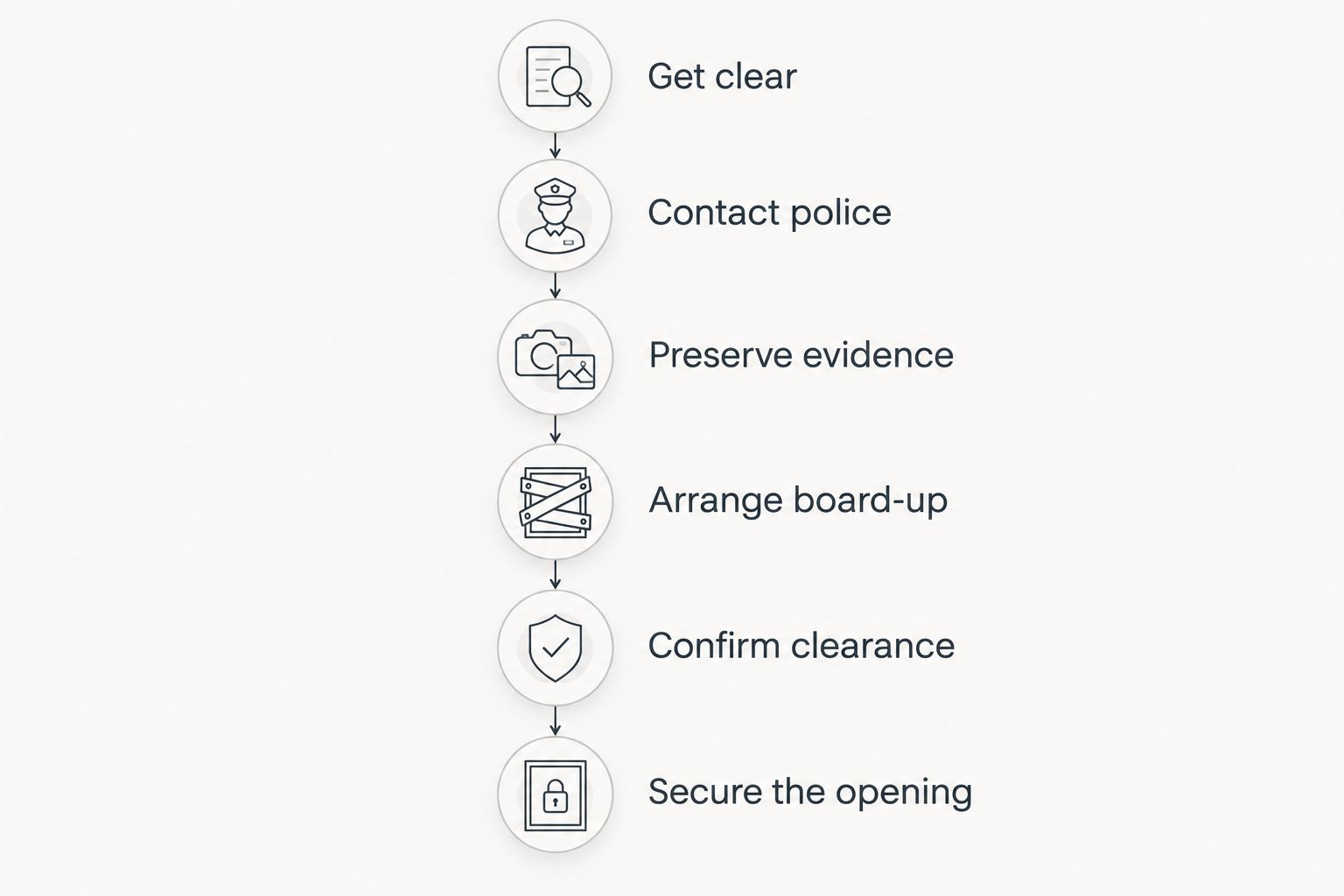
Use this sequence rather than waiting for an arbitrary deadline:
- Get clear. Move people and pets away from broken glass. If the intruder might still be present, stay outside and do not investigate.
- Contact police. Call 911 if there is an immediate threat, an injury requiring emergency assistance, or a crime in progress. Otherwise, use the appropriate police reporting channel.
- Preserve evidence. Avoid touching the window, moving objects, or sweeping the entry point until officers give permission.
- Arrange board-up. Tell the provider that the damage followed a break-in and whether police are still working at the property.
- Confirm clearance. Ask the responding officer when the affected opening can be photographed, cleaned, and secured.
- Secure the opening. Have the damaged window assessed and covered without obstructing a required exit.
You can make arrangements from a safe location before officers finish. Booking help and physically altering the scene are different actions; make that distinction clear to everyone involved.
An accessible opening: arrange emergency protection now
If someone can reach through or enter the damaged window, treat securing it as an immediate task after police clearance. Do not assume a closed curtain, taped glass, or a person watching the property replaces a physical barrier.
Describe the actual condition when requesting help. Say whether glass is missing, the sash is damaged, the window will not close, or the surrounding frame has been forced apart. A description of the opening is more useful than simply reporting a broken pane.
Keep the area out of use while you wait. In a home, redirect children and pets; in a business, keep customers and staff away from the affected frontage. Do not place yourself beside unstable glass to guard the opening.
Cracked glass without an open gap: get the condition assessed
A window that remains in its frame needs a different assessment from an empty opening. Do not press on cracked glass, test it by opening the window, or assume it remains secure because it has not fallen out. Keep people away and describe the damage to the professional handling the repair or temporary protection.
Board-up is not automatically necessary for every mark or crack. The decision depends on whether the glass is stable, the window still closes and locks, and the surrounding structure can support a secure installation.
If you cannot establish those conditions safely, do not make a hands-on inspection yourself. Request an assessment and explain that the damage followed forced entry, including any damage to nearby locks or doors.
Board-up or permanent repair: which should happen first?
Choose the action that safely closes the opening without leaving the property exposed while another job is arranged. Permanent repair addresses the damaged window; board-up provides temporary protection when that repair cannot proceed immediately.
These are response options, not equivalent security measures:
| Response | Best for | Main benefit | Limitation |
|---|---|---|---|
| Emergency board-up | An opening that needs temporary physical protection | Covers the damaged opening while repairs are arranged | Does not restore the window, frame, or locks |
| Permanent window repair | A site where the required repair can proceed safely | Restores the damaged assembly as the repair scope requires | Requires confirmation of the glass, frame, and installation needs |
| Keeping people away | Immediate injury prevention while help is arranged | Reduces contact with the damaged area | Does not close or secure the opening |
Ask what the proposed work includes. Covering the window does not establish that every damaged lock, door, or neighboring pane has been addressed. Likewise, replacing glass alone does not resolve a frame that no longer closes properly.
Do not remove temporary protection just because a repair appointment has been booked. Coordinate removal with the person carrying out the permanent work so the opening is not left exposed between visits.
Why the timing of board-up varies
The right start time depends on access and safety, not just the time of the break-in. Explain these conditions when arranging service:
- Police activity: Officers must tell you when work can begin around potential evidence. Confirm whether that permission includes glass cleanup as well as covering the opening.
- Remaining glass: Hanging or unstable pieces create a hazard for occupants and anyone approaching the window.
- Frame damage: A forced or broken frame changes how the opening can be secured. Do not describe the job as glass damage only if the surrounding assembly has moved.
- Access conditions: Upper-level windows, blocked approaches, and damage near entrances affect how workers reach the opening safely.
- Weather exposure: Rain or wind entering through the opening adds another reason to arrange protection promptly. Tell the provider what is entering the building.
- Exit requirements: A temporary barrier must not trap occupants or obstruct a required escape route. Explain whether anyone will remain inside.
These conditions justify communicating early, not attempting unsafe work to save time. If the property cannot be occupied safely, stay elsewhere until the relevant hazards have been assessed.
What should you tell the board-up provider?
Give a short, factual description that helps the provider understand the job before arrival. Do not estimate dimensions by climbing over debris or reaching through the damaged opening.
Have these details ready:
- The property address and a safe way to reach the affected area.
- Whether the property is a home, apartment building, storefront, or another commercial space.
- Which windows and doors are damaged, including any opening away from the obvious entry point.
- Whether police have released the affected area for cleanup and securing.
- Whether glass remains overhead, in the frame, or across an access route.
- Who can authorize the work and meet the provider safely.
- Whether occupants need access to a nearby entrance or exit.
Bestboardup is suited to Los Angeles residential and commercial customers needing 24/7 emergency window board-up and glass cleanup. Its board-up work provides temporary property securing; it does not replace the need to arrange permanent window repairs.
You can request help through Bestboardup. Confirm the current arrival estimate, the proposed scope, and any access restrictions directly rather than assuming round-the-clock service means an immediate arrival.
Arrange emergency property securing
Request window or door board-up and glass cleanup for a Los Angeles residential or commercial property.
Should you wait for the insurance adjuster before boarding up?
Contact your insurer promptly, but do not treat an adjuster appointment as permission to leave an accessible opening unsecured. Ask what documentation the insurer needs before temporary protection begins, and follow police instructions about preserving the scene.
Coverage and claim requirements depend on your policy. Do not assume that board-up is covered, that every charge will be reimbursed, or that an insurer requires you to wait for an inspection. Get those answers from the insurer handling your claim.
For your 2026 incident record, keep the police report reference, safe-to-take damage photos, correspondence, work authorization, and itemized invoices together. Record when you discovered the damage and when temporary protection was completed, using the actual times rather than reconstructing them from memory later.
Photograph the opening only from a safe position and only when permitted. Documentation does not justify touching evidence, standing beneath loose glass, or entering a building that has not been cleared for access.
Can you leave a broken window until morning?
Do not leave an accessible opening until morning simply because permanent glass work must wait. Arrange temporary securing after police clearance and keep people away from the damage in the meantime.
Nighttime does not remove the underlying problems: an opening remains an opening, and loose glass remains a hazard. Tell the provider whether the building is occupied and whether the damaged area affects a route people must use.
If police have not released the scene, follow their directions instead of starting work. Explain the delay to the provider so arrangements reflect the actual access conditions.
Can you board up the window yourself after a break-in?
Do not start a DIY board-up while police are preserving evidence or while glass, access, or the surrounding frame is unsafe. Working around broken glazing can expose you to sharp edges and falling pieces, and an improvised covering does not establish that the opening is secure.
A DIY decision also needs to account for safe fixing points and required exits. If you cannot assess those without disturbing the damage, stop and arrange professional help rather than experimenting with the opening.
Keep people away while you wait. That is useful immediate action and does not require you to handle the broken window.
What should happen before you leave the property?
Check the completed work with the provider from a safe position. Ask which openings were secured, which damaged areas remain unresolved, and whether any part of the property must stay out of use.
Before leaving, confirm:
- The covered opening does not have an obvious remaining access gap.
- Glass hazards within the agreed cleanup area have been addressed.
- Required entrances and escape routes remain usable.
- Other doors and windows affected by the break-in have been assessed.
- The person responsible for permanent repairs understands the remaining damage.
- You have photographs and a written record of the completed temporary work.
For a 2026 repair handoff, distinguish completed board-up from outstanding glass, frame, and lock work. A single note saying the property is fixed obscures what still needs attention.
FAQ
How soon after a break-in should I board up my windows?
Board up damaged windows as soon as police permit work and the opening can be approached safely. Arrange help immediately, but do not disturb evidence or enter an unsafe area to begin installation.
Can I call a board-up company while police are still there?
Yes, you can arrange board-up while police are still working at the property. Tell the provider that installation and cleanup must wait until officers release the affected area.
Does 24/7 board-up mean a crew will arrive immediately?
No, 24/7 service does not establish a specific arrival time. Bestboardup provides 24/7 emergency board-up across the Los Angeles area; confirm the current arrival estimate directly.
Should I clean up broken glass before police arrive?
Do not clean the affected entry point before police give permission. Keep people and pets away, and tell officers about glass hazards without touching the damage.
Do I need to wait for my insurer before securing a broken window?
Contact your insurer promptly for documentation instructions rather than assuming you must wait for an adjuster. Follow police clearance requirements and confirm coverage directly with your insurer.
Does boarding up a window finish the repair?
No, board-up is temporary protection, not a completed window repair. Arrange the necessary glass, frame, and lock work separately and coordinate removal of the temporary covering.
What should I save for a break-in claim in 2026?
For a break-in claim in 2026, save your police report reference, permitted damage photos, correspondence, work authorization, and itemized invoices. Ask your insurer what additional records your specific claim requires.
One last thing
The point of forced entry is not the only opening to check. Once police permit access, have other affected windows and doors assessed instead of assuming the most visible broken pane is the entire job.
Close your 2026 incident record only after temporary securing and permanent repairs are clearly distinguished. A covered window means the opening has temporary protection; it does not mean the damaged property has been fully repaired.
