
The cost to board up a school or municipal building depends on the damaged openings and the work needed to secure them; get an itemized site-specific quote before authorizing work. Separate temporary boarding from glass cleanup, door securing, and permanent repairs so you know exactly what the authorization covers. Keep students, staff, and visitors away from the damaged area while you arrange service.
- How much does it cost to board up a school or municipal building? Get an opening-by-opening quote, not an unsupported average.
- Separate emergency board-up, glass cleanup, door securing, and permanent repairs in the written scope.
- Keep required exits usable; boarding an opening does not establish that a building is safe to occupy.
- Bestboardup provides 24/7 emergency board-up and glass cleanup across the Los Angeles area.
How much does it cost to board up a school or municipal building?
Get a quote tied to identified openings, not just the building's name or square footage. A damaged classroom window and a damaged public entrance require different descriptions of work. Your request should identify what is broken, where it is, and what must remain accessible.
For a 2026 work order, use the same scope when requesting or reviewing estimates. The board-up services for schools and municipal buildings guide addresses this property category; the immediate task is to document your building's actual damage.
Ask the contractor to separate these components rather than combine everything under an unexplained emergency-service total:
| Quote component | What the written scope should identify | What you need to confirm |
|---|---|---|
| Window boarding | Each affected opening and proposed temporary closure | Which windows are included |
| Door securing | Damaged door, frame, and temporary access arrangement | Whether authorized entry remains possible |
| Glass cleanup | Areas containing broken glass and debris | Whether interior and exterior cleanup are included |
| Site access | Work locations, access restrictions, and contact person | What the crew needs before starting |
| Follow-up work | Removal, inspection, or additional securing if requested | Whether later visits require separate authorization |
| Permanent repairs | Glass, door, or frame replacement if separately proposed | What remains outside temporary securing |
A useful quote lets you match every charge to a location or task. An estimate that says only “secure building” leaves too much room for disagreement about what the crew will complete.
Why this matters: secure the hazard without creating another
A boarded window does not resolve every problem at a damaged school or public building. Broken glass, an unsecured entrance, and an obstructed exit are separate concerns. Assign someone to coordinate the response rather than leave staff to make conflicting requests.
Start with access control. Move people away from loose glass, keep visitors out of the work area, and contact emergency services if there is an active threat, fire, or immediate danger. Do not enter an area that authorities have restricted.
If the damage affects an exit, read about whether commercial window boarding violates fire exit codes before treating the opening as an ordinary boarding task. Required exits must remain usable; temporary security is not permission to block escape routes.
Define the scope before approving the work
For your 2026 authorization, describe the immediate outcome you need: contain the damaged area, secure the affected openings, and preserve necessary access. Avoid instructions that imply the contractor should make unrelated repairs without approval.
Identify each opening
Give each damaged window or door a location that another person can find. Use room names, building identifiers, or entrance descriptions already used on site. Photographs taken from a safe location help connect the written request to the damage.
Include nearby damage in the description without diagnosing it yourself. If a frame looks distorted or the surrounding wall is damaged, flag it for assessment. Do not assume that covering the opening resolves the condition supporting it.
Identify cleanup boundaries
Specify where you have seen broken glass: inside the room, along an exterior walkway, or around an entrance. Keep those areas restricted until the hazard has been addressed. Do not direct untrained staff to pick through debris to improve the photographs.
Ask what cleanup the proposed work includes and how completion will be recorded. Clearing an entrance is a different scope from addressing glass spread through adjacent rooms.
Identify access requirements
Tell the contractor which entrances staff must use and which spaces remain occupied. Name the person authorized to approve changes. If access arrangements change during the work, update the site contact before the crew leaves.
Do not let a temporary closure become an undocumented operating arrangement. Record how authorized staff will enter and who will control the secured area afterward.
Why school and municipal board-up quotes vary
These are scope questions to resolve with the contractor, not reasons to accept an unexplained total. Your 2026 estimate should show how the proposed work addresses the actual condition of the building.
- Affected openings: Identify every window and door included. A request for one damaged room should not silently become an authorization for unrelated areas.
- Opening condition: Distinguish broken glazing from a damaged door, frame, or surrounding surface. Ask what the temporary closure will attach to and what needs further assessment.
- Glass cleanup: Define the cleanup area separately from the boarding work. Confirm whether the proposal addresses both sides of the damaged opening.
- Building access: Explain where crews can enter, where people remain present, and which routes must stay clear. Flag access restrictions before work begins.
- Timing: State when you need the property secured and ask the provider to identify any timing-related terms in writing. Do not interpret service hours as a promised arrival time.
- Duration and handoff: Explain whether the closure bridges an immediate repair or remains while repair decisions are pending. Ask who handles follow-up inspection, removal, and repair coordination.
If competing estimates describe different work, request a revised scope before comparing totals. The lowest total does not answer your question if it excludes cleanup or leaves a damaged entrance unsecured.
Choose the scope that matches the damage
Authorize the smallest complete scope that addresses the immediate hazard—not the smallest description of work. You need a clear boundary around what gets secured now and what still needs attention afterward.
| Scope option | Best for | Main benefit | Limitation |
|---|---|---|---|
| Damaged-opening board-up | An identified broken window or door | Focuses the work on the affected opening | Does not address other unsecured areas unless included |
| Board-up with glass cleanup | An opening with surrounding glass debris | Addresses closure and the specified cleanup area | Cleanup boundaries still need to be defined |
| Broader property securing | Damage involving several access points | Coordinates the identified openings under one scope | Requires a fuller site review and authorization |
These are scope choices, not named service packages. Ask the contractor to describe the work rather than choose a label and assume everything is included.
For Los Angeles property contacts needing emergency board-up and glass cleanup, Bestboardup is a relevant service option. Bestboardup provides those services 24/7, but temporary securing does not replace permanent repairs or an occupancy decision.
What should you send before a crew arrives?
Send information that helps the contractor locate the hazard and confirm the requested work. Keep the message short enough for the site contact to use during an emergency.
- Locate the damage. Provide the property address, building identifier, and affected room or entrance.
- Restrict access. Describe the area being kept clear and identify any occupied adjoining spaces.
- Document safely. Share photographs taken without approaching loose glass or entering a restricted area.
- Confirm authority. Name the person who can approve the scope and any necessary changes.
- Plan the handoff. Explain who receives completion records and who controls access afterward.
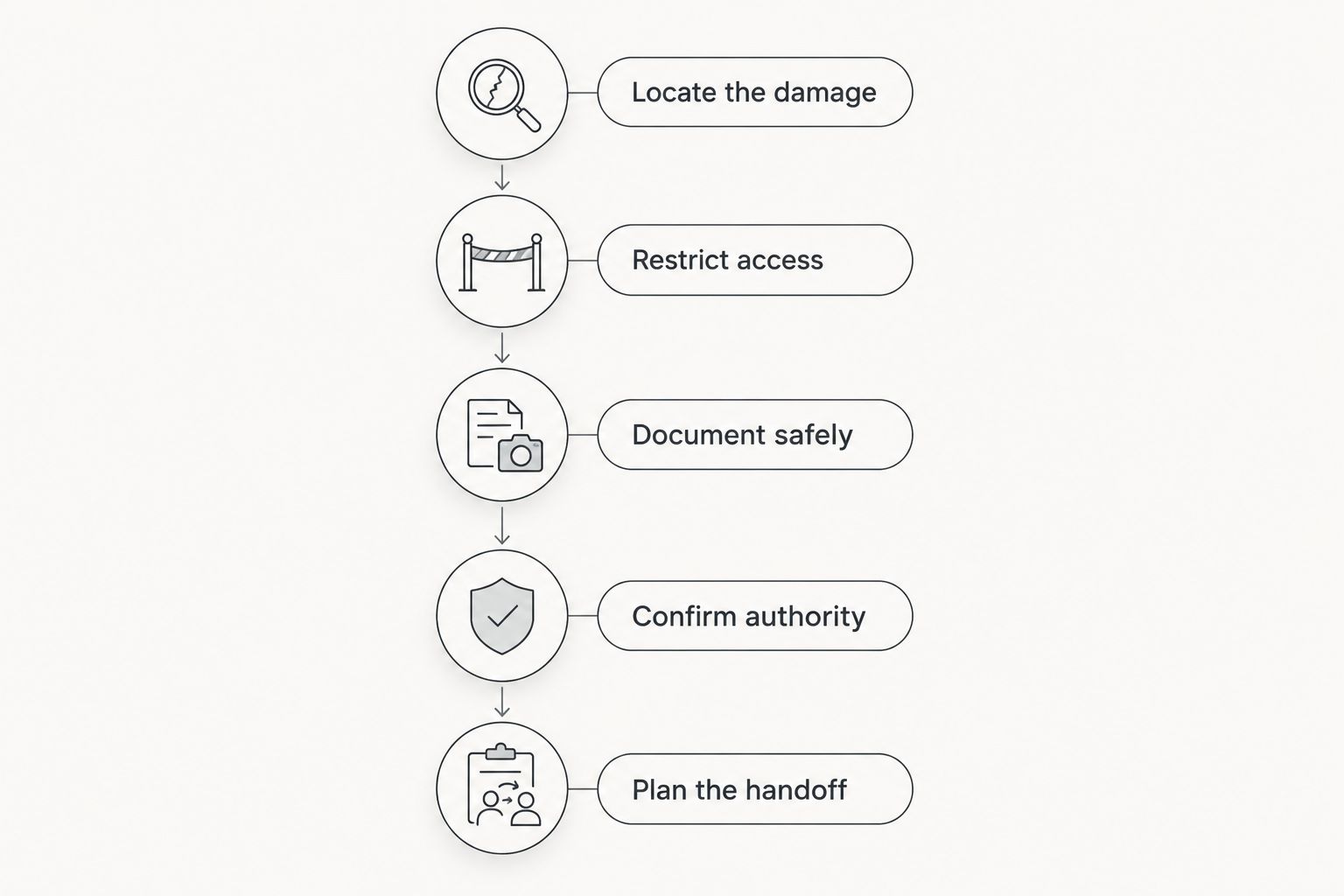
Do not delay emergency help to assemble a perfect file. Send the essential location and hazard information first, then provide additional documentation from a safe place.
How should you handle fire-damaged openings?
After a fire, obtain direction from the responding authorities before allowing access or authorizing work in a restricted area. A visible opening is not proof that the surrounding structure is safe to approach. Keep the board-up request separate from decisions about structural repairs, smoke damage, or reoccupation.
For a 2026 fire-loss work order, identify what temporary securing covers and where the restoration handoff begins. Boarding an opening and restoring the building are different assignments; work proposed by fire damage restoration companies should be reviewed separately from the immediate closure scope. The distinction keeps approval for temporary protection from being mistaken for approval of a broader restoration project.
Record any access restrictions passed on by authorities. Give the same restrictions to the board-up contact and the person coordinating repairs, rather than assume that information will transfer automatically.
Compare estimates without losing the emergency scope
Put the written scopes side by side before reviewing totals. Match each damaged opening, cleanup area, access arrangement, and follow-up responsibility. Ask for clarification wherever one estimate includes work that another does not mention.
A comparable estimate describes the same result. Different wording is acceptable; different boundaries of work need an explanation before approval.
Use these questions when reviewing a proposal:
- Does the scope identify every opening you asked to secure?
- Does it distinguish boarding from glass cleanup?
- Does it explain how required access will be preserved?
- Does it identify exclusions and separately authorized work?
- Does it explain how additional damage discovered on site will be handled?
- Does it identify the completion records you will receive?
Do not assume an insurer will reimburse the work or that a public agency's emergency purchasing rules are identical to routine purchasing. Follow your organization's approval process and ask the insurer or authorized claims contact about documentation. Keep the contractor's scope, authorization, photographs, and invoice together.
Close the work order with a repair handoff
Before accepting completion, have the authorized site contact review the agreed scope from a safe position. Confirm which openings were secured, which cleanup areas were addressed, and what remains restricted. Record unfinished or newly identified work without treating it as automatically authorized.
For your 2026 maintenance record, distinguish “temporarily secured” from “repaired.” That wording matters when another employee, department, or contractor takes responsibility for the building.
Assign the next action to a named contact. Someone should own repair scheduling, access coordination, and decisions about the temporary closure. Without that assignment, an emergency measure can remain in place simply because nobody has responsibility for removing it.
FAQ
Can I get a school board-up quote without a site visit?
Ask whether the contractor can prepare an initial estimate from photographs and an opening list. Confirm what requires on-site verification before the scope becomes final.
Does a board-up quote include broken-glass cleanup?
Glass cleanup is included only when the written scope says so. Identify the affected interior and exterior areas and ask the contractor to confirm the cleanup boundaries.
Can a school stay open while a damaged window is boarded?
Boarding a window does not establish that a school is safe to occupy. Follow the responsible authorities’ direction and keep damaged areas, work zones, and required exit routes appropriately controlled.
Does Bestboardup provide emergency service in Los Angeles?
Bestboardup provides 24/7 emergency window and door board-up, glass cleanup, and property securing across the Los Angeles area. Confirm the requested scope and arrival arrangements directly when requesting service.
Will insurance pay for a municipal building board-up?
Ask the insurer or authorized claims contact whether the specific loss and work are covered. Keep the damage photographs, written scope, approval, and invoice; do not treat a contractor’s estimate as a coverage decision.
Does temporary board-up include permanent window replacement?
Temporary board-up and permanent window replacement are separate scopes unless the agreement explicitly includes both. Identify who will arrange repairs and who will remove the temporary closure.
One last thing
Put the removal responsibility in writing before closing the emergency work order. A secure opening is the immediate objective; a documented path back to normal access is the next one. Name the person who owns that handoff.
