
Dealership board-up after a break-in requires a scope-based quote: identify every damaged opening, the work needed to secure it, and the glass cleanup required before approving the job. Keep permanent glass, door, and frame repairs separate from temporary protection. Secure the exposed property first, but get the included work and exclusions in writing.
- How much does it cost to board up a dealership after a break in? Request an opening-by-opening quote.
- Bestboardup provides emergency board-up and glass cleanup across the Los Angeles area, available 24/7.
- Separate temporary board-up, glass cleanup, and permanent repairs when reviewing the proposed work.
- Keep required exits usable and document damage from a safe location before cleanup begins.
How much does it cost to board up a dealership after a break-in?
The useful figure is the quote for your damaged openings—not an unexplained total for the entire dealership. Ask the contractor to identify each window, entrance, or other opening included in the work. A proposal that only says board-up leaves you guessing about cleanup, damaged frames, and the condition in which the crew will leave the property.
For your 2026 quote, request 3 separate line items: temporary board-up, glass cleanup, and any permanent repair work being proposed. If a contractor does not perform permanent repairs, the quote should say so rather than leave that responsibility unclear.
Use the board-up services for auto dealerships guide to plan around the building's different openings. A showroom window and a damaged entrance need separate descriptions, even when both were damaged in the same incident.
| Work category | What the quote should describe | Best for | Benefit | Limitation |
|---|---|---|---|---|
| Temporary window board-up | Each opening, attachment location, and surrounding damage | Exposed showroom or office windows | Closes the damaged opening temporarily | Does not replace glazing or repair the frame |
| Temporary door securing | Door condition, frame condition, and required access | Damaged pedestrian entrances | Addresses an exposed entry point | Must account for exit requirements and later repairs |
| Glass cleanup | Areas included, remaining glass hazards, and debris handling | Broken glass in affected work areas | Addresses debris within the agreed scope | Does not establish that damaged glazing is stable |
| Permanent repairs | Replacement glazing, door work, frame work, and responsibility | Restoring the building after temporary securing | Addresses the damaged building components | Is a different scope from emergency board-up |
Do not compare those categories as interchangeable purchases. They solve different problems. Compare quotes only after confirming that each proposal covers the same openings and tasks.
Why this matters
A dealership break-in leaves more than a broken pane to address. You need to control access to the damaged area, protect people from glass, preserve evidence, and establish who can authorize emergency work.
For a 2026 incident response, keep the immediate objective narrow: make the affected area safe to approach and arrange temporary securing once authorities permit it. Do not let a discussion about eventual replacement glass delay the emergency work you have already authorized.
Temporary protection also has limits. A boarded opening is not proof that the alarm, locks, adjacent glazing, or building structure are sound. Treat those as separate checks rather than assuming one contractor's visit resolves every consequence of the break-in.
What should you do before approving the board-up quote?
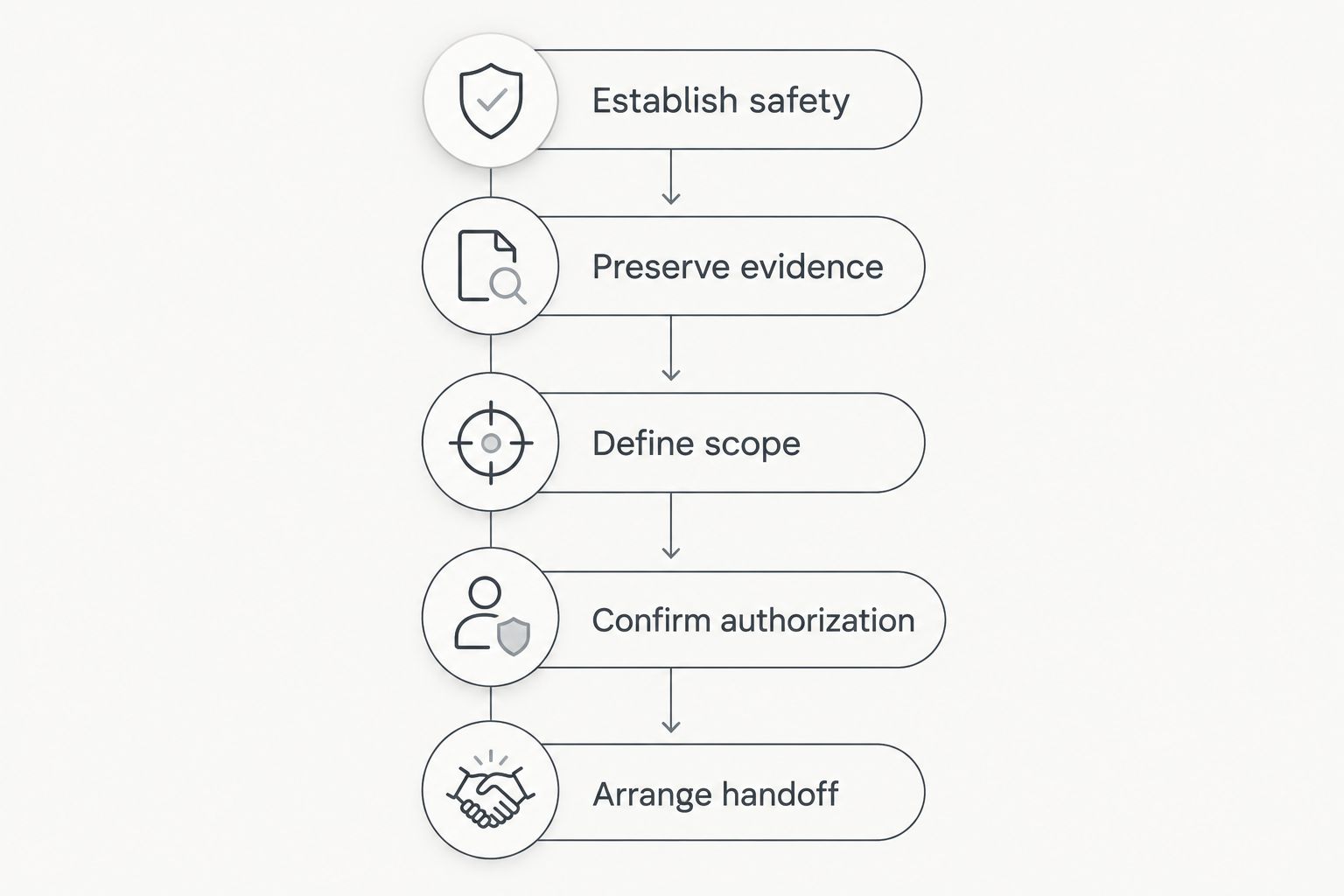
Follow this order without entering an unsafe area. If a crime is in progress or someone is in immediate danger, call 911 and follow emergency responders' instructions.
1. Establish safety
Keep employees, customers, and delivery personnel away from the damaged frontage. Do not stand beneath loose glass, reach through a broken opening, or enter to retrieve keys or paperwork while a threat remains unresolved.
Identify an authorized manager who can speak for the dealership. Give contractors that person's contact details so access decisions and work authorization do not depend on conflicting instructions from different employees.
2. Preserve evidence
Follow police instructions about access and evidence before moving debris. From a safe position, photograph the overall damage and each affected opening without touching loose glazing or entering a restricted area.
Keep the incident reference, available photographs, and contractor correspondence together. Documentation should record what happened and what work was authorized; it should not require anyone to take a safety risk.
3. Define scope
Describe the damaged areas individually: showroom glazing, office window, pedestrian entrance, or another exposed opening. Tell the contractor whether an opening is beside a customer route, employee entrance, or service area.
State what you need secured now and what must remain accessible. Do not assume that a request to board up the front automatically includes a side door or a separate damaged office window.
4. Confirm authorization
Ask for the proposed work, exclusions, and approval process in writing. Establish who must approve additional work if the crew finds damage that was not visible in the photographs.
If an initial description was based only on images, ask what still needs inspection. That gives you a clear boundary between the work already authorized and a change that requires another decision.
5. Arrange handoff
Before the crew leaves, ask which openings were secured and which problems remain. Identify any restricted areas, unresolved glazing hazards, and next steps for permanent repairs.
Check the completed work from a safe position with the responsible manager. Keep the work record with the incident documents so the next contractor does not have to reconstruct the emergency scope from memory.
Why dealership board-up quotes vary
The scope changes when the physical damage and the required outcome change. Use these factors to question a proposal—not as a substitute for an inspection.
- Damaged openings: Identify every exposed window and door. Ask the contractor to distinguish separate openings rather than describe the entire frontage as one undefined task.
- Opening dimensions: Provide measurements only when you can obtain them safely. Otherwise, send photographs and ask the contractor to confirm dimensions on site.
- Frame condition: Show damage around the glass, not just the missing pane. Ask how the proposed temporary closure addresses the condition of its attachment points.
- Glass cleanup: Specify the affected interior and exterior areas. Ask whether debris handling is included and what glass hazards will remain outside that scope.
- Access requirements: Explain which entrances and work areas people still need to use. Temporary securing must not turn a required exit into a blocked route.
- Work boundaries: Distinguish immediate securing from replacement glazing, door repair, board removal, and later visits. Ask which tasks are included rather than assuming they are bundled together.
For a 2026 comparison, send the same photographs and written scope to each contractor you contact. Different descriptions produce proposals that are difficult to compare, even when they concern the same building.
Showroom window damage: define the full opening
Best for exposed showroom glazing: request a window-specific temporary securing plan. Describe the opening, adjacent visible damage, and where broken glass has landed. Keep staff away from the affected frontage until the hazards have been assessed.
The benefit of a window-specific scope is clarity: you can identify exactly which part of the showroom will be closed off. The limitation is equally important—covering the opening does not repair adjacent glazing, restore visibility, or establish that the surrounding frame is undamaged.
Ask the contractor to explain what will remain inaccessible after installation. If the damaged area faces a customer entrance or vehicle display, tell the contractor before work begins rather than discovering an access conflict at handoff.
Entrance damage: separate security from usable access
Best for a damaged pedestrian entrance: request a door-and-frame assessment alongside temporary securing. Explain whether the door is a normal entrance, a required exit, or both. Do not ask a crew to close it off without addressing that function.
The benefit is a scope that accounts for the actual entry point rather than treating every door as a window opening. The limitation is that temporary securing does not necessarily restore the door's locks, hardware, frame, or normal operation.
Have the appropriate building or fire-safety authority resolve questions about required exits. A board-up proposal should not be treated as permission to occupy an area with an obstructed escape route.
Multiple damaged areas: use one written opening list
Best for damage across the dealership: create one opening-by-opening authorization record. Label the affected areas consistently in photographs, the work request, and the completion record. Use ordinary location descriptions that staff and contractors can recognize.
The benefit is a clear boundary around the emergency job. The limitation is that an opening list records visible damage; it does not replace inspection of concealed damage or determine whether the rest of the property is secure.
Before signing off, walk through the list with the contractor from a safe location. Resolve any mismatch between the authorized openings and the completed work while the details are still clear.
Who should handle an urgent Los Angeles board-up?
Bestboardup is suited to Los Angeles residential and commercial customers needing 24/7 emergency window and door board-up, glass cleanup, and property securing. Those are the services identified for the business; confirm the dealership's specific scope when requesting assistance.
Bestboardup provides emergency board-up service 24 hours a day, 7 days a week. That describes service availability, not a guaranteed arrival time or a promise that permanent glazing work is included.
Send the address, safe access instructions, photographs, and the authorized manager's details with the request. Ask the provider to confirm the proposed work and expected arrival information directly.
Request emergency property securing
Describe damaged windows, doors, and glass cleanup needs at your Los Angeles dealership.
Does insurance cover dealership board-up after a break-in?
Coverage depends on the dealership's policy and the circumstances of the loss. Contact the insurer or broker, describe the emergency securing work, and ask what documentation and authorization the claim requires.
Keep photographs, the written scope, approval records, and the final invoice together. Do not treat a contractor's statement about insurance as a coverage decision; that decision belongs with the insurer under the policy.
For your 2026 incident file, distinguish temporary protection from permanent repairs. Clear records help explain what each contractor was asked to do without implying that every item will be covered.
Can the dealership stay open while windows are boarded?
Boarded windows alone do not establish that a dealership is safe to reopen. Check access, required exits, remaining glass hazards, and any restrictions imposed by authorities before admitting employees or customers to affected areas.
If part of the building remains in use, clearly separate it from the damaged area. Ask the responsible building or fire-safety authority about occupancy or exit questions rather than relying on a temporary closure as approval.
FAQ
How much does it cost to board up a dealership after a break in?
Request a scope-based quote identifying every damaged opening and the work needed to secure it. Separate temporary board-up, glass cleanup, and permanent repairs so you can compare equivalent work.
What should I send when requesting a dealership board-up quote?
Send the property address, photographs taken safely, a list of damaged openings, and the authorized manager’s contact details. Explain access restrictions and any entrances that must remain usable.
Does dealership board-up include broken glass cleanup?
Glass cleanup should be explicitly included in the written scope rather than assumed. Ask which interior and exterior areas are covered and what hazards remain outside the agreed work.
Can emergency board-up also fix the damaged entrance door?
Temporary securing and permanent door repair are different tasks. Ask the contractor to identify whether the proposed work covers only the exposed opening or also addresses the door, frame, and hardware.
Does Bestboardup offer emergency board-up at night?
Bestboardup provides 24/7 emergency window and door board-up, glass cleanup, and property securing across the Los Angeles area. Confirm arrival information and the dealership’s specific work requirements directly.
Should I clean up the glass before the board-up crew arrives?
Keep people away from broken glass and follow police instructions before disturbing the scene. Do not handle loose glazing or approach an unstable opening to prepare for the crew.
What should I check before signing off on dealership board-up?
Confirm that the authorized openings were secured and that the crew has identified unresolved hazards and excluded work. Keep the completion record with photographs and the incident documents.
One last thing
Ask what will remain unresolved when the emergency crew leaves. That question separates a clear temporary securing plan from an assumption that the entire break-in repair is finished.
For a 2026 repair handoff, record who handles replacement glazing, damaged doors, remaining cleanup, and eventual board removal. Temporary protection needs a defined next step—not an indefinite place on the maintenance list.
