
Board-up time for a large commercial building depends on the damaged openings, safe access, cleanup, and the scope the crew must secure—not simply the building’s size. Get an arrival estimate and a separate completion estimate after the crew assesses the damage; securing an exposed entrance is not the same as finishing every damaged opening.
- How long does board up take for a large commercial building? Get a site-specific completion estimate, separate from arrival.
- Bestboardup fits Los Angeles commercial owners needing emergency board-up and glass cleanup.
- Agree on priority openings, required exits, cleanup, and the final security walkthrough before work starts.
- A boarded opening does not mean the building is repaired or cleared for occupancy.
How long does board-up take for a large commercial building?
The useful estimate is the time to complete a defined scope, not a promise based on square footage. A large building with damage confined to an accessible entrance presents a different job from damage spread across separate elevations, tenant spaces, or upper floors.
Bestboardup provides emergency window and door board-up, glass cleanup, and property securing across the Los Angeles area. When requesting service, describe the openings and hazards rather than asking for a deadline based only on the property’s size.
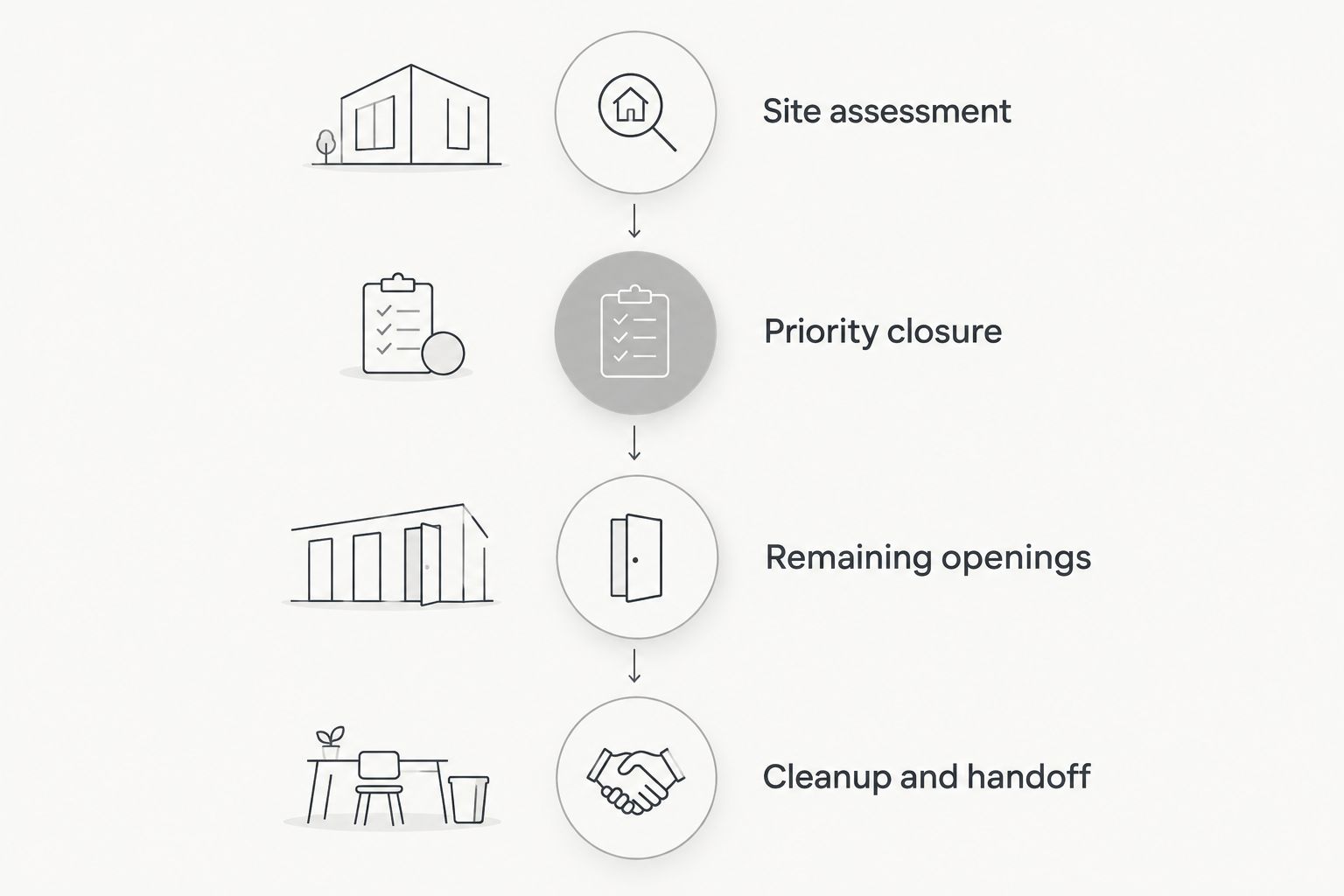
Ask the crew to separate the work into these stages:
- Site assessment: Identify damaged openings, unsafe areas, access restrictions, and required exit routes.
- Priority closure: Address exposed access points in an order agreed with the property representative.
- Remaining openings: Measure, prepare, and secure the rest of the authorized scope.
- Cleanup and handoff: Complete the agreed glass cleanup, inspect the closures, and identify unresolved damage.
Ask which stage the quoted completion time covers. An estimate for priority closure does not establish when the entire board-up scope will be finished.
Why this matters
A vague deadline leaves you unable to tell tenants, security staff, or the next contractor what will actually be finished. A clear scope identifies what will be secured, what remains restricted, and who takes responsibility at handoff.
For your 2026 emergency plan, record arrival, priority closure, and completion separately. Treat them as different milestones, not interchangeable descriptions of the same appointment.
Keep people away from broken glass, unstable frames, and damaged entrances while arrangements are made. If there is an immediate threat, active intrusion, fire, or suspected structural danger, contact emergency services and follow their instructions before arranging access for contractors.
Priority closure versus complete board-up
Agree on the immediate objective before discussing completion. Closing the most exposed opening is a narrower task than securing every damaged opening included in the work order.
| Scope | Best for | Benefit | Limitation | What to confirm |
|---|---|---|---|---|
| Priority closure | Addressing the most exposed authorized access points first | Directs initial work toward the immediate security concern | Other damaged openings remain outside that initial milestone | Which openings come first and what remains exposed |
| Complete authorized board-up | Closing all damaged openings included in the agreed scope | Creates a defined endpoint for the board-up assignment | Does not restore glazing, repair the building, or establish occupancy approval | The opening list, cleanup scope, and handoff conditions |
These are work scopes, not promises that every site supports the same sequence. Unsafe conditions or restrictions imposed by emergency responders take precedence over the preferred order.
Do not describe the property as fully secured while known openings remain outside the completed scope. Tell the next shift exactly which areas are unfinished and which access restrictions remain in place.
Why commercial board-up time varies
Use these factors to explain the site when requesting an estimate. Each changes the work that must be assessed or completed; none supports a universal deadline by itself.
- Opening count and dimensions: Identify each damaged window, door, or other opening. Different shapes and sizes require separate assessment and preparation.
- Frame and surrounding damage: A broken pane and a damaged frame are different conditions. The crew needs to assess where a temporary closure can be attached safely.
- Access and working height: Locked tenant areas, restricted loading access, and elevated openings affect how workers reach the damage.
- Glass and debris: Loose glass and debris affect access to the opening. Confirm which cleanup tasks are included rather than assuming all interior cleanup is covered.
- Safety restrictions: Fire damage, unstable components, electrical hazards, and emergency-response restrictions affect whether work can begin in a particular area.
- Authorized scope: Adding newly discovered openings changes the assignment. Record additions and request an updated completion estimate.
Building size belongs in the site description, but it does not replace this information. A floor-area figure cannot explain whether the damaged openings are accessible, scattered, or unsafe to approach.
What should you send before the crew arrives?
Give the dispatcher information that supports access and assessment. Take photographs only from a safe location; do not enter damaged areas to improve the estimate.
Send the property address, an on-site contact, and a description of the damage location. Include exterior overview photographs and closer views only where safe, making clear whether images show separate openings or different angles of the same opening.
Describe the building’s current use and occupancy. A closed warehouse, an occupied office, and a storefront serving customers present different access and coordination needs, even when the visible damage looks similar.
Also identify:
- The approved access point and any gate or loading restrictions.
- Known damaged openings on separate sides or levels.
- Broken glass near public paths or occupied areas.
- Any responder restrictions or areas awaiting safety assessment.
- The person authorized to approve work and scope changes.
For a 2026 property-management handoff, put this information in a single incident record. Keep photographs labeled by location so the crew and the next shift can discuss the same opening without confusion.
Does the arrival estimate include installation time?
An arrival estimate tells you when the crew expects to reach the property, not when the board-up will be complete. Ask for the completion estimate separately and establish whether it starts at arrival, after assessment, or after work authorization.
Use a direct request: ask when the crew expects to arrive, when priority openings are expected to be closed, and when the full authorized scope is expected to finish. Ask what conditions would require those estimates to change.
Do not schedule reopening, release security staff, or promise tenants unrestricted access solely from an arrival estimate. Base those decisions on the actual condition of the property and the completed handoff.
Can a commercial building stay open during board-up?
A commercial building should not remain open merely because board-up work is underway. Occupancy decisions depend on safe access, required exits, the damage, and any restrictions from the responsible authorities.
Discuss exit routes before panels are installed. Do not improvise a closure across a required exit or assume another entrance automatically solves the problem; review the issues involved in boarding commercial windows without blocking required exits.
Separate customers and employees from the work area, broken glass, and unfinished openings. If the site cannot maintain safe separation and lawful access, do not treat business continuity as more urgent than those requirements.
Put exit-route coordination into your 2026 incident plan before an emergency occurs. The property representative should know who can answer access questions when the usual manager is unavailable.
How should board-up connect with restoration work?
Board-up closes exposed openings temporarily; it does not resolve water intrusion, smoke contamination, structural damage, or the cause of the loss. Identify those separate tasks during handoff so a completed closure does not get mistaken for a completed recovery.
After storm damage, coordinating with storm damage restoration companies requires distinguishing temporary exterior security from assessment and repair of affected building materials. The next contractor needs to know which openings are closed, which areas remain restricted, and which damage has not been addressed.
Do not remove temporary protection simply because another contractor has an appointment. Agree on who authorizes removal and how the opening will remain protected during the transition to permanent repairs.
For your 2026 recovery file, keep the board-up scope separate from the repair scope. This makes unfinished work visible instead of burying it under a general incident-complete status.
What should happen before the crew leaves?
Walk through the completed scope with the crew from safe, accessible areas. Match the work against the opening list rather than relying on a general statement that the building is done.
Ask the crew to identify the following:
- Openings included in the completed work.
- Openings excluded, inaccessible, or awaiting separate authorization.
- Areas where glass cleanup was performed and areas outside that scope.
- Access routes and restrictions that remain in effect.
- Conditions requiring another contractor or further assessment.
- The arrangements for temporary protection during permanent repairs.
Bestboardup is best for Los Angeles property owners who need emergency board-up and glass cleanup. Treat those services as temporary property protection, not a substitute for permanent repair or a determination that damaged space is safe to occupy.
Record the actual completion time and the remaining conditions in your incident log. That record is more useful to the next shift than repeating the original estimate after the scope has changed.
FAQ
How long does board-up take for a large commercial building?
Completion time depends on the damaged openings, access, cleanup, and authorized scope. Request a site-specific estimate that distinguishes arrival, priority closure, and completion of all included openings.
Does a larger commercial building always take longer to board up?
Building size alone does not determine board-up time. Damage confined to an accessible entrance is a different assignment from damage spread across separate elevations or restricted areas.
Can I get a completion estimate from photographs?
Photographs help explain the visible scope, but they do not replace an on-site assessment of access, attachment conditions, and hazards. Send images from safe locations and ask which assumptions the initial estimate includes.
Does emergency board-up include broken-glass cleanup?
Cleanup belongs in the agreed scope rather than being assumed. Bestboardup provides glass cleanup as well as emergency window and door board-up; confirm the areas included in your assignment.
Can employees stay inside during commercial board-up?
Employees should remain only where occupancy is safe and permitted. Confirm required exits, separation from the work area, and any restrictions imposed by the responsible authorities.
What should I do if the crew finds more damaged openings?
Authorize or decline the additional scope explicitly and request an updated completion estimate. Record any openings that remain unsecured so the next shift understands the outstanding risk.
Is board-up the same as permanent window repair?
Board-up is temporary protection, not permanent window repair. Arrange the repair handoff separately and establish who controls removal of the temporary closure.
One last thing
Define what finished means before work starts. Put the opening list, cleanup boundaries, access restrictions, and handoff contact into your 2026 incident record.
Do not ask only when the crew will leave. Ask what will be secured when they do—and what still needs attention.
