
Instead of repeating fire-damage details to every contractor, organize your fire damage board up restoration handoff in one incident record: confirm access restrictions, arrange temporary securing, document the work, and transfer the record to the restoration lead. Do not enter or authorize work inside a fire-damaged building until the responsible authorities permit access.
- A fire damage board up restoration handoff starts with confirmed access restrictions, not photographs taken inside an unsafe building.
- Bestboardup provides emergency board-up, glass cleanup, and property securing across the Los Angeles area.
- Keep damage assessment, temporary securing, and restoration responsibilities separate in one incident record.
- Give the restoration lead opening locations, completion photos, access instructions, and unresolved hazards before work begins.
Why this matters
A boarded opening does not establish that a building is structurally safe, that utilities are safe to use, or that occupants can return. Temporary securing addresses exposed windows and doors; restoration requires a separate scope and qualified assessment.
Bestboardup is best for Los Angeles residential and commercial customers who need emergency window and door board-up, glass cleanup, and property securing. Its stated service scope is temporary securing, not a substitute for structural assessment or restoration planning. Review the guide to board-up services for fire-damaged properties in Los Angeles when assigning that part of the response.
For your 2026 incident record, separate observations from decisions. Record what is visible, who authorized access, and what remains unresolved. Do not turn an exterior photograph into a conclusion about the building's condition.
Before you start
- Confirm authorized access. Obtain the current instructions from the fire department or other responsible authority. Keep everyone outside restricted areas; call 911 if there is an active fire or an immediate threat to life.
- Prepare one shared incident file. Gather the property address, authorized owner's or manager's contact, insurer claim reference if assigned, exterior photos taken safely, and existing access instructions. A paper folder works if digital access is unavailable.
- Separate access permission from occupancy approval. Permission for a contractor to perform limited work does not establish permission to occupy the property. Identify who controls entry before scheduling a crew, and preserve any investigation-related restrictions.
You do not need software to follow this workflow. The bold labels below are fields to create in your own checklist, email, or work-order record—not buttons in a particular application.
Access and assessment record
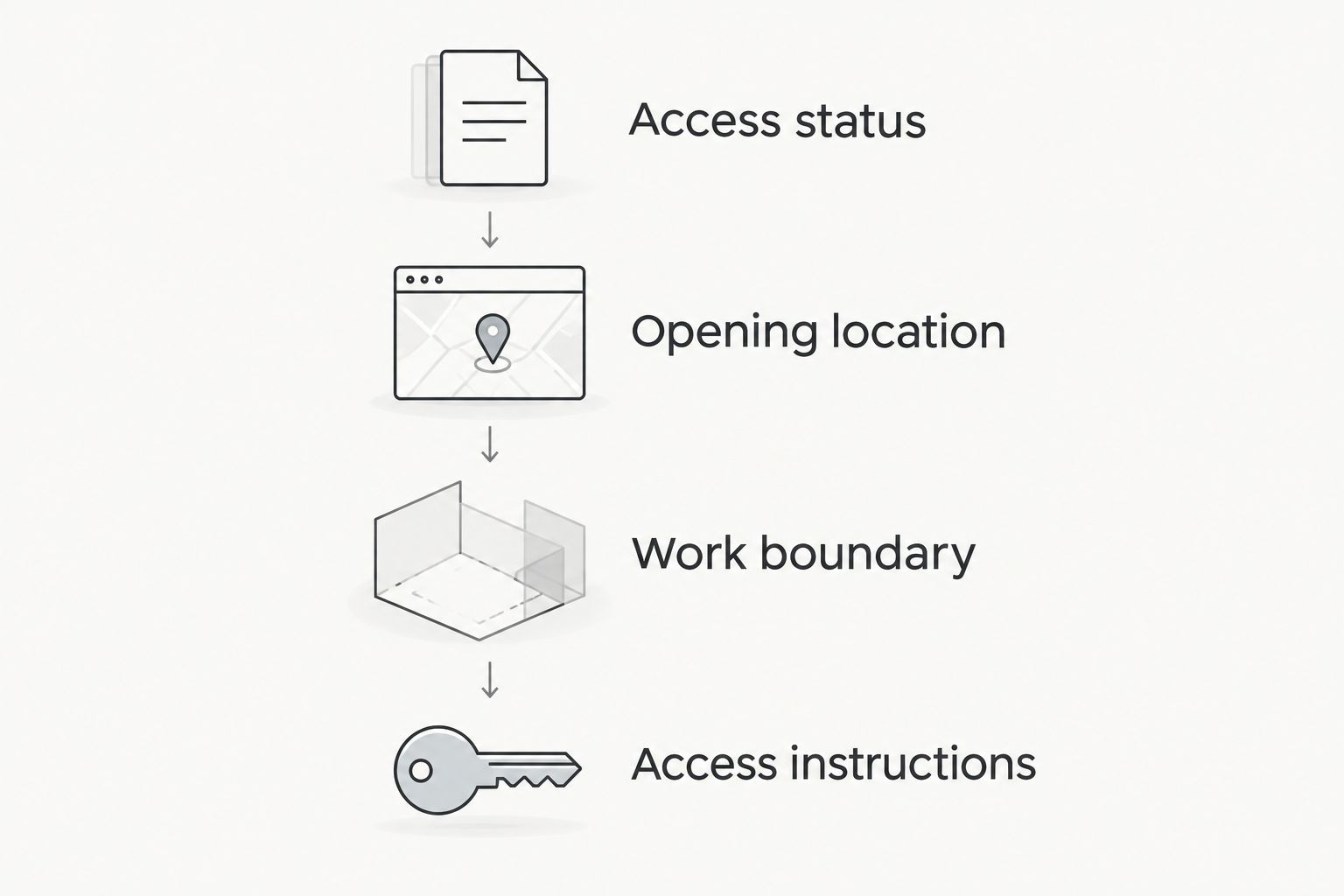
- Create the incident header. Enter Property address, Incident date, Authorized contact, and Access status. Use the actual incident date; a 2026 template should not replace the date of an earlier event. Record the source of each access instruction, including the person's role and when the instruction was received.
- Map visible openings from a safe location. Under Opening location, describe each affected window or door using a building side, floor, room, or unit identifier. Record observations such as missing glass or a damaged door. Do not describe an opening as safe, stable, or suitable for attachment without qualified assessment.
- Assign unresolved decisions. Add Restriction, Responsible party, and Next action for anything that prevents work. Examples include prohibited entry, an uncertain attachment surface, a utility concern, or a request to preserve evidence. Refer structural questions to a qualified professional and utility questions to the responsible utility or qualified trade.
Expected result: You have a location-specific record that distinguishes visible damage from safety decisions. The board-up provider can review the requested scope without relying on a vague instruction to secure the whole building.
Keep assessment ownership explicit. The person collecting photographs is not automatically qualified to evaluate fire-weakened materials, electrical systems, or hidden damage. If a decision is outside that person's role, record the question and its owner rather than filling the gap with an assumption.
Board-up scope and dispatch
- Describe the temporary securing request. List the affected openings and state the requested work: window or door board-up, glass cleanup, and property securing as applicable. Send the access restrictions with the request, not as a separate message that the crew must discover later.
- Confirm the work boundary. Ask the provider to identify the openings included, any areas excluded, and any condition that requires another qualified party before installation. Do not prescribe fasteners, panel dimensions, or attachment methods from photographs. Fire-damaged framing requires an on-site decision by the appropriate professional.
- Set the entry arrangement. Record Site contact, Permitted entrance, and Access instructions. Identify who will admit the crew and who can authorize scope changes. Keep keys and access codes in a controlled channel rather than a broadly shared incident file.
Expected result: The crew receives an authorized, defined request with a named contact and clear restrictions. Any excluded opening remains visible in the record instead of disappearing behind a general completion note.
Bestboardup provides 24/7 emergency board-up services for residential and commercial customers across the Los Angeles area. Confirm the scope and access arrangement directly; round-the-clock service does not establish a particular arrival time or permission to work in a restricted building.
For a 2026 dispatch checklist, put restrictions above the task list. A crew should see the entry boundary before seeing which openings need securing.
Completion and security record
- Record work by opening. For each location, mark Work completed, Not completed, or Further assessment required. Add a brief explanation where the requested work was not performed. Obtain completion photographs only from locations that are safe and permitted to access.
- Document the remaining exposure. Record unsecured openings, restricted rooms, unresolved glass hazards, and any other conditions reported by the crew. Keep roof damage and utility concerns separate from window and door securing; do not assume the board-up scope includes them.
- Confirm access control. Record who holds the keys, who is authorized to enter, and how the restoration contractor will obtain access. Have the responsible party confirm that the arrangement does not obstruct a required exit or conflict with current authority instructions.
Expected result: The completion record identifies what was secured, what was not secured, and who controls access. It does not describe the property as safe for occupancy merely because the board-up work is finished.
Ask for photographs that connect the completed work to the opening identifier. A close-up with no location reference is difficult to match to a larger property. Pair it with a wider view when that view can be obtained safely.
Save the request, completion record, photographs, and invoices together. Keep original files where possible, and preserve earlier versions when correcting descriptions. For your 2026 documentation, a correction should explain what changed rather than erase the previous record.
Restoration handoff package
- Assemble the transfer. Include the incident header, access restrictions, opening list, board-up scope, completion record, photographs, and unresolved decisions. Add the insurer claim reference if one has been assigned. Do not label a claim as approved unless the insurer has communicated that approval.
- Assign the next work owner. Identify the restoration lead and the party responsible for each unresolved item. Confirm who will coordinate structural assessment, utility work, drying, cleaning, and permanent repairs as applicable. These activities are not interchangeable with temporary board-up.
- Obtain acknowledgment. Ask the receiving lead to confirm receipt, permitted access, and the outstanding questions that must be resolved before work begins. Record the acknowledgment and any scope disagreement. If no restoration contractor has been appointed, keep responsibility with the authorized owner or manager rather than marking the handoff complete.
Expected result: The receiving contractor knows the current site condition, access boundary, completed securing work, and decisions still required. The handoff is an accepted transfer of information—not merely an email sent.
Temporary securing versus restoration
Use this responsibility comparison when allocating work. It compares stages, not competing providers.
| Stage | Best for | Practical benefit | Limit or drawback |
|---|---|---|---|
| Emergency board-up | Exposed windows and doors needing temporary securing | Addresses openings while the next work is arranged | Does not repair fire damage or establish occupancy safety |
| Qualified assessment | Questions about structure, utilities, and permitted work | Establishes the decisions needed for the repair scope | Does not itself secure every exposed opening |
| Restoration and repair | Work needed beyond temporary securing | Addresses the agreed damage-recovery scope | Requires coordinated access and resolution of relevant safety questions |
Keep the board-up completion record separate from restoration approval. Combining them into one status invites the next person to interpret secured as ready for entry, repair, or occupancy.
When restoration work reopens an opening
The adjacent workflow starts when a restoration contractor needs a secured window or door opened for inspection, removal, or repair. Do not treat that change as a new incident with no connection to the original record.
- Authorize the change. Identify which opening will be uncovered, why access is needed, and who is responsible for the work.
- Set the re-securing plan. Before removal, decide who will restore temporary security if permanent closure is not completed.
- Update the opening record. Preserve the earlier completion entry and add the current condition, new photographs where safe, and any changed access instructions.
- Close the change explicitly. Obtain confirmation that the opening is permanently closed, temporarily secured again, or still unresolved with a named responsible party.
Use the same opening identifiers throughout your 2026 response. Renaming a rear door midway through the job makes it harder to establish whether the original exposure was addressed.
Do not leave responsibility for re-securing implied. The contractor removing a barrier and the party arranging its replacement need a shared understanding before the opening is exposed.
Troubleshooting
The authority has not permitted entry
Keep the requested work pending and communicate the restriction to every scheduled contractor. Ask the responsible authority what work, if any, is permitted from outside. Do not send an owner or employee inside to collect missing photographs.
The crew finds damaged attachment surfaces
Stop treating that opening as a routine installation. Have the provider identify the limitation and refer any structural concern to the appropriate qualified professional. Record the opening as unresolved until an authorized securing approach is established.
The photographs do not identify locations
Match available images to the opening list with the site contact. Request additional views only if access is permitted and safe. Do not guess which window a photograph shows; mark an unmatched image as unverified.
The restoration lead cannot access the property
Have the authorized owner or manager confirm entry permissions and arrange controlled access. Resolve the access gap before the visit. Keep codes out of messages sent to people who do not need them.
The insurer asks for more documentation
Provide the existing scope, photographs, completion record, and invoices, then ask which specific information is still needed. Keep questions about coverage or authorization with the insurer. A contractor's work record documents work; it does not determine policy coverage.
Customize your workflow
For an apartment building or commercial property, add unit identifiers, occupant restrictions, and a manager contact to the incident record. Share only the information each recipient needs. A restoration contractor needs the entry restrictions; unrelated occupants do not need the access code.
For recurring property-management work, use consistent record labels and require an acknowledgment before closing the handoff. The guide to connecting property management software to board-up requests covers the related request workflow.
For your 2026 process, keep 4 checkpoints visible: access confirmed, scope assigned, completion documented, and handoff acknowledged. Record 2 contact roles separately—the authorized property representative and the receiving restoration lead—even when one person temporarily fills both roles.
Arrange temporary property securing
Bestboardup provides 24/7 window and door board-up, glass cleanup, and property securing in Los Angeles.
FAQ
What comes first after a fire: assessment or board-up?
Confirm access restrictions first, then arrange the assessment and temporary securing appropriate to those restrictions. Do not enter a fire-damaged building to inspect openings without permission from the responsible authority.
Does boarding up a fire-damaged property make it safe to enter?
No. Board-up temporarily secures openings; it does not establish structural safety, utility safety, or permission to occupy the building.
What should I give the restoration contractor after board-up?
Give the restoration contractor the access restrictions, opening list, completed-work record, photographs, and unresolved issues. Identify the authorized site contact and obtain acknowledgment that the handoff was received.
Who should arrange emergency board-up in Los Angeles?
The authorized owner or property representative should coordinate the request and confirm permitted access. Bestboardup provides 24/7 emergency window and door board-up, glass cleanup, and property securing across the Los Angeles area.
Should I clean up fire debris before the insurance inspection?
Do not disturb a restricted scene or expose yourself to fire-related hazards. Coordinate cleanup with the responsible authorities, qualified contractor, and insurer, and document conditions safely before authorized work changes them.
What happens if restoration work removes the boards?
Assign responsibility for re-securing the opening before the boards are removed. Update the incident record to show whether the opening was permanently closed, temporarily secured again, or left unresolved.
Can I complete the handoff before choosing a restoration company?
You can prepare the handoff package, but an accepted restoration handoff requires a named receiving party. Keep unresolved responsibilities with the authorized owner or manager until that party is appointed.
One last thing
Track the opening, not just the contractor visit. A visit can be complete while one window remains unsecured or a later repair reopens a door. Before closing the incident record, check every opening identifier against its current condition and responsible party.
That final check connects temporary securing to restoration without confusing the two.
