
Boarding up a commercial window does not automatically violate fire exit codes; it violates requirements when the covering blocks a required exit, obstructs an escape route, or interferes with another required life-safety function. Before securing the opening in 2026, identify what it serves—not just whether it looks like a window—and keep people out of any area whose required escape route is compromised.
- Does boarding up a window violate fire exit codes? Yes, when it obstructs required egress or another required life-safety function.
- Bestboardup provides commercial board-up in Los Angeles; fire-code approval comes from the authority having jurisdiction.
- Keep exit doors, release hardware, exit signs, and escape routes unobstructed during emergency property securing.
- A temporary board-up does not authorize continued occupancy; resolve uncertain exit requirements before reopening the affected area.
Why this matters
A broken storefront creates two immediate problems: unauthorized entry and unsafe conditions for people inside. Solving the first must not worsen the second. A panel that covers damaged glass but also traps an adjacent exit door is not an acceptable security solution.
Treat installation permission and exit compliance as separate questions. The guide to whether you need a permit to board up a window in Los Angeles addresses the permit question; permission to install a covering does not, by itself, establish that the occupied space has adequate exits.
Secure the damaged opening without sacrificing the route people need to leave. If you cannot establish that both conditions are satisfied, restrict access to the affected space and contact the local fire prevention or building department.
Does boarding up a commercial window violate fire exit codes?
Not automatically. The opening's required function and the effect of the installation determine the answer. A fixed display window and a glazed exit door are different building components, even when both sit in the same storefront frame.
Start with this comparison. It identifies what needs checking, not whether a particular installation has official approval.
| Opening or condition | Best for | Benefit of securing it | Limitation or fire-safety concern |
|---|---|---|---|
| Fixed display window beside a separate exit | Protecting a damaged, non-egress opening | Covers the exposed opening | Panels and framing must not obstruct the neighboring exit or required systems |
| Broken glazing within an exit door | Protecting a damaged door while preserving its function | Addresses the broken glass area | The door, release hardware, and required opening must remain usable |
| Opening with an uncertain emergency function | Assessment before installation | Allows the correct securing method to be selected | Appearance alone does not establish whether blocking it is permitted |
| Window in a vacant or fire-damaged building | Securing a restricted property | Limits access through the damaged opening | Vacancy does not establish permission to obstruct required emergency access |
Under federal OSHA's workplace exit rules, exit routes must remain free and unobstructed. OSHA 29 CFR 1910.37(a)(3) specifically addresses obstructions, including temporary materials and equipment. Section 1910.36(d)(1) requires employees to be able to open an exit-route door from inside without keys, tools, or special knowledge.
Those are workplace requirements, not a complete Los Angeles building-code determination. For a 2026 installation, the local authority must resolve building-specific questions involving approved plans, occupancy, fire protection, and any applicable orders.
What should you do before the opening is covered?
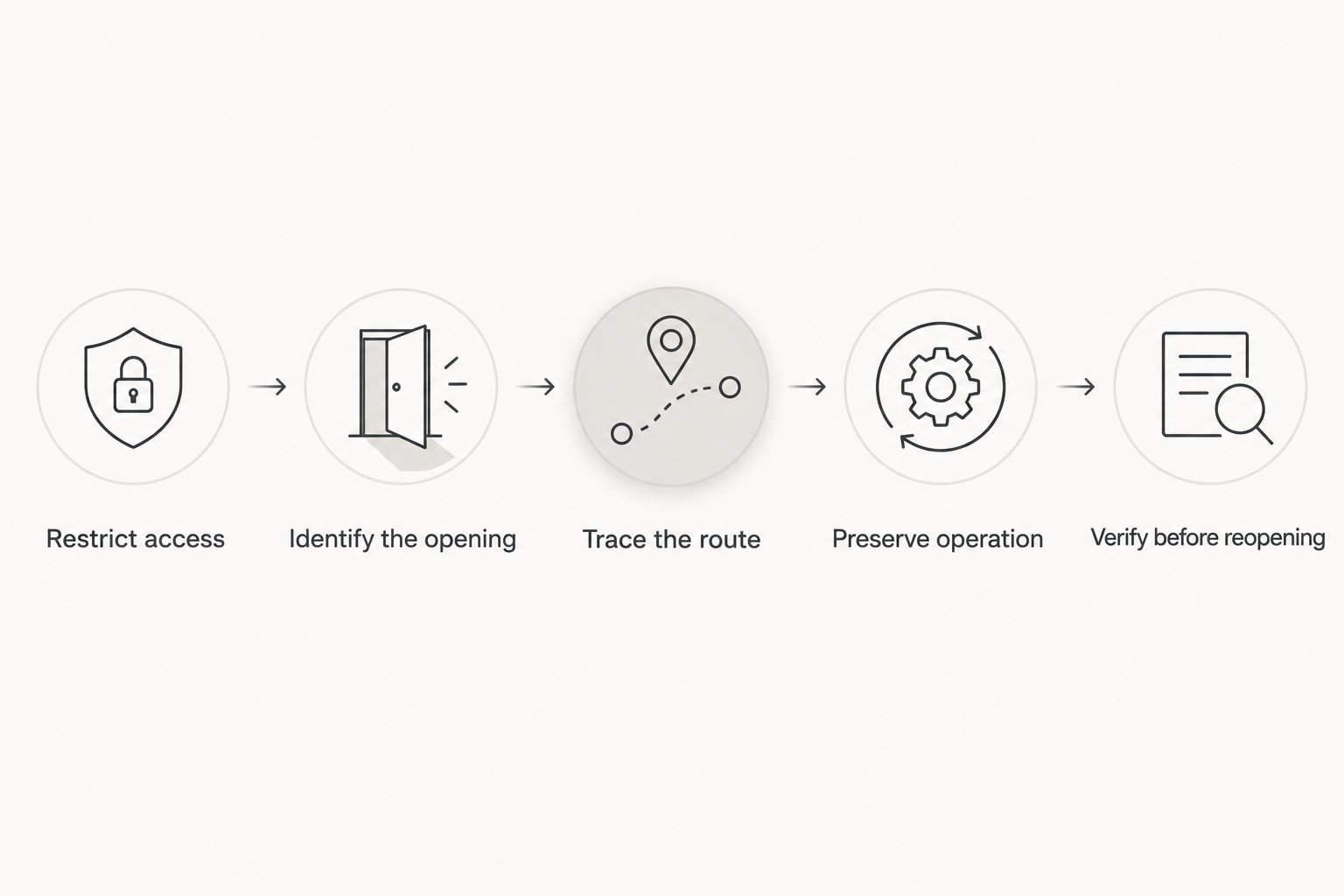
Use this sequence before anyone starts fastening panels. If there is an active fire, suspected structural instability, or another immediate emergency, leave the danger area and contact emergency services instead of inspecting it yourself.
- Restrict access. Keep customers, staff, and bystanders away from broken glass and unstable components. Do not place temporary barriers across an escape route.
- Identify the opening. Establish whether it is fixed glazing, part of an exit door, or an opening with a designated emergency function. Check available plans and ask the responsible building representative.
- Trace the route. Follow the path from occupied areas through the exit and onward to a safe exterior location. Check both sides of the damaged storefront.
- Preserve operation. Specify that panels, supports, and fasteners must not immobilize required doors or interfere with release hardware, signs, lighting, or fire-protection equipment.
- Verify before reopening. Have the responsible person check the completed work. Escalate uncertain conditions to the fire prevention or building department before allowing use of the affected area.
The installer needs the occupancy status before work begins. Tell the crew whether employees remain inside, whether customers will return, and whether another tenant shares the corridor or exit discharge.
Fixed storefront windows: check the surrounding exit
A fixed display window is not automatically an emergency exit. Covering that glass still requires checking the entire installation, because the panel's edges, braces, and fastening points can affect nearby components.
Look beyond the damaged pane. A panel extending across the frame can interfere with an adjacent door; stored materials can narrow the approach; cleanup equipment can obstruct the sidewalk outside. The relevant question is whether the completed work preserves every required function, not merely whether the plywood fits.
Best for an ordinary fixed-window opening: a securing plan that stays clear of the exit assembly and escape path. Its benefit is separating property protection from door operation. Its limitation is that the opening's status must be established first; calling it a display window does not prove that status.
Do not remove or cover equipment simply because it complicates installation. Identify conflicts with exit signs, emergency lighting, alarms, or other safety equipment before the crew begins.
Glazed exit doors: preserve the door's function
Broken glass in a door requires a different plan from broken glass beside a door. A sheet fastened across the door and surrounding frame can turn an operable exit into a fixed barrier.
The securing method must preserve the door's required movement and release operation. Do not accept an arrangement that requires occupants to find a screwdriver, remove screws, or wait for someone outside to release the door.
Best for a damaged exit door: a repair or temporary securing method that maintains required egress, subject to applicable approval. The benefit is continued protection without intentionally disabling the exit. The limitation is that some damage prevents safe continued use; another usable door does not automatically resolve the building's exit requirements.
For the service considerations, see emergency door board-up services in Los Angeles. Describe the opening as an exit door when requesting help, rather than asking only for a broken pane to be covered.
Vacant or fire-damaged properties: do not assume exemption
An empty building still requires a securing plan appropriate to its condition. A fire department restriction, damaged structure, shared access route, or required emergency-access opening changes what work is appropriate.
Do not enter a restricted building to check a window or recover items. Establish who controls access and what official instructions apply before authorizing installation. A property owner's request cannot substitute for clearance where an authority has restricted entry.
Best for a restricted property: coordinated securing that follows the controlling instructions. Boarding openings helps limit unauthorized entry, but it does not establish that the structure is safe or authorize people to return. Keep those decisions separate in the work order and handoff.
Why fire-code compliance varies
The answer changes with the building and the installation—not with how urgently you need the opening covered. These factors determine what must be checked:
- Opening function. Fixed glazing, exit-door glazing, and designated emergency openings serve different purposes.
- Occupancy and use. The approved use and number of occupants affect required exit arrangements; business type alone is not enough to decide.
- Remaining exit routes. Losing access to one opening requires an assessment of the required system, not an assumption that another door is sufficient.
- Installation footprint. Panels, framing, tools, debris, and barriers can obstruct the route even when the window itself is not an exit.
- Building condition. Fire damage, unstable framing, and official restrictions affect access and the scope of permissible work.
- Local requirements. The applicable code, approved plans, permit conditions, and enforcement instructions govern the particular property.
For a 2026 board-up request, give the installer these facts at dispatch. Photograph the damage from a safe position and identify any nearby exit door, but do not approach unstable glass to obtain a better picture.
What measurements matter before you reopen?
Do not use a single measurement as proof of compliance. OSHA 29 CFR 1910.36(g)(2) sets a minimum exit-access width of 28 inches, but capacity and applicable building requirements can require more width. That federal minimum is not a universal storefront-door specification.
OSHA 29 CFR 1910.36(b) generally requires 2 exit routes, with exceptions and additional requirements based on the workplace. This does not mean that finding any two doors makes the premises safe. Location, capacity, usability, and the route beyond each door still matter.
Measure the clear route as installed, including anything projecting into it. Check the door through its required movement rather than judging it from a photograph. If you do not know the required dimensions or exit arrangement, obtain that determination before reopening the affected area.
What should you tell the board-up company?
Give dispatch a clear scope: damaged opening, current occupancy, nearby exit doors, shared access, and any fire or building department instructions. Ask how the proposed installation preserves the required exit functions, and identify who will verify the result.
Bestboardup is best for Los Angeles residential and commercial customers needing emergency board-up, glass cleanup, and property securing. Bestboardup provides these services 24 hours a day, 7 days a week; that service scope does not replace the local authority's compliance determination.
Request separate documentation for the damaged opening and any unresolved safety issue. A useful handoff records what was secured, which areas remain restricted, and what repair or official assessment is still needed. Do not describe a temporary covering as a completed permanent repair.
Arrange emergency property securing
Describe the damaged opening, occupancy status, and nearby exits before installation.
Can employees stay inside during board-up work?
Employees should not occupy an area with a compromised required escape route or uncontrolled installation hazards. Separate the work area without blocking the paths occupants need to leave, and keep temporary storage out of those paths.
Continued use requires more than leaving a door unlocked. Broken overhead glass, damaged framing, dust, and work equipment can make an otherwise accessible area unsafe. The responsible employer or building representative must address those conditions as well as egress.
Does temporary boarding avoid fire-exit requirements?
Temporary boarding does not exempt an occupied workplace from exit-route requirements. OSHA's obstruction rule expressly includes temporary materials and equipment, so a short repair interval does not justify blocking a required path.
Set a repair and inspection plan when arranging the board-up. In 2026, as at any occupied property, the temporary installation needs checks after changes to access, tenant use, or the surrounding work area. Remove unnecessary materials promptly rather than allowing the emergency setup to become permanent storage.
Who decides whether the board-up is acceptable?
The local authority having jurisdiction resolves applicable code and enforcement questions. The installer controls the installation work; the owner, manager, and employer retain their respective responsibilities for safe use and access.
Ask a precise question: identify the address, opening, occupancy status, proposed covering, and remaining exits. Ask what documentation, inspection, or approval is required for that condition. A general answer about boarding windows is not a determination for your particular storefront.
FAQ
Does boarding up a window violate fire exit codes in Los Angeles?
Boarding up a window violates requirements when it obstructs required egress or another required life-safety function. A fixed window is not automatically an exit, but the installation must preserve nearby doors and escape routes.
Can I board over the glass in an emergency exit door?
Do not use a covering that disables the emergency exit door or its required release operation. Have the damaged assembly assessed and select a method that preserves required egress.
Is plywood allowed if the business stays open?
Plywood alone does not determine whether the business can remain open. The installation, remaining exits, damage conditions, and applicable requirements determine whether continued occupancy is acceptable.
Can I block one exit if another door still works?
Do not assume another working door permits blocking a required exit. The required exit arrangement depends on the building and occupancy, not simply the presence of a second door.
Does an insurance claim authorize me to board an exit?
An insurance claim does not authorize obstructing a required exit. Coordinate property protection with the building’s life-safety requirements and any official restrictions.
Who should check a commercial board-up in 2026?
The responsible building representative should verify the completed installation, and the local authority should resolve code or approval questions. Bestboardup provides emergency property securing, not a substitute for that official determination.
One last thing
Check the outside of the exit, not just the door. A door can open correctly while discarded glass, panels, barriers, or parked equipment obstruct the route beyond it. Before returning the affected area to use in 2026, walk the complete safe route and resolve anything blocking it.
