
Yes, a boarded-up storefront can stay open for business if customers and employees can enter, move through, and leave safely, and no closure order prohibits occupancy. Boarding covers the damaged opening; it does not establish that the building, entrance, or sales floor is safe to use.
- Can a boarded up storefront still stay open for business? Yes, when safe access, emergency exits, and occupancy conditions allow.
- Keep customers out until broken glass, unstable materials, and the damaged entrance have been addressed.
- Bestboardup provides emergency board-up and glass cleanup in Los Angeles; securing an opening is not permission to reopen.
- Choose full operation, restricted operation, or temporary closure based on actual conditions, not the appearance of the plywood.
Can a boarded-up storefront still stay open for business?
A boarded display window does not automatically require a business to close. A blocked exit, unsafe entrance, or official closure order changes the answer. Decide whether to open by checking the usable premises, not just whether the damaged opening has been covered.
Start with these 5 checks before admitting customers:
- Safe entry: Customers can reach and use the entrance without crossing broken glass or entering the work area.
- Clear exits: Required exit routes and doors remain available and unobstructed.
- Contained damage: Loose glass, unstable framing, and other hazards cannot reach occupied areas.
- Usable premises: The occupied space has the conditions and systems needed for its permitted use.
- Occupancy status: No applicable closure order or restriction prevents the proposed operation.
For help securing the damaged opening, see board-up services for commercial storefronts in Los Angeles. Keep the opening secured while you separately resolve whether the premises can remain occupied.
Why this matters
A temporary cover addresses an exposed opening. It does not repair damaged door hardware, remove every glass fragment, restore a fire-damaged space, or approve a different customer entrance. Those are separate checks, and each can affect whether you should serve customers inside.
Bestboardup is a fit for Los Angeles businesses needing emergency board-up and glass cleanup. Its role is property securing; any required occupancy clearance belongs with the authority responsible for that decision.
For your 2026 reopening checklist, separate two decisions: whether the opening is secure and whether the occupied business is safe. Completing the first does not settle the second.
Choose the operating arrangement that matches the damage
Use the table to identify the arrangement to evaluate. These are operating choices, not substitutes for an inspection or required approval.
| Operating arrangement | Best for | Benefit | Limitation or reason to stop |
|---|---|---|---|
| Full indoor operation | Damage confined to a display opening, with safe access and unaffected occupied areas | Keeps the normal customer experience | Inappropriate if hazards, exit problems, or restrictions remain |
| Restricted indoor operation | A separable damaged area with a safe, usable customer area elsewhere | Keeps customers away from the repair zone | Requires effective separation without compromising access or exits |
| Exterior pickup only | Businesses able to arrange a safe, permitted handoff outside | Avoids bringing customers through the damaged storefront | Does not resolve employee safety or authorize sidewalk use |
| Temporary closure | Unsafe access, uncontrolled hazards, or an applicable closure order | Keeps customers out while problems are addressed | Interrupts on-site trading until reopening conditions are met |
Full indoor operation: keep the customer route unaffected
Full operation is an option to evaluate when the damage is limited to a window and the entrance, exits, and occupied interior remain safe. Check both sides of the board-up, including nearby displays and the sidewalk approach. A secure panel does not make adjacent loose glass safe.
Do not place merchandise in front of the damaged area simply to hide it. That can conceal a problem from staff and invite customers closer to the repair zone.
Restricted indoor operation: separate people from the work
Restricted operation requires more than a handwritten warning. Customers should have a clear route that does not pass through broken glass, tools, unsecured materials, or active repair work. Keep the separation understandable to someone entering the store for the first time.
If the proposed barrier blocks an exit or leaves customers dependent on staff moving it, stop and reassess the arrangement. A smaller sales area is not a safe compromise when it creates another hazard.
Exterior pickup: check the handoff location first
Exterior pickup keeps customers outside, but employees still need safe access to prepare and retrieve orders. Identify a handoff location away from falling material, cleanup, vehicles, and the damaged opening.
Confirm permission before using shared walkways, neighboring premises, or public space. Calling an operation pickup-only does not remove the need to address unsafe conditions inside.
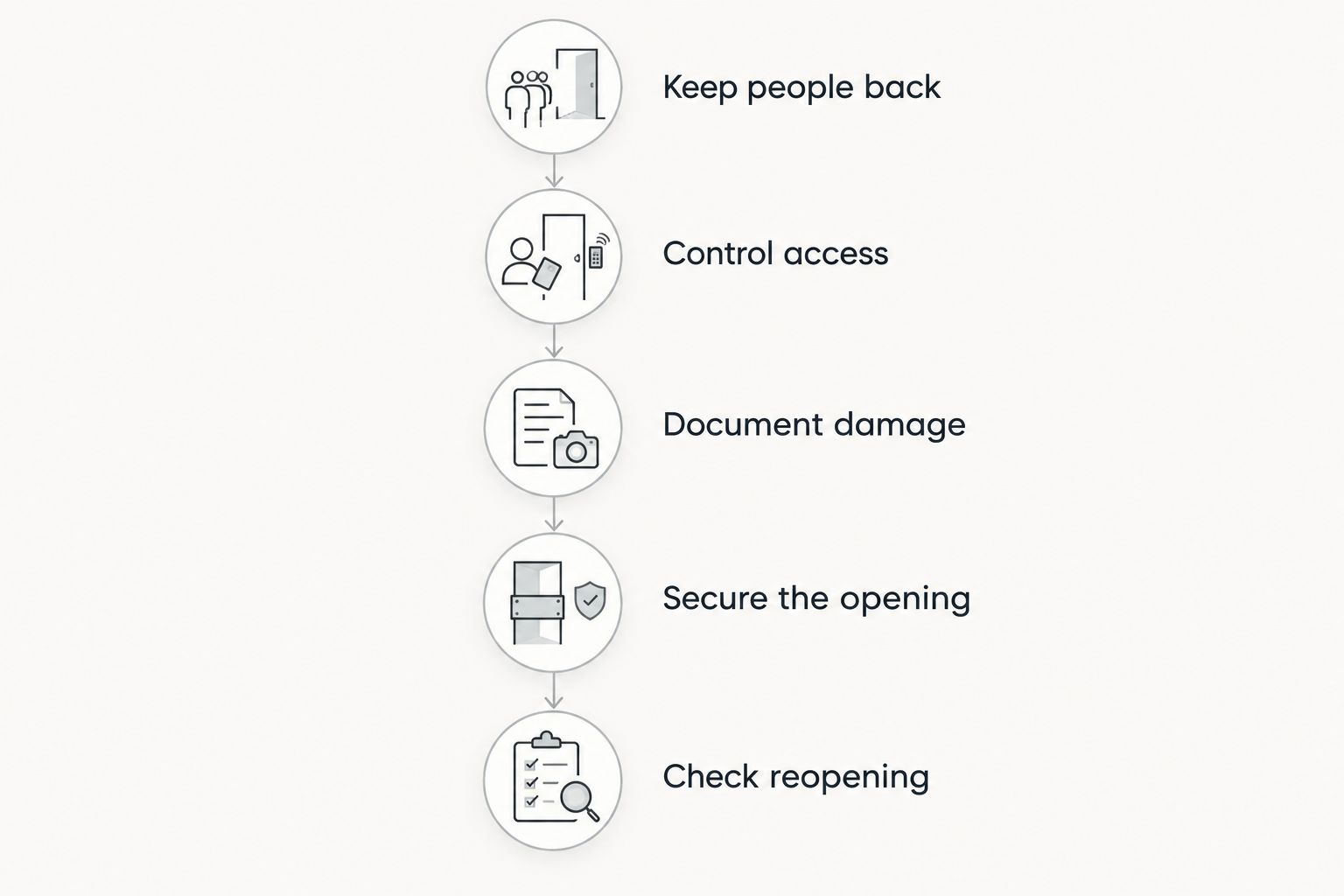
What should you do immediately after storefront damage?
Use this sequence before considering sales. The priority is preventing another injury or unauthorized entry, not making the frontage look normal.
Keep people back
Move customers and employees away from the broken opening. Do not let someone stand under cracked glass or handle a damaged door to demonstrate that it still works. If there is an immediate threat, injury, fire, or suspected structural instability, contact emergency services and follow their directions.
Control access
Stop customers from entering the affected area while the condition is assessed. Keep people away from both the interior and exterior sides of the opening; debris and loose materials are not limited to the sales floor.
Do not redirect customers through a rear or side door without checking whether that route is suitable for customer use. A door that staff normally use for deliveries is not automatically an acceptable public entrance.
Document damage
When it is safe, photograph the opening, door frame, surrounding damage, and affected contents before cleanup changes the scene. Notify the property owner or manager and your insurer as applicable. Follow police instructions if the damage involves a crime scene.
Documentation must not delay emergency measures needed to protect people. Take photographs from a safe position rather than stepping into the debris field.
Secure the opening
Tell the board-up provider whether you intend to keep the business occupied. Identify the doors that must remain usable, nearby customer routes, and any restrictions already issued by responders or officials.
Bestboardup provides 24/7 emergency window and door board-up, glass cleanup, and property securing across the Los Angeles area. Those services address the damaged opening; they do not replace permanent repairs or establish that the rest of the premises is safe.
Check reopening
Walk through the intended customer and employee routes after cleanup and securing work is complete. Check the space as it will actually operate, with counters, displays, deliveries, and staff positions in place. Resolve any required inspection or clearance before admitting customers.
Why the answer varies between storefronts
The same-looking board-up can leave very different operating conditions. Use these factors in your 2026 decision rather than treating every boarded window as equivalent:
- Window versus doorway: Covering a display opening has different access consequences from covering the customer entrance.
- Extent of damage: A broken pane and damaged framing require different assessments; visible plywood does not show the full condition.
- Exit arrangement: The proposed occupied area still needs its required exit routes, without stored materials or temporary barriers obstructing them.
- Customer access: Steps, narrow passages, damaged thresholds, and unsuitable alternate entrances can prevent a workable public route.
- Other hazards: Fire, smoke, water, electrical damage, or unstable materials can make occupancy unsafe even after the opening is covered.
- Official restrictions: A closure order or required clearance controls whether the business can resume the proposed use.
Do not infer approval from the absence of a person inspecting the storefront. If the damage raises an unresolved occupancy question, contact the relevant building or fire authority before reopening.
Can you stay open if the front door is boarded up?
A boarded front door requires a separate access and exit assessment before you admit customers. An intact display window elsewhere does not compensate for a required door being unusable.
Check whether another entrance is suitable for public use and whether all required exit routes remain available. Do not promise customers that a back entrance is open until you have confirmed the route, the door operation, and any approval needed for the arrangement.
Keep the distinction clear in your 2026 staff instructions: the entrance tells customers how to get in; the exit arrangement determines how occupants can get out. Both need attention.
Does a completed board-up mean you can reopen immediately?
A completed board-up does not, by itself, establish that you can reopen. It addresses the exposed opening, while cleanup, safe access, utilities, fire protection, and any required clearance remain separate matters.
Ask for a clear explanation of what work was completed and what remains unresolved. If permanent glass replacement is separate, record that next step rather than assuming the temporary cover completes the repair.
Can you operate while glass replacement is underway?
You should not admit customers into the glass-replacement work zone. Whether another part of the business can operate depends on effective separation, safe routes, and the conditions of the work.
Agree on the customer boundary with the repair contractor before work begins. If carrying materials or removing glass requires crossing the customer route, stop customer access during that work instead of relying on verbal warnings.
Make it clear that the business is operating
Once the premises are safe to use, explain the temporary arrangement plainly. Put readable directions where customers can see them before approaching the damaged frontage. Keep signs separate from required exit markings and away from moving doors.
Your customer notice should identify the usable entrance, current operating hours, and any service restriction. Do not advertise normal indoor service if customers are limited to pickup or a restricted area.
Update online business information only when the arrangement is confirmed. In 2026, a correct temporary notice is more useful than leaving customers to interpret a boarded facade. Remove outdated directions when the entrance changes again.
Keep the temporary setup under review
Treat the board-up as an interim condition, not a finished repair. Before opening each day, look for movement, new gaps, damaged fasteners, wet areas, and debris around the opening. Keep customers away if conditions have changed and arrange an assessment.
Give staff a simple stop-work rule: close the affected area when a panel shifts, glass appears, or an exit becomes obstructed. Do not ask employees to improvise repairs while customers continue passing nearby.
Keep the damage photographs, securing-work documentation, repair arrangements, and any official instructions together. Your 2026 reopening record should show the actual condition and decisions, not just a photograph of installed plywood.
FAQ
Can I keep my shop open with a boarded display window?
Yes, if the occupied premises remain safe, required access and exits are usable, and no applicable closure order prevents operation. Check for loose glass and damage beyond the covered opening before admitting customers.
Can customers use the back door while the front is boarded?
Only use a back door for customers after confirming that the entrance, approach, and exit arrangement are suitable for that use. Do not assume a delivery entrance is an acceptable replacement for the public entrance.
Does a board-up company approve my store to reopen?
A board-up company’s securing work is not occupancy approval. Resolve any required clearance with the relevant authority and address hazards outside the scope of the board-up.
Can I serve customers while broken glass is being cleaned up?
Keep customers out of the cleanup area and any route affected by the work. Operating elsewhere requires effective separation and safe access, not just a warning sign.
Does Bestboardup provide emergency storefront securing in Los Angeles?
Bestboardup provides 24/7 emergency window and door board-up, glass cleanup, and property securing across the Los Angeles area. These services secure damage but do not replace permanent repairs or required occupancy clearance.
Should I close if the board-up starts coming loose?
Keep people out of the affected area and arrange an assessment before using it again. If the problem affects the entrance, an exit, or customer safety, stop the affected operation.
One last thing
Test your temporary entrance instructions from the customer's approach, not from behind the counter. Confirm that a first-time visitor can identify the usable door without walking toward broken glass, entering the work area, or trying a blocked entrance. If the route is confusing, fix it before opening.
