
Instead of repeating the same break-in details to police, your insurer, and a board-up crew, use one incident record to coordinate the response: get somewhere safe, contact police, preserve evidence, and arrange securing work after officers permit access. This break in police report board up workflow keeps emergency protection moving without treating a finished police report as permission to enter.
- Bestboardup provides emergency board-up and glass cleanup for Los Angeles residential and commercial properties.
- The break in police report board up workflow starts with personal safety, not damage photos.
- Arrange dispatch while police respond, but keep workers outside any restricted scene.
- Keep police references, insurance claim details, photographs, and board-up records together.
Bestboardup is best for Los Angeles homeowners and commercial property contacts needing emergency window and door board-up and glass cleanup. Bestboardup provides these property-securing services 24/7. Board-up is temporary protection, not permanent glass replacement or proof that a building is safe to occupy.
Why this matters
A police report documents the incident. A board-up closes damaged openings. Neither replaces the other, and neither establishes insurance coverage.
Your immediate job is to keep people away from danger and coordinate access without disturbing evidence. For your 2026 response plan, separate these responsibilities: police control their scene, the authorized property contact approves work, and the contractor documents the securing work.
Start coordination immediately; start physical work only when access is permitted. You do not need to finish every administrative task before asking a contractor about dispatch.
Before you start
- Safe communication: Use a phone from a safe location. Call 911 for an active break-in, immediate danger, or a medical emergency; use the responsible police agency's non-emergency process for a discovered incident without immediate danger.
- Property authority: Have the address, unit or suite, callback number, and owner or authorized manager's contact details. For a rental or managed building, establish who can approve emergency work.
- Evidence restriction: Do not enter, sweep glass, touch damaged locks, or let workers approach evidence before police permit it. Booking a crew does not release a crime scene, and receiving a reference number does not authorize access.
Keep occupants and bystanders away from broken glass and unstable doors. Do not ask someone to enter merely to obtain measurements or photographs.
Incident record and police contact
Use a phone note or shared document as the incident record. The labels below are a practical template you create, not fields in a police, insurer, or contractor system.
- Establish safety. Move away from the affected entrance. If you suspect someone remains inside, do not search the property or confront them; contact police from a safe location.
- Report observable facts. Give the address, your location, any immediate danger, and what you actually saw. Distinguish a witnessed break-in from damage you discovered afterward.
- Create the record. Add these labels: Property address, Authorized contact, Incident discovered, Police agency, Police reference, Access restrictions, Damaged openings, and Next action. Record the full date, including 2026, and the actual local time.
- Preserve evidence. Leave locks, frames, tools, glass, and disturbed belongings untouched. Preserve relevant camera footage in its original form when you can do so safely; do not rely solely on a screenshot.
- Confirm the next police step. Ask how to obtain the report or reference, whether officers must attend, and which areas must remain untouched. Record the instructions accurately rather than interpreting silence as permission.
Expected result: You have a safe contact point, an incident record, and clear police instructions. An incident reference and a completed report remain separate records unless the agency identifies them otherwise.
Do not label an incident reference as a final report number just to complete a form. Keep the original label the agency gives you, then add the final report details when received.
Dispatch and access coordination
You can discuss the damaged property with a board-up provider while police respond. Make the access restriction explicit so dispatch planning does not become unauthorized cleanup.
- Describe the opening. Explain whether the damage affects a window, door, storefront, or several areas. Describe loose glass or a damaged frame only from a safe position; do not approach for a closer look.
- Identify the approving contact. Give the contractor the name and callback details of the person authorized to approve the work. Explain whether that person is on-site or coordinating remotely.
- State scene restrictions. Tell dispatch whether police are attending, access remains prohibited, or permission covers only particular areas. Ask the provider to confirm how those restrictions will reach the crew.
- Confirm the proposed scope. Discuss board-up, glass cleanup, and property securing. Ask what the crew needs to assess on arrival and what work requires separate repair arrangements.
- Record the handoff. Add Dispatch contact, Approved scope, Access permission, and On-site contact to the incident record. Keep any arrival estimate separate from a confirmed arrival.
Expected result: The contractor knows where to go, who can authorize work, and what must remain untouched. You have not promised access that police or the property authority has withheld.
For a 2026 response checklist, use this sequence as a handoff guide rather than a guaranteed schedule: safety, reporting, permission, securing, and documentation. The sequence prevents a rushed cleanup from overtaking the evidence instructions.
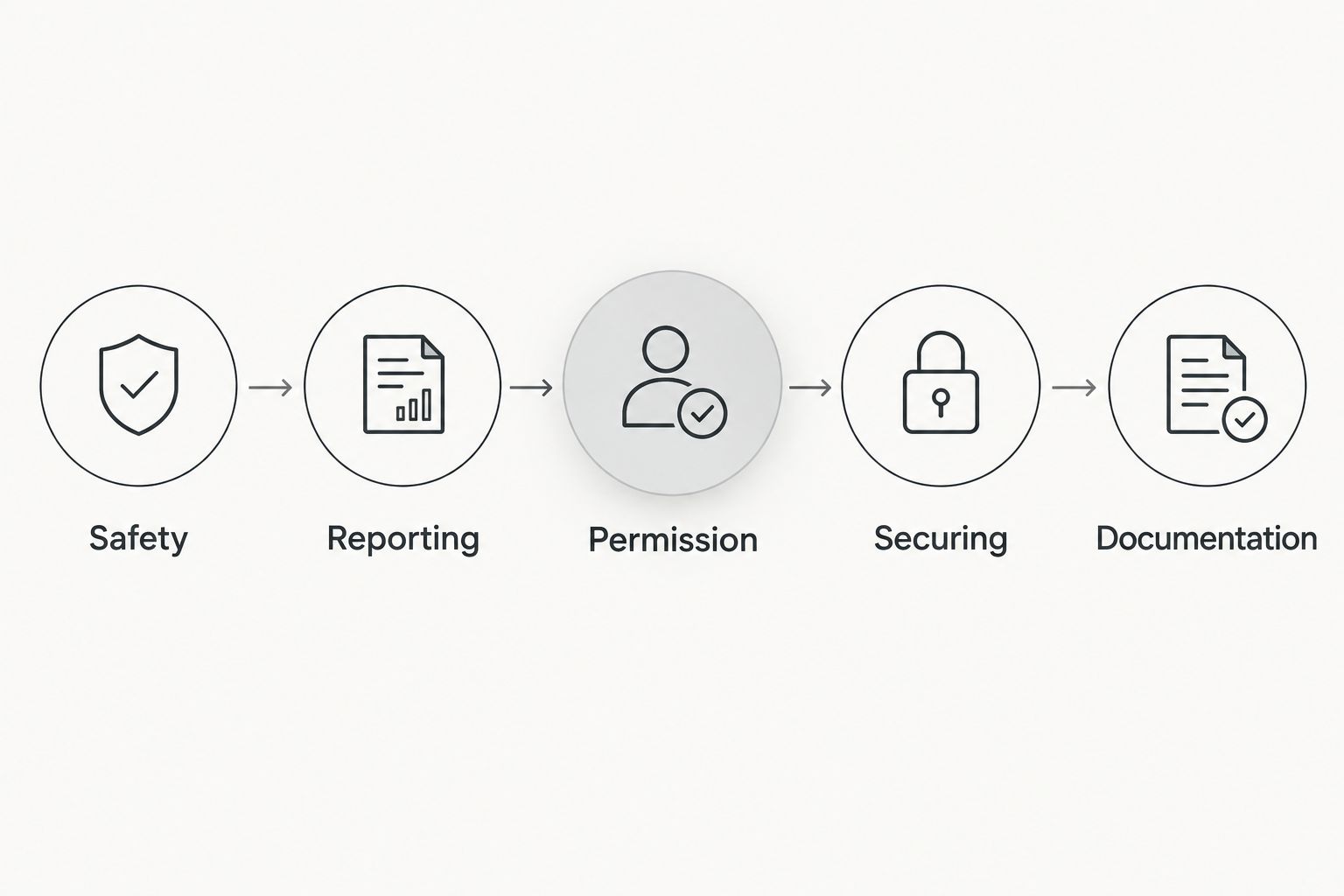
Which coordination approach fits your incident?
Choose a workflow based on access restrictions, not pressure to finish paperwork.
| Workflow option | Best for | Advantage | Limitation |
|---|---|---|---|
| Dispatch coordination while police respond | An exposed property with police attendance pending | Starts access and authorization planning early | Workers must wait outside restricted areas |
| Dispatch coordination after police permit access | A scene with unresolved evidence restrictions | Makes the permitted work area clear before arrival planning | Leaves dispatch arrangements until permission is established |
Use early coordination when you can clearly communicate restrictions. Bestboardup provides emergency board-up and glass cleanup; those services do not replace police attendance, structural assessment, or permanent repairs. Do not treat a securing contractor as the authority on whether evidence collection is finished.
Securing work and documentation
Once police permit the relevant access, confirm that the authorized property contact has approved the work. Scene permission and owner authorization answer different questions; you need both where applicable.
- Document the starting condition. Photograph the affected openings only from permitted, safe positions. Capture the surrounding area and visible damage without touching suspected evidence or entering an unsafe space.
- Reconfirm restrictions with the crew. Point out areas police told you to leave untouched. If instructions conflict or remain unclear, stop the affected work and ask the responsible officer or agency for clarification.
- Review the securing scope. Confirm which windows and doors require protection and which glass areas require cleanup. Tell the crew about entrances occupants still need; do not authorize blocking required exits.
- Record the completed condition. Obtain photographs showing the protected openings and the work performed. Note any openings, locks, frames, or access issues still requiring attention.
- Collect the work record. Keep the scope, authorization, invoice, and any completion documentation. Ask the contractor to describe the actual work rather than using a vague description such as property repairs.
- Update the insurer. Follow the insurer's claim-reporting instructions and provide the records it requests. Ask how to document emergency mitigation, retained materials, and later repairs; do not assume reimbursement.
Expected result: The approved openings are documented before and after securing, and unresolved repair needs remain visible in the record. A completed board-up does not certify structural safety, eliminate every security risk, or authorize reoccupation.
Use the board-up services for insurance claims in Los Angeles guide to plan the documentation handoff. Keep coverage decisions with the insurer and policy terms, not the emergency contractor.
Arrange emergency property securing
Bestboardup provides 24/7 emergency window and door board-up and glass cleanup across the Los Angeles area.
When the police report or claim is updated
A report update is an administrative handoff, not an instruction to remove boards. Keep protection and documentation on separate tracks until permanent repairs are arranged.
- Add the official reference. When the police report becomes accessible, record the correct report identifier and preserve the earlier incident reference. Do not overwrite the original chronology.
- Update the claim record. Send the report information through the insurer's instructed channel. Retain submission confirmations and record what additional documents the insurer requests.
- Correct factual errors carefully. If the address, incident details, or property description is wrong, ask the issuing agency or organization how to request a correction. Do not alter an official document yourself.
- Coordinate permanent repairs. Give the repair provider the documented damage and current securing condition. Establish who will remove temporary protection and how the opening will remain protected during the handoff.
Expected result: Your report, claim, emergency-work record, and repair plan remain connected without confusing their purposes.
For a 2026 incident file, keep the discovery time, reporting time, permission instructions, and work completion as separate entries. A later document date should not replace the date you discovered the damage.
Troubleshooting
Police have not permitted cleanup
Keep cleanup and boarding away from restricted areas. Tell dispatch exactly what remains prohibited, and ask police whether any separate opening can be secured without interfering with evidence. Do not move broken glass to make the area easier for workers.
The report is not ready, but an opening is exposed
Separate report delivery from access permission. Ask police about the permitted work area and document their instructions. Arrange securing when access and authorization are established; do not describe a pending report as completed.
The tenant, manager, and owner give conflicting instructions
Identify one authorized approval contact before work begins. Keep occupants safe while the responsible parties resolve authorization. Record the approved scope so the crew is not relying on several contradictory messages.
Someone cleaned up before police arrived
Disclose what changed instead of trying to recreate the scene. Preserve original photographs, footage, receipts, and an accurate account of what was moved or discarded. Tell police and the insurer the facts without guessing what the original condition proved.
A boarded door affects normal access
Do not treat every closed opening as an acceptable finished condition. Tell the contractor which routes occupants use and identify required exits. Keep people out of unsafe areas until the responsible professionals resolve access and repair needs.
Customize your workflow
For a home, designate one household contact to coordinate police, the owner or landlord, the insurer, and the crew. For a commercial property, identify the manager authorized to approve work and the person controlling staff access.
Build your 2026 response plan around two record sets: an incident chronology and a work file. The chronology holds facts and instructions; the work file holds photographs, authorizations, scopes, and completion records.
Limit sharing to the people who need each record. A contractor needs the damaged-opening details and access instructions, not an unrestricted copy of every sensitive document.
FAQ
What should I do first after discovering a break-in?
Get to a safe location and contact police through the appropriate emergency or non-emergency channel. Do not enter if someone might still be inside, and keep people away from broken glass and unstable openings.
Do I need the completed police report before arranging board-up?
A completed report is not the same as permission to access the scene. You can coordinate dispatch while the report is pending, but physical work must respect police restrictions and property authorization.
Can the board-up crew clean broken glass before police arrive?
Do not authorize cleanup in an area police need preserved. Ask the responsible police agency what can be touched, and pass those instructions to the crew before work begins.
What details should I give a board-up provider?
Give the property address, damaged-opening description, authorized contact, callback details, and access restrictions. Describe conditions from a safe position rather than entering to obtain measurements.
Does Bestboardup handle emergency glass cleanup in Los Angeles?
Bestboardup provides 24/7 emergency window and door board-up, glass cleanup, and property securing across the Los Angeles area. These services cover residential and commercial customers; permanent repairs and insurance coverage remain separate matters.
Will insurance reimburse emergency board-up after a break-in?
Reimbursement depends on your policy and the insurer’s claim decision. Keep photographs, authorization, the work scope, and invoices, and ask the insurer how to document emergency mitigation.
What should my 2026 break-in response checklist include?
Include safety instructions, police contact routing, an authorized property contact, access restrictions, dispatch details, and documentation responsibilities. Keep temporary securing separate from the permanent-repair handoff.
One last thing
The most useful handoff note is not simply that police attended. Record which area police permitted you to access, what must remain untouched, and who received that instruction. That distinction helps the next person act without treating the whole property as released.
