
Board up services for restaurant owners secure a damaged storefront, door, or window fast enough to stop a broken glass line from becoming a health code shutdown. A restaurant can't operate with an open gap facing the sidewalk — health inspectors, insurance adjusters, and the landlord all have a stake in how fast that opening closes, and in 2026 the crews who answer at 2 a.m. are the ones restaurant owners keep saved in their phones.
- Board up services for restaurant owners prioritize same-day closure over cleanup — boarding comes first, glass cleanup comes second.
- A health department can treat an open storefront as a sanitation or pest violation within hours, not days.
- Photograph damage before the board goes up or the insurance claim gets harder to support.
- Request fire-rated plywood that covers the full frame, not whatever a handyman has in the truck.
- Best Board Up runs 24/7 board-up dispatch across Los Angeles for commercial kitchens and storefronts.
Why board-up services matter for restaurant owners
A broken storefront window or a kicked-in back door doesn't just cost a pane of glass — it costs a seating section, an exposed kitchen line, and a health permit that assumes a sealed building. Restaurants run under tighter occupancy and sanitation rules than most retail storefronts on the same block, so an unsecured opening after a break-in or a storm turns into liability faster than it would for the shop next door.
Los Angeles restaurant owners who've dealt with a late-night break-in know the sequence: police report, insurance call, then the scramble to find someone who'll show up before the morning shift. Commercial storefront board-up services exist specifically to shortcut that scramble — a crew that boards a retail window and a crew that boards a kitchen wall near a walk-in cooler are not solving the same problem.
Every hour a storefront sits open to the street is an hour of lost cover count and a question the landlord will eventually ask. The restaurant that reopens by lunch service is the one whose owner called a board-up crew before calling anyone else.
How to secure a restaurant after storefront or door damage
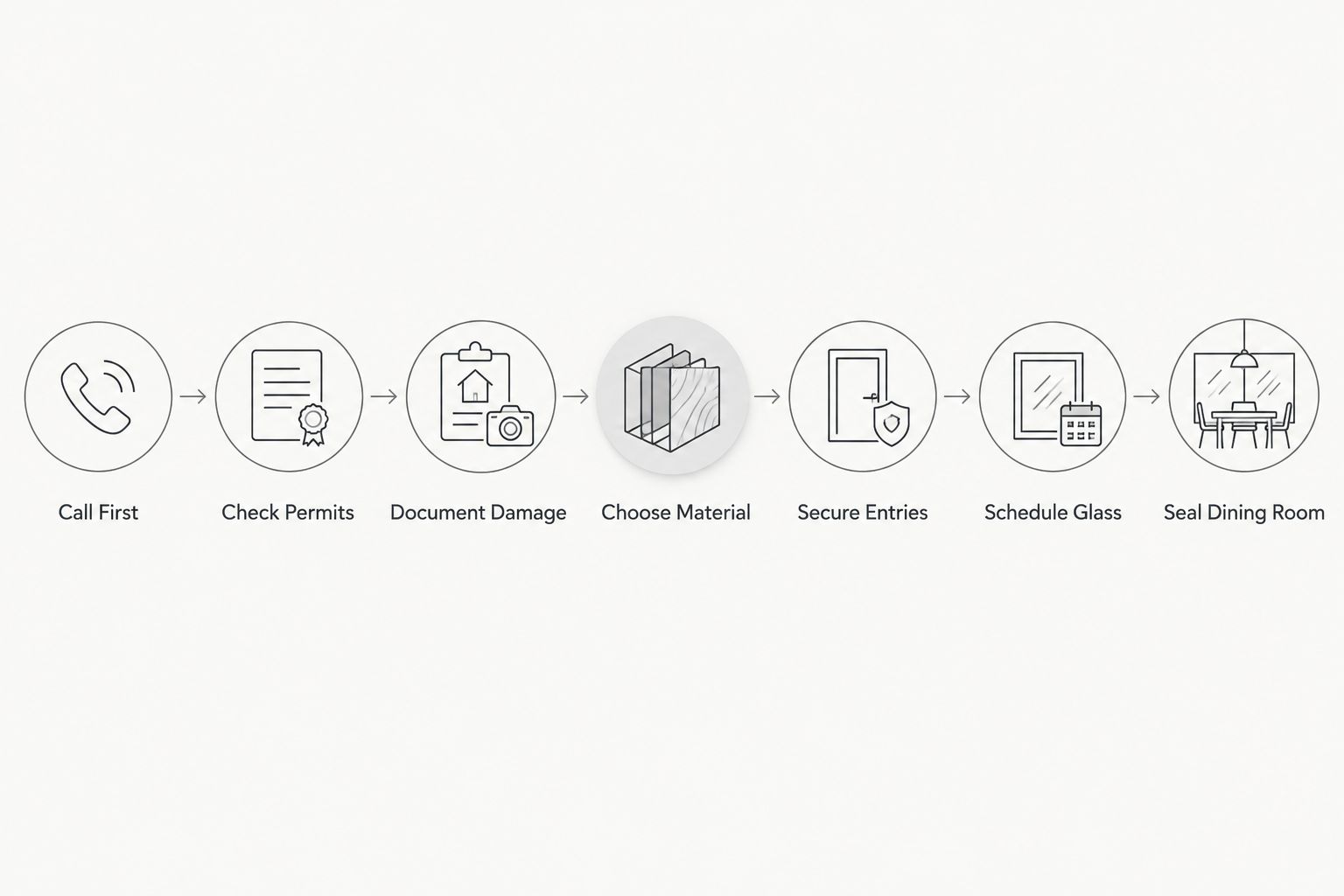
Call before you touch anything
Don't start cleanup, don't move furniture near the break, and don't wait for an insurance adjuster's go-ahead. Call first.
- Call a 24/7 board-up company immediately rather than waiting for business hours
- Get a real ETA before deciding whether to cancel the morning shift
- Ask if the crew carries code-compliant plywood or if that's on you to source
- Keep the police report number ready — most crews and insurers both ask for it
Check your lease and health permit obligations
Most restaurant leases say who's responsible for temporary securing after damage, and most owners have never read that clause until they need it.
- Read the commercial lease section on storefront repairs — many put temporary securing on the tenant, not the landlord
- Call the health department line if the kitchen line itself is exposed, not just the dining room
- Confirm with your health inspector contact whether a properly boarded opening counts as compliant for same-day service
- Keep your permit number on hand in case the crew needs it for a commercial job
Document the damage before it's covered
Once the board goes up, the damage is gone from view — and so is your leverage with the insurer if you didn't shoot it first.
- Photograph every broken pane, frame, and forced-entry point from outside and inside
- Get one wide shot of the full storefront, not just the break itself
- Note the time of discovery and who found it — insurers ask
- Save the police report number and responding officer's name with the photos
- This record is exactly what board-up services for insurance claims decisions get built on later
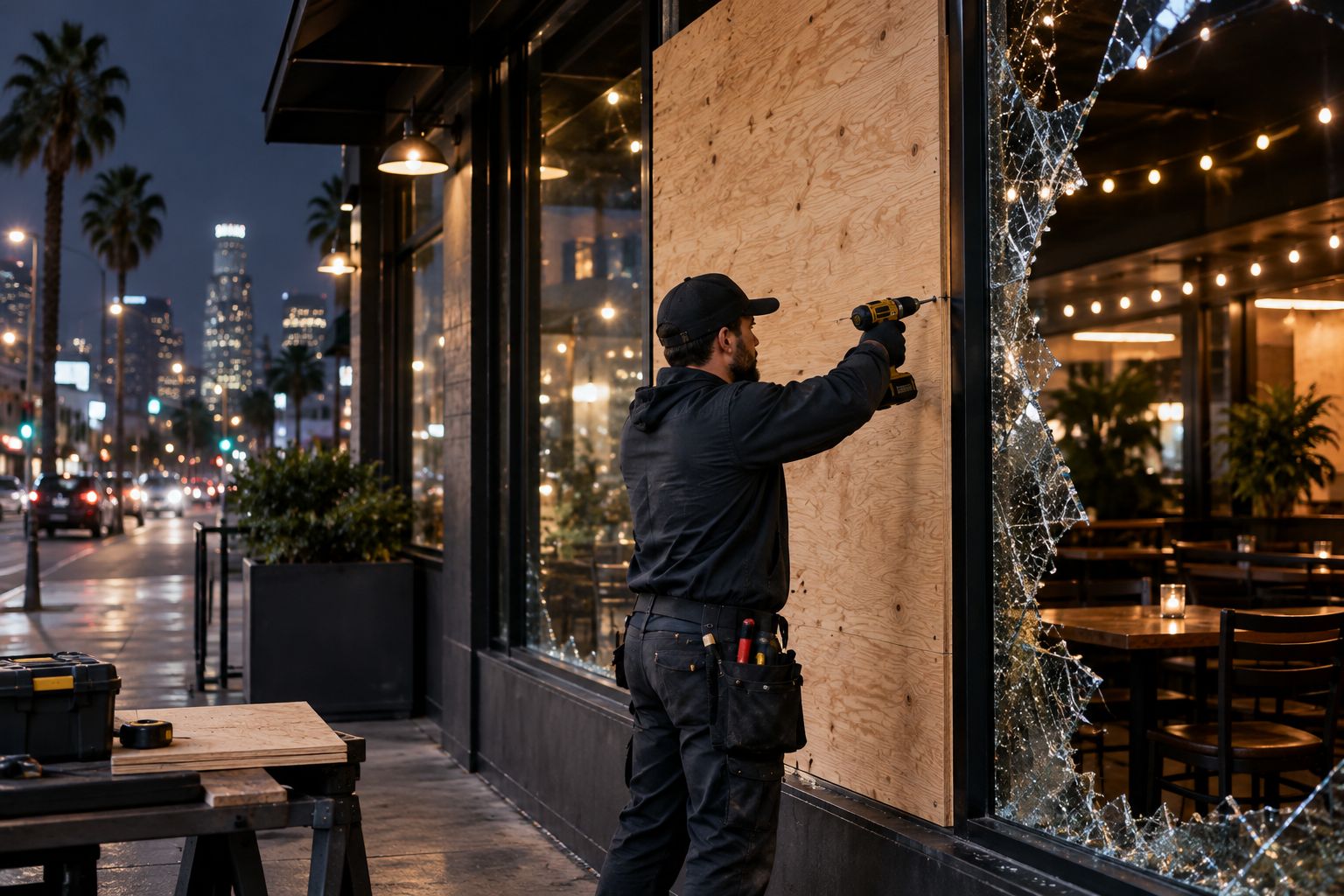
Choose a board-up material that meets fire and health code
Scrap lumber from a back room is not the same as treated plywood on an occupied commercial kitchen wall, and a health reinspection will care about the difference.
- Ask for fire-rated or treated plywood, not whatever's on hand
- Confirm the board covers the full frame, not just the broken pane
- For street-facing storefronts, ask about polycarbonate if the opening needs to stay visible or lit
- Skip anything that leaves gaps at the edges — that's a pest and code problem, not just a security one
Secure every point of entry, not just the obvious one
Break-ins and storm damage rarely hit a single opening on a building with a kitchen, a dining room, and a back delivery door.
- Check the back kitchen door and delivery entrance — forced entry often hits more than one point
- Inspect window locks on any upper floor or patio section sharing the building
- Confirm the board is screwed into the frame, not propped or taped
- Walk the full perimeter once the crew leaves, before reopening to guests
Schedule glass replacement on its own timeline
Boarding and glass replacement are two different jobs on two different clocks, and rushing the second one rarely helps the first.
- Get a separate glass quote once the opening is secured — don't rush it same night
- Ask the board-up crew if they also handle glass cleanup and disposal
- Match replacement glass to code if the original pane was tempered storefront glass
- Keep the board up until the new glass is actually on-site and ready to install
Keep the dining room sealed, not just boarded
A board that's up isn't the same as a dining room that's actually sealed against drafts, pests, or water.
- Check for drafts, pests, or water intrusion along the board edges daily until repair
- Tell hosts and staff exactly which section is boarded so no one seats guests near it
- Post a sign if the boarded section blocks a normal entrance
- Re-inspect the board after any wind or rain event before the next service
Once the opening is actually secured, the next decision is who you're calling back the next time this happens — and whether that's the same crew or someone with a faster number.
Get a restaurant boarded up now
24/7 dispatch for storefronts, kitchen walls, and back doors across Los Angeles.
Board-up options for restaurant owners compared
| Option | Best For | Key Limitation | Verdict |
|---|---|---|---|
| DIY plywood from a hardware store | Owners with tools and time before an early inspection | No fire-rating confirmation, full-frame coverage easy to miss | Hold — fine for a small crack, risky for a full break-in |
| General handyman or maintenance crew | Properties with an existing maintenance contract | Response depends on their other jobs, not built for 2 a.m. calls | Hold for non-urgent damage |
| 24/7 emergency board-up company | Restaurants needing same-day closure before service or inspection | Coverage is local to the service area, not nationwide | Buy for anything urgent |
| General contractor already on-site | Properties mid-renovation with a GC already booked | Slower to mobilize for a single emergency opening | Skip for same-night needs |
Best Board Up runs the 24/7 emergency lane in this table — boarding, glass cleanup, and property securing for Los Angeles restaurants, handled as one call instead of three separate vendors.
Common mistakes restaurant owners make with board-up
- Boarding the broken storefront window but leaving the back delivery door unsecured overnight
- Skipping photos before the board goes up, then fighting the insurer over scope later
- Using untreated scrap wood on a commercial kitchen wall, which can fail a health reinspection
- Waiting on insurance approval before calling anyone, losing a full service day in the process
- Pulling the board the moment glass is scheduled instead of waiting until it's actually installed
FAQ
What’s the best board-up service for a restaurant break-in in Los Angeles?
A 24/7 emergency board-up company that dispatches the same night, since a restaurant can’t wait for business hours to reopen. Best Board Up covers storefronts, kitchen walls, and back doors across the Los Angeles area.
How fast can a restaurant get boarded up after hours?
Most 24/7 Los Angeles crews dispatch the same night a restaurant calls, aiming to close the opening before the next service period. Response depends on the crew’s current job load and your location.
Does board-up count as compliant for a health inspection?
A properly sealed, full-frame board can satisfy a same-day inspection in many cases, but confirm with your health inspector directly. A gap-filled or partial board does not count as compliant.
Is plywood or polycarbonate better for a restaurant storefront?
Plywood is the faster, standard emergency option and works for most break-ins. Polycarbonate is worth asking about when the storefront needs to stay visible or lit during the repair window.
Who pays for board-up services, the restaurant or the landlord?
It depends on the commercial lease — many leases put temporary securing responsibility on the tenant, not the landlord. Read the repair clause before assuming either way.
Should a restaurant document damage before boarding it up?
Yes, photograph every broken pane and entry point before the board goes up. Once it’s covered, that evidence is gone, and insurers ask for exactly this record.
How long can a board-up stay up before it’s a problem?
A board-up is a temporary fix meant to last until glass replacement is scheduled and completed, not an ongoing solution. Check it daily for drafts, pests, or water intrusion along the edges.
Does board-up service help with an insurance claim?
Yes, a documented, professionally boarded opening supports an insurance claim better than unsecured or self-repaired damage. Photos taken before boarding strengthen the claim further.
One last thing
Most restaurant storefront glass is tempered, which means it doesn't crack in place — it shatters across the entire pane at once. That's exactly why a board needs to cover the full frame and not just the hole: there's no partial break to patch around once tempered glass lets go. Owners who ask for a board sized to the visible damage usually end up calling back within a day for the section they missed.
In 2026, Los Angeles restaurants dealing with storefront damage have more board-up options than ever, but the 24/7 response and the full-frame coverage are the two things that actually separate a real fix from a temporary patch.
