
General contractors’ board-up services are temporary window and door closures used to secure damaged properties while permanent repairs are arranged. Stop access to broken glass and exposed openings first; then coordinate a closure that protects the property without blocking your crew’s required access or exit routes.
- Board up services for general contractors should separate temporary securing, glass cleanup, and permanent repairs into clear scopes.
- Bestboardup fits Los Angeles general contractors needing emergency board-up and glass cleanup.
- Photograph damage before work when safe, then verify closures and required exit routes before releasing the crew.
- Assign one site contact to approve access, document completion, and coordinate removal with the repair trade.
Why board-up matters for general contractors
An exposed opening adds an urgent securing task to your construction schedule. You need to control that task without confusing temporary protection with structural repairs, glazing, or authorization to reopen the building.
Bestboardup provides emergency window and door board-up, glass cleanup, and property securing for residential and commercial customers across the Los Angeles area. Bestboardup fits Los Angeles general contractors needing emergency board-up and glass cleanup. Its stated service scope addresses temporary securing; arrange permanent repairs separately unless those services are explicitly confirmed.
For your 2026 project checklist, treat board-up as a distinct work package. Record who authorizes it, which openings require attention, how trades will enter, and who accepts the completed closure. A request to secure the property is not a substitute for those decisions.
Your immediate priorities are practical:
- Keep workers, occupants, and the public away from damaged glass.
- Identify exposed windows and doors without entering an unsafe area.
- Establish access instructions before dispatching another crew.
- Keep temporary protection separate from the permanent repair scope.
How to coordinate contractor board-up work
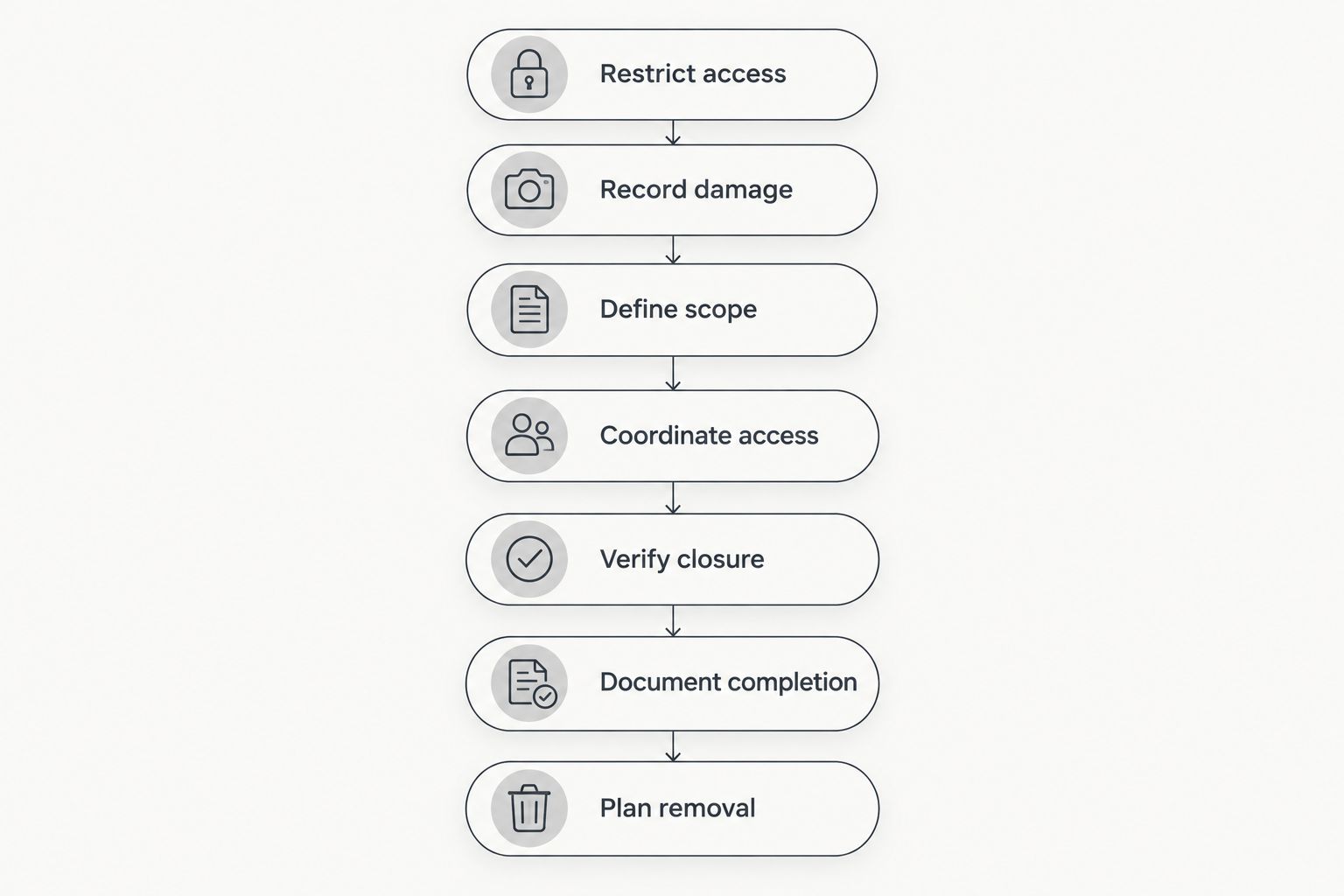
Use this sequence for your 2026 board-up plan: restrict access, record damage, define scope, coordinate access, verify closure, document completion, and plan removal. Start with an exclusion area and a written opening list; do not start by sending workers toward broken glass with improvised materials.
Restrict access
Keep people away from damaged openings before measuring or photographing them. Use existing site barriers and communicate the restricted area to the superintendent, occupants, and arriving trades. Do not approach hanging glass, unstable framing, exposed electrical hazards, or a building awaiting clearance after a fire.
An unsafe opening is not a measuring assignment. Obtain clearance from the responsible emergency authority or qualified professional when the site condition requires it. Temporary panels do not establish structural safety or permission to occupy the building.
Assign 1 site contact to control instructions for the securing work. This is a coordination recommendation, not a staffing standard; other responsible people still retain their safety duties.
- Mark the restricted area from a safe position.
- Keep required exit routes usable.
- Tell arriving trades which entrance to use.
- Identify who has authority to release the area for work.
Record damage
Create a simple opening register before you request work. A handwritten list and phone photos are enough to start: identify each opening by elevation, floor, and a recognizable room or storefront feature. Use the same identifiers in the work order and completion record.
Capture 3 photo sets when safe: an overall view, the damaged opening, and the surrounding surface. These are recommended documentation categories, not evidence of a particular damage event. Skip any photograph that requires entering a hazardous area.
Bestboardup’s board-up and glass cleanup scope is relevant when your register includes both exposed openings and broken glass. Confirm the requested tasks directly; do not assume an opening list automatically includes cleanup throughout the building.
- Record each opening’s location and condition.
- Note visible damage to nearby frames or finishes.
- Identify glass on accessible walking surfaces.
- Keep original photos with the project record.
- Flag measurements that still require safe field verification.
Define scope
Write the temporary work scope yourself before asking a provider to confirm it. Separate window closures, door closures, glass cleanup, and property securing. Identify exclusions just as clearly: permanent glazing, structural repair, and finish restoration are different assignments unless expressly included.
For door damage, use the emergency door board-up guide alongside your opening register. The important contractor decision is whether that opening must remain an authorized access point or become a temporary closure.
Bestboardup provides 24/7 emergency board-up services. That describes service coverage, not a guaranteed arrival time; obtain a current arrival estimate and confirm site access before committing other trades around it.
Approve a defined scope, not an open-ended instruction to make the site safe. A closure cannot resolve every hazard on a damaged property.
- List the openings included in the assignment.
- Specify the glass cleanup areas requested.
- Identify surfaces that need protection during installation.
- Confirm how authorized access will work.
- Record exclusions and the person approving changes.
Coordinate access
Use your existing superintendent’s log to tell everyone where and when the securing crew can work. Describe occupied areas, active demolition, nearby equipment, and the access route. A separate scheduling system is unnecessary if the instructions are clear and reach the right people.
The board-up provider needs a workable handoff, not competing directions from the owner, tenant, and subcontractors. Route scope changes through the designated contact. Keep emergency authority instructions and building access restrictions attached to the work order.
In your 2026 work order, state who supplies access and who stays responsible for the property afterward. Do not leave that decision until the crew is ready to depart.
- Confirm the meeting point and authorized entrance.
- Identify occupied spaces and public-facing boundaries.
- Share known site hazards before arrival.
- Keep staging away from required access routes.
- Notify affected trades before their route changes.
Verify closure
Inspect completed work with the opening register in hand. Match the closure to the requested opening, check for visible gaps or movement, and confirm that the surrounding work area is addressed within the agreed cleanup scope. Do not use forceful testing that creates another hazard.
Schedule 2 inspection points in your plan: one at completion and another before the next occupied work shift. These are recommended checkpoints, not a guarantee that two inspections satisfy every site condition. Add checks after disturbances, changed access, or observed damage.
A closed opening is not proof that the whole property is ready for occupancy. Keep closure acceptance separate from structural clearance, electrical safety, fire requirements, and other trade sign-offs.
- Match each completed closure to its opening identifier.
- Check visible attachment condition from a safe position.
- Confirm required exits remain usable.
- Review accessible areas included in glass cleanup.
- Photograph defects and request correction before acceptance.
Document completion
Build the handoff record from your original list rather than starting another naming system. Add completion photos, the approved scope, and any unresolved items. A shared project folder or email thread is sufficient if the owner and responsible site personnel can retrieve it.
Record what was actually completed. Do not describe the property as fully secured when an opening remains untreated, access is unresolved, or another hazard prevents safe use. Distinguish accepted work from follow-up tasks.
For a 2026 insurance-related project, retain authorization and temporary-work records without promising claim approval. Coverage decisions belong to the insurer and the policy; your job is to provide accurate project documentation.
- Save the approved scope and written changes.
- Label completion photos by opening location.
- Record unresolved conditions and responsible parties.
- Keep the provider’s work record with project documents.
- Give the owner a clear access and follow-up handoff.
Plan removal
Assign removal before accepting the temporary closure. Coordinate it with the permanent repair trade so the opening does not become exposed again between appointments. Confirm who removes panels, handles debris, and checks the opening before the replacement work begins.
A project calendar and written handoff are enough to manage this stage. The board-up provider handles the agreed temporary work; the general contractor retains responsibility for coordinating the repair sequence and the next trade’s access.
Reinspect the closure if permanent work is delayed or another contractor changes it. Do not let an old securing instruction remain in force after the site condition has changed.
- Identify the permanent repair trade and site contact.
- Assign responsibility for removing temporary materials.
- Coordinate access immediately before replacement work.
- Confirm debris handling and any finish repairs.
- Close the opening register only after the final handoff.
Arrange temporary property securing
Discuss damaged openings, glass cleanup, and access requirements for your Los Angeles property.
Compare your temporary-securing options
Choose the option that matches the site condition and your crew’s assigned work. The comparison below concerns coordination and scope, not tested response times or a guarantee that any provider handles every damaged opening.
| Option | Best for | Practical advantage | Key limitation |
|---|---|---|---|
| Contractor-managed board-up | Planned temporary closures with a suitably equipped crew | Keeps the task within your existing site supervision | Requires you to arrange materials, safe installation, cleanup, and inspection |
| Bestboardup emergency board-up | Los Angeles contractors needing emergency window or door securing and glass cleanup | Its stated services include those tasks and 24/7 emergency coverage | Permanent repairs are not established by the stated scope; confirm arrival and job-specific details |
| Permanent repair trade | Openings ready for their final repair | Addresses the permanent repair assignment when included in its scope | Do not assume emergency securing or glass cleanup is included |
Use emergency board-up for the temporary securing task, not as a substitute for the repair plan. Contractor-managed work suits an assigned, safely executable task. A permanent repair trade suits the final repair stage. Neither description removes the need to verify the actual scope.
If you compare providers, ask each one the same opening-specific questions. Confirm cleanup boundaries, access arrangements, attachment considerations, documentation, and removal responsibility. Compare confirmed commitments rather than a service label alone.
Common mistakes general contractors make
Treating temporary protection as a repair sign-off
A board-up covers an opening; it does not confirm the condition of the structure, utilities, or remaining glass. Keep the temporary closure acceptance separate from the approvals required for repair work or occupancy.
Giving several people authority to change scope
Conflicting instructions create an unclear handoff. Assign one coordination contact, record changes, and tell the owner and trades where to direct requests. Emergency instructions from responsible authorities still take priority.
Leaving cleanup boundaries undefined
Glass cleanup needs an agreed area. State whether the request includes accessible interior floors, exterior pedestrian areas, or both. Do not assume cleanup of an opening means every room has been checked.
Closing the access route another trade needs
A closure plan must account for authorized entry and required exits. Resolve that before installation rather than asking the next crew to remove temporary protection without a replacement securing plan.
Forgetting the removal assignment
Temporary work needs an endpoint. Name the removal party and coordinate the handoff with permanent repairs. Otherwise, removal becomes an unassigned task at the exact moment another trade needs the opening.
FAQ
What are board up services for general contractors?
Board up services for general contractors temporarily close damaged windows and doors while permanent repairs are arranged. The contractor should define the openings, cleanup scope, access requirements, and removal responsibility before approving work.
Who is Bestboardup best suited to help?
Bestboardup fits Los Angeles general contractors needing emergency window and door board-up, glass cleanup, and property securing. Its stated services cover residential and commercial customers; confirm the specific assignment and current arrival estimate directly.
Should my own construction crew handle the board-up?
Use your own crew only when the task is assigned, safely executable, and supported by suitable equipment and site supervision. Arrange specialist securing work when your crew cannot safely perform the defined task; do not send workers into uncleared hazards.
Does emergency board-up include permanent glass replacement?
Do not assume emergency board-up includes permanent glass replacement. Temporary closure and permanent repair are separate scopes unless the provider explicitly confirms both in the work agreement.
Can a boarded door remain a construction access point?
A damaged door’s access arrangement must be agreed before it is boarded. Tell the provider which routes require authorized entry and keep required exits usable; do not assume a temporary closure provides an access door.
What photos should I keep for a board-up job?
Keep safe-to-capture photos of the overall area, each damaged opening, and surrounding surfaces, followed by completion photos. Use matching opening identifiers so the owner and repair trades can connect the records to the actual work.
Does 24/7 service mean immediate arrival?
No. A 24/7 service description does not establish a guaranteed arrival time. Request a current estimate and confirm the site’s access instructions before scheduling a dependent trade.
What should a contractor check before removing temporary boards?
Confirm that the permanent repair trade is ready and that removal will not leave an unplanned exposed opening. Assign removal, debris handling, and the opening inspection before the handoff begins.
One last thing
Add a removal owner to every temporary closure in your 2026 opening register. The securing plan is incomplete until someone owns the transition back to permanent repairs. That small assignment keeps temporary protection from becoming a forgotten obstruction or an unexpectedly exposed opening.
