
Auto dealership board-up service is emergency glass and door securing for car lots and showrooms, built to protect vehicle inventory, cash drawers, and plate-glass storefronts the moment a break-in, storm, or vehicle-through-window accident happens. A dealership's needs differ from a retail shop or a house: the glass spans are larger, the lot stays open to the street overnight, and every hour a showroom sits exposed is an hour of exposure for six-figure inventory sitting a few feet from the sidewalk.
- Best Board Up secures dealership showroom glass and service bay doors within the same response window used for commercial storefronts across Los Angeles.
- Board up services for auto dealerships must cover both plate-glass showrooms and rear service-bay doors, not just the front window.
- 3/4-inch CDX plywood on 4×8 sheets is the standard board-up material for large dealership glass spans in 2026.
- DIY boarding works for a single cracked pane; a 24/7 board-up crew is the right call for full storefront breaks or multi-door break-ins.
- Photograph damage before boarding starts — insurance adjusters reject claims when the opening is covered before documentation exists.
Why board-up services matter for auto dealerships
A dealership lot is a different risk profile than a boutique or a restaurant. The showroom glass is often floor-to-ceiling and spans 10 feet or more, the vehicles behind it carry real resale value, and the lot itself stays lit and accessible to the street 24 hours a day even when the building is locked. A single broken panel on a showroom wall isn't a cosmetic problem — it's an open door to the inventory until something covers it.
Break-ins and vandalism against dealerships tend to hit after close, which means the clock starts on an empty building with no staff on-site to flag the damage until morning. That gap is exactly where commercial storefront board-up services earn their keep: a crew that boards the opening at 2 a.m. prevents a second entry attempt before sunrise, and prevents rain or marine-layer moisture from reaching showroom flooring and vehicle interiors overnight.
Secure the broken glass or door first
Nothing else on this list matters until the opening is covered. A dealership showroom with a shattered panel is a standing invitation, and every additional hour raises the odds of a second break-in or weather intrusion.
- Call a 24/7 board-up provider the moment damage is discovered, day or night
- Cover the full opening, not just the cracked section — a partial board still lets hands and tools through
- Use 3/4-inch CDX plywood for large storefront spans; thinner material flexes and fails under forced entry
- Secure service-bay roll-up doors separately from showroom glass — they're a different lock and frame system entirely
- Check for secondary entry points: side doors, parts-counter windows, and fencing gaps near the lot perimeter
Protect the vehicle inventory on the lot
Boarding the building secures the showroom, but dealership risk doesn't stop at the glass line. Vehicles parked near a broken storefront are exposed to the same opportunists who caused the damage.
- Move high-value inventory away from the damaged opening until the board is up
- Confirm perimeter lighting is working — a boarded but dark storefront still reads as vacant to passersby
- Log VINs and lot positions of vehicles near the breach for insurance and police reports
- Walk the fence line for cut sections or forced gates that might need a separate repair
Document everything before the board goes up
Insurance adjusters want proof of the original damage, not just the repair invoice. A board-up crew that covers the opening before anyone photographs it creates a documentation gap that can delay or shrink a claim payout.
- Photograph the break from outside and inside before any plywood goes on
- Capture wide shots showing the storefront in context, not just close-ups of the glass
- Note the time damage was discovered versus the time the board-up crew arrived
- Keep the board-up invoice itemized by material and labor hours for the claims file
- Cross-check documentation requirements against insurance claim board-up services before the adjuster visit
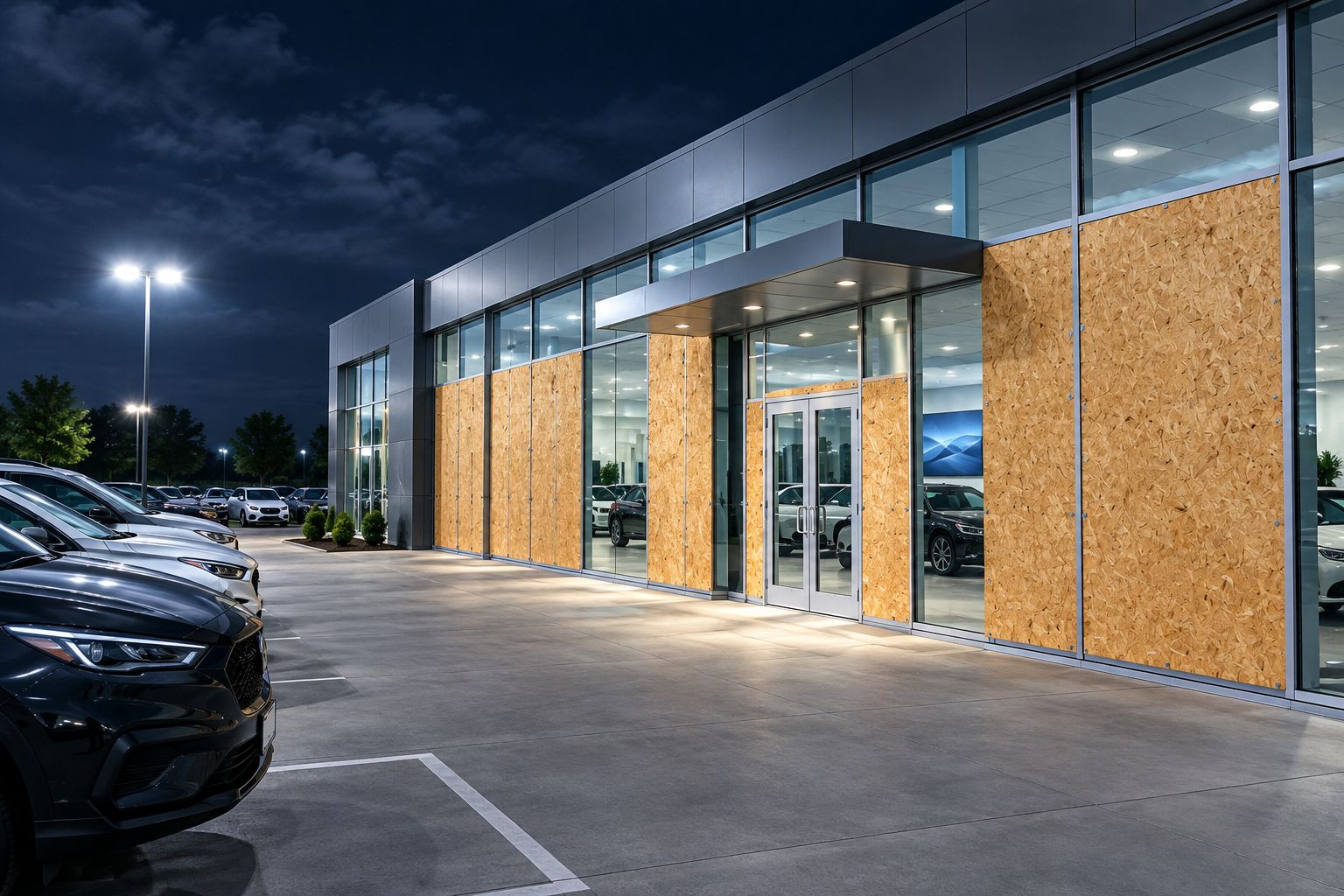
Match the board material to the glass type
Showroom glass and service-bay windows aren't built the same, and the board-up material should match the break. Tempered storefront glass shatters into pebbles across a wide area; laminated or wired glass in older bays can crack without fully separating.
- Use full plywood sheets for tempered glass breaks — the entire pane needs replacement, not a patch
- Check whether the opening calls for plywood or a clear polycarbonate panel when the dealership wants to keep the showroom visible to passing traffic
- Compare plywood vs. polycarbonate board-up options before committing to one for a long repair window
- Frame-mount the board rather than taping it — forced entry through taped plywood is common within days
Schedule the permanent glass replacement fast
Board-up is a holding measure, not a fix. A dealership showroom boarded for weeks loses foot traffic and looks closed for business, which hurts walk-in sales as much as the original break did.
- Get a glass replacement quote the same day the board goes up, not after the insurance claim clears
- Ask whether the board-up provider also handles same-day glass replacement to cut the gap between securing and repair
- Confirm the replacement glass matches code for storefront tempered panels before installation
- Keep the board up until the new glass is actually set, not just scheduled
Options compared for dealership board-up
| Option | Best for | Key limitation |
|---|---|---|
| DIY plywood patch | A single small crack during business hours | No overnight response, weak against repeat break-ins |
| General handyman | Minor cosmetic window damage | No 24/7 availability, limited large-span experience |
| 24/7 board-up specialist | Full storefront breaks, after-hours break-ins | Response time varies by provider and distance |
| National franchise board-up | Multi-location dealership groups | Dispatch routed through a call center, slower local response |
Verdict: for dealership-scale glass breaks after hours, a dedicated 24/7 board-up crew beats DIY or general handyman options on both response time and material capacity.
Get your dealership secured now
24/7 response for showroom and service-bay glass breaks.
Common mistakes dealerships make
- Boarding only the broken pane, not the full glass wall. Adjacent panels weakened by the same impact fail later the same night.
- Skipping photos before the crew arrives. Once the board goes up, the adjuster only has the repair invoice to work with.
- Treating service-bay doors as lower priority than the showroom. Bays hold tools, diagnostic equipment, and sometimes customer vehicles awaiting repair — just as exposed as the front glass.
- Delaying restoration coordination after storm damage. A dealership hit by wind-driven rain through a broken window often needs drying and cleanup on top of the board-up itself; providers like water damage restoration services handle that follow-up work once the opening is secured, and waiting to call them lets moisture spread into flooring and electrical panels.
- Choosing the cheapest quote without checking response time. A board-up company that answers in 90 minutes beats one that's $50 cheaper but takes four hours, especially on a lot full of unsold inventory.
A dealership that calls a 24-hour board-up company at the first sign of a break gets ahead of all five mistakes at once — speed is the variable that fixes the rest.
FAQ
How fast can a board-up crew reach a dealership in Los Angeles?
Response time depends on the provider and the dealership’s location, but 24/7 crews built for commercial storefronts typically prioritize dealership-scale glass breaks over residential calls because of the exposed inventory risk. Confirm expected arrival time when you call, not after the crew is already dispatched.
What’s the best material for boarding a dealership showroom window?
3/4-inch CDX plywood on 4×8 sheets is the standard for large tempered-glass storefront spans in 2026. Polycarbonate is an option when the dealership wants the boarded section to stay visible to street traffic.
Do I need to photograph damage before the board goes up?
Yes. Insurance adjusters need photos of the original break, not just the board-up invoice, so photograph the opening from both sides before any plywood is installed.
Should service-bay doors be boarded the same way as showroom glass?
No, they use different frame and lock systems, so board them as a separate job even if the break-in hit both areas the same night.
Is DIY board-up ever enough for a dealership?
Only for a single small crack during business hours with staff on-site. Full storefront breaks or after-hours break-ins call for a 24/7 specialist with commercial-grade material on hand.
How long should a board stay up before glass replacement?
As briefly as possible — get a replacement quote the same day the board goes up and keep the plywood in place only until the new glass is actually installed, not just scheduled.
Does board-up cost get covered by insurance?
Often yes, when documentation is complete before the opening is covered. Check an insurance-claims board-up provider’s process and keep an itemized invoice for the claims file.
What’s the biggest mistake dealerships make after a break-in?
Boarding only the cracked pane instead of the full glass wall, which leaves weakened adjacent panels exposed to a second break the same night.
One last thing
The detail dealerships miss most in 2026: service-bay roll-up doors get hit almost as often as showroom glass, but they're rarely mentioned in a dealership's incident plan until the first break happens. Build the bay doors into the same call you make for the showroom — one provider, one dispatch, one invoice, instead of discovering the gap at 3 a.m.
