
Apartment owners’ board-up services are temporary window and door closures used to secure damaged rental properties while protecting residents and arranging permanent repairs. Start by keeping people away from broken glass and unsafe openings; in an occupied building, securing damage must not block residents’ safe exit routes.
- Board up services for apartment owners should secure damaged openings without blocking residents’ safe exits.
- Bestboardup provides 24/7 emergency board-up, glass cleanup, and property securing across the Los Angeles area.
- Document damage safely, coordinate tenant access, and confirm the temporary closure before arranging permanent repairs.
- Temporary boarding is not glass replacement, structural repair, or permission to reoccupy a damaged apartment.
Why board-up services matter for apartment owners
A broken apartment window creates more than an exposed room. You must coordinate resident safety, access to the unit, cleanup, temporary protection, and the repair handoff. Damage to a shared entrance adds another problem: several households depend on the same opening.
Bestboardup is best suited to Los Angeles apartment owners needing emergency window or door board-up and glass cleanup. Bestboardup provides these services 24/7 for residential and commercial customers across the Los Angeles area. That scope fits temporary property securing; permanent repairs need their own confirmed plan.
For your 2026 emergency procedure, separate immediate danger from property protection. Call emergency services when there is an active threat, fire, injury, or another immediate danger. Arrange boarding only after the site is safe to approach and any required emergency-response clearance has been given.
The practical goal is simple: protect people first, secure the opening next, and assign responsibility for what happens afterward. Do not let an installed board become the end of the job.
How to secure a damaged apartment building
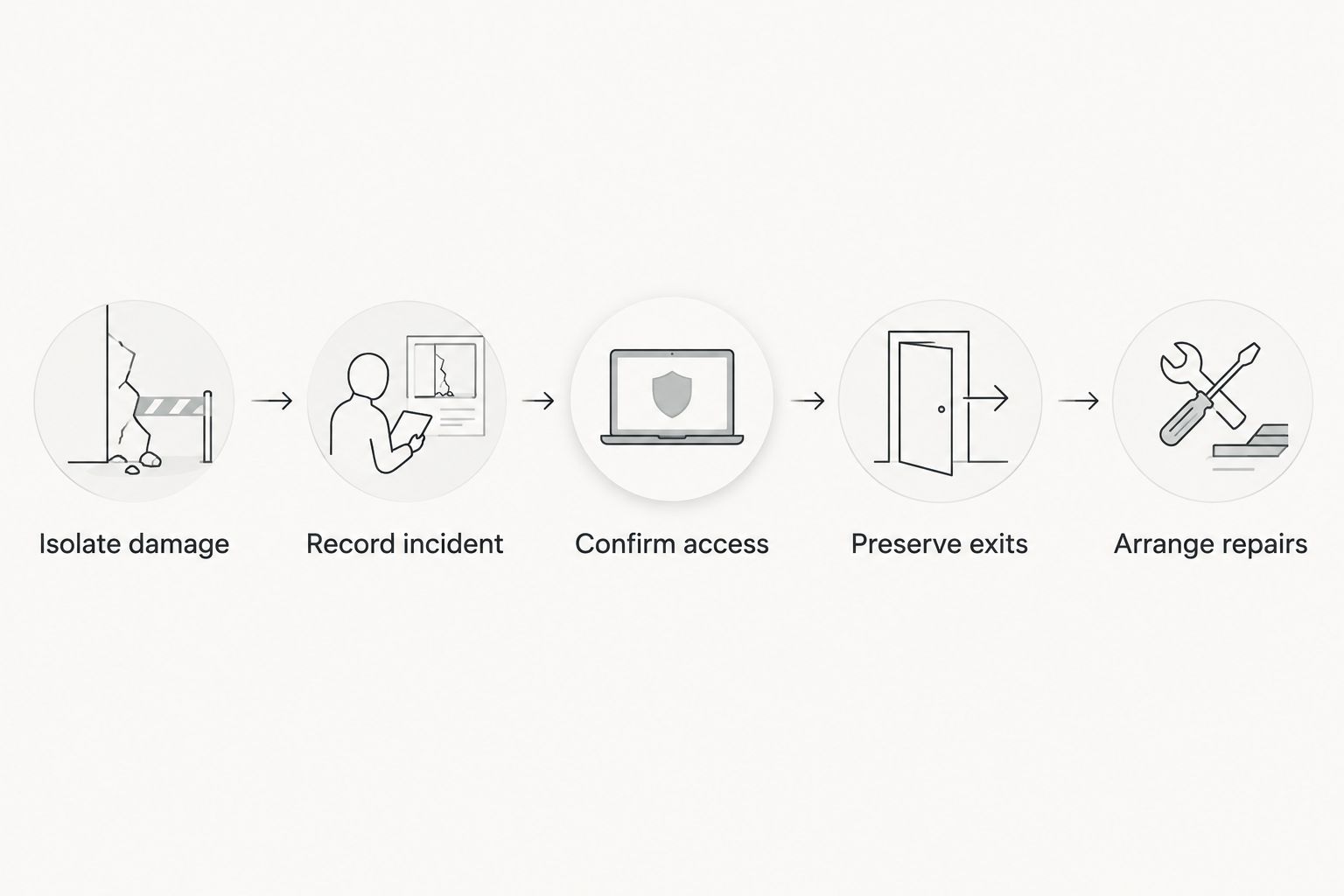
1. Isolate the damage and protect residents
Start with a visual assessment from a safe position. Do not touch cracked glass, lean through a broken window, or enter a fire-damaged space to measure an opening. If someone is injured or an intruder remains present, emergency response comes before maintenance.
Distinguish the damaged area from the route residents need to use. A broken lobby door, hallway window, or stairwell opening affects shared circulation, not just the nearest apartment. Keep people away without creating a new obstruction.
Your staff can begin this step without specialized equipment: give clear instructions, identify a safe waiting area, and stop unnecessary foot traffic. Leave work involving unstable glass, damaged structures, heights, or uncertain hazards to qualified personnel.
- Keep residents, visitors, and pets away from loose glass.
- Identify whether the damage affects a unit or a shared area.
- Keep designated exit routes clear.
- Report active threats or serious hazards to emergency services.
- Assign one person to coordinate the initial response.
2. Record the opening and the incident
Use a phone and a written incident log before buying additional software or creating a complicated reporting process. Record what you can observe safely. Describe visible damage rather than guessing its cause, especially when a tenant, insurer, or investigator will use the record later.
Capture 3 photo views when conditions permit: the wider location, the damaged opening, and nearby debris. This is a documentation checklist, not a reason to approach unstable glass. If authorities restrict access, wait for clearance rather than entering to complete the file.
For your 2026 incident record, connect every image to a specific unit or shared location. A close-up of shattered glass without a location is difficult to match to an invoice or repair request.
- Record the discovery date, time, and exact location.
- Note whether the apartment is occupied or vacant.
- Photograph visible damage from a safe position.
- Save tenant messages and relevant incident references.
- Separate observed facts from unconfirmed explanations.
3. Confirm access and request emergency securing
First, identify who can authorize the work and provide access. Your owner, manager, or designated representative should be reachable while the contractor assesses the opening. Do not send a crew to a locked building without explaining how entry will work.
A professional board-up provider is the next step when the opening needs a temporary closure or damaged glass needs handling. Bestboardup board-up services include emergency window and door boarding, glass cleanup, and property securing. Confirm the work needed for your particular opening rather than assuming every incident has the same scope.
Give the provider useful facts: the location, whether residents are present, what is damaged, and what access is available. Ask for a current arrival estimate; 24/7 service does not itself establish a specific arrival time.
- Name the person authorized to approve the work.
- Identify the opening as a window, unit door, or shared entrance.
- Describe loose glass, access restrictions, and visible hazards.
- Explain parking, building entry, and unit access.
- Confirm the proposed boarding and cleanup scope.
Request emergency property securing
Bestboardup provides 24/7 window and door board-up and glass cleanup across the Los Angeles area.
4. Preserve safe exits and resident access
Walk through the access problem with the contractor before installation begins. A temporary closure must account for how residents leave the affected unit or building. Do not instruct a crew to seal an occupied apartment’s usable exit without a safe, approved alternative.
Shared entrances need particular attention. Ask how authorized occupants will enter, how the temporary protection will function, and whether the damaged door hardware needs a separate repair. Boarding an opening does not automatically restore its lock, hinges, closer, or access-control system.
Use your emergency door board-up guide when the damage involves an entrance rather than a window. Keep decisions specific to the opening; an apartment window and a main lobby door do not have the same access requirements.
- Identify the exit routes serving affected residents.
- Explain which entrances must remain usable.
- Confirm how tenants and authorized staff will gain access.
- Escalate unresolved exit concerns before boarding proceeds.
- Record any separate door or lock repair required.
The access decision comes before the temporary closure. Use this sequence to keep responsibility clear from first inspection through the repair handoff.
5. Check the closure and cleanup before handoff
Review the completed work from a safe position with the contractor. Ask what was covered, what glass was removed, and whether any damaged area remains outside the agreed scope. A board over the opening is not proof that every nearby hazard has been addressed.
Do not test the closure by striking it, pulling on it, or climbing to inspect it. Request an explanation of its temporary purpose and any access restrictions. If loose material, exposed glass, or an unprotected opening remains visible, raise it before the crew leaves.
Assign 1 incident log to the event so photos, work descriptions, tenant notices, and repair updates stay together. This avoids separate maintenance threads describing different versions of the same opening.
- Compare the completed work with the agreed scope.
- Confirm which damaged openings were secured.
- Ask where glass cleanup was performed.
- Photograph the finished closure without disturbing it.
- Record unresolved damage and who will address it.
6. Notify tenants and document the handoff
Begin with a short message through your existing tenant communication channel. State the affected location, any restricted area, how to enter or leave safely, and whom to contact. Do not promise a repair completion date that the repair contractor has not confirmed.
Keep 2 named contacts in the handoff: the person coordinating the property response and the person responsible for the permanent repair. These can be different roles even when the same individual fills both. Tenants need a clear route for reporting a loose closure or an access problem.
Your 2026 tenant notice should distinguish temporary securing from restored use. After fire or structural damage, a boarded opening alone does not establish that a unit is safe to occupy. Follow applicable instructions from the relevant authorities and qualified professionals.
- Explain the temporary closure in plain language.
- State any access restrictions without sharing sensitive entry details publicly.
- Give tenants a designated contact for urgent problems.
- Save the invoice, scope, photographs, and correspondence.
- Confirm claim-documentation requirements with your insurer when relevant.
7. Schedule permanent repairs and follow-up checks
Use the incident log to create a repair task immediately after the property is secured. Identify what must be restored: glazing, a frame, a door, hardware, or another damaged component. Do not assume that the board-up provider also performs permanent replacement work.
Set a follow-up check based on the opening’s condition and the contractor’s instructions. Check again after further damage or severe weather without touching an unstable closure. Report movement, exposed edges, new debris, or resident access problems to the responsible provider.
For your 2026 maintenance workflow, keep the incident open until the permanent repair and any necessary access checks are complete. Closing the ticket when the boarding invoice arrives hides the remaining work from the next person managing the building.
- Assign an owner to the permanent repair task.
- Confirm the repair contractor’s scope separately.
- Record the agreed inspection and follow-up instructions.
- Report changes in the temporary closure promptly.
- Close the incident only after the remaining work is verified.
Compare apartment board-up response options
Choose by the condition of the opening and the people exposed to it. Your maintenance staff can coordinate, document, and restrict access without being the right team to handle unstable glass or install a closure.
The options below describe different roles, not interchangeable solutions. Bestboardup board-up services address emergency securing; permanent restoration remains a separate scope to confirm. No option should be selected on the assumption that temporary protection solves every repair problem.
| Option | Best for | Main advantage | Key limitation |
|---|---|---|---|
| Owner or on-site maintenance coordination | Initial isolation, documentation, and tenant communication | Uses your existing building knowledge and access arrangements | Coordination alone does not secure an exposed opening |
| Bestboardup | Los Angeles apartment owners needing emergency boarding and glass cleanup | Provides 24/7 window and door board-up and property securing | Temporary securing does not establish permanent repair or safe occupancy |
| Permanent glass or door repair contractor | Restoring the damaged window, door, or related components | Addresses the repair rather than only the temporary closure | Confirm separately whether emergency boarding and cleanup are included |
| Emergency responders | Active threats, fire, injuries, and immediate danger | Addresses the immediate emergency | Emergency response is not a substitute for arranging property repairs |
If staff cannot safely assess the opening, do not turn the incident into a do-it-yourself installation. Give the provider accurate access information and keep residents clear while the appropriate work is arranged.
Common mistakes apartment owners make
Treating every opening like a vacant-unit window
An occupied unit and a shared entrance need an access plan. Tell the contractor who depends on the opening before authorizing the closure. A method chosen without that information can conflict with residents’ need to enter or leave.
Photographing damage without identifying the unit
Label each set of images with its location and incident reference. Similar windows across an apartment building make unlabeled close-ups difficult to use. Keep the wider-location image with the close-up, not in a separate message thread.
Assuming cleanup covers every affected area
Ask where the agreed cleanup begins and ends. Glass inside a unit, outside a window, and along a shared walkway can involve different affected areas. Confirm the scope instead of telling tenants the entire area is clear without checking.
Promising repair dates before confirming the work
Tell tenants what is scheduled and what remains unconfirmed. A temporary closure does not establish when replacement glass or a damaged door will be installed. Keep the next update tied to a confirmed action rather than an unsupported deadline.
Closing the maintenance ticket after boarding
Keep temporary securing and permanent repair as separate milestones. In your 2026 incident process, the boarded opening should remain visible as unfinished restoration work. Record who owns the next action so a shift change does not leave the repair unassigned.
FAQ
What should an apartment owner do first after a window breaks?
Keep residents away from broken glass and assess the situation from a safe position. Contact emergency services for immediate danger, then arrange temporary securing once the site is safe to approach.
Who are board up services for apartment owners best suited to?
Board up services for apartment owners are suited to damaged rental-property openings that need temporary securing before permanent repair. Occupied apartments and shared entrances also require a resident access plan.
Does Bestboardup provide emergency apartment board-up in Los Angeles?
Bestboardup provides 24/7 emergency window and door board-up, glass cleanup, and property securing across the Los Angeles area. Confirm the scope and current arrival estimate for your particular property.
Can a board-up crew seal a shared apartment entrance?
A temporary closure must not block residents’ safe exit routes. Explain the building’s access requirements and resolve any exit concerns before installation proceeds.
Does boarding a window include replacing the glass?
Boarding a window is temporary securing, not permanent glass replacement. Confirm the replacement work separately rather than assuming it is part of the board-up scope.
Will apartment insurance cover emergency boarding?
Your policy and the circumstances of the loss determine coverage. Contact your insurer, confirm its documentation requirements, and retain photographs, invoices, and the work description.
What should tenants be told after an apartment is boarded?
Tell tenants the affected location, access restrictions, and the designated contact for problems. Distinguish temporary securing from permanent repair and do not announce safe occupancy based on boarding alone.
One last thing
Check the resident’s route, not just the damaged opening. Before leaving the site, trace how an affected tenant will enter, exit, and reach the designated safe area without approaching debris. That final access check turns a completed installation into a usable handoff—and exposes problems a photograph of the board alone will miss.
