
Best overall: Bestboardup for emergency board-up and glass cleanup. Best for planned openings: your qualified site crew. Best for replacement-ready damage: a glazing contractor. This 2026 guide compares board up services for general contractors in Los Angeles by the job you need completed—not unsupported company rankings.
- Bestboardup provides board up services for general contractors needing emergency window securing, door securing, and glass cleanup in Los Angeles.
- Use qualified site crews for planned temporary closures, not uncontrolled damage or unsafe openings.
- Choose glazing-led work when permanent replacement is ready; confirm temporary securing separately.
- Keep emergency board-up, access control, and permanent repairs as separate written responsibilities.
Why this matters
A broken storefront or damaged entry creates an immediate decision: secure the opening now, or coordinate a permanent repair that is actually ready to proceed. Those are different scopes. Treating them as interchangeable leaves room for missed cleanup, blocked access, and unclear responsibility.
For your 2026 subcontractor plan, separate emergency securing from the repair schedule. Appoint 1 site lead to authorize work, describe the damage, and accept the completed closure. A single decision-maker keeps the board-up crew, superintendent, property owner, and repair trade working from the same instructions.
What makes the best contractor board-up service
Evaluate board-up proposals against these criteria before you compare service options:
- Opening coverage: Identify every affected window and door. Do not assume a request for storefront securing includes a damaged rear entry.
- Glass cleanup: Define the work area, including accessible interior and exterior debris. Record areas that remain unsafe or inaccessible.
- Access and egress: Identify occupied areas, required exits, deliveries, and the entrance workers will use.
- Dispatch clarity: Get the provider's response estimate for your actual address and conditions. Round-the-clock service does not establish a fixed arrival time.
- Repair handoff: Assign responsibility for measurements, temporary closure removal, permanent repairs, and any remaining frame damage.
- Written acceptance: Require a clear description of completed work and unresolved conditions before the site lead signs off.
Use this same checklist for every 2026 request. A provider that answers each point gives you a scope you can manage; a vague promise to secure everything does not.
Contractor board-up options at a glance
| Service option | Best for | Standout feature | Key limitation |
|---|---|---|---|
| Emergency board-up specialist | Unexpected broken windows or doors | Dedicated temporary securing and glass cleanup | Temporary securing does not replace permanent repairs |
| Qualified in-house site crew | Planned openings during controlled work | Direct coordination with the construction sequence | Requires suitable competence, materials, and supervision |
| Glazing contractor | Openings ready for permanent glass replacement | Repair planning centered on the replacement glass | Temporary securing and cleanup require explicit confirmation |
| Restoration-led coordination | Damage involving several repair trades | A single coordination structure for connected scopes | Board-up responsibility still needs a named owner |
Choose the service route that matches the opening's current condition. A planned demolition opening and a vandalized storefront should not trigger the same work order.
1. Bestboardup: best for emergency contractor board-up
Bestboardup provides 24/7 emergency window and door board-up, glass cleanup, and property securing for residential and commercial customers across the Los Angeles area. Those services match a contractor's immediate need when damaged glass or an unsecured entry interrupts work.
Keep your request focused on the emergency condition. State which openings are damaged, whether people occupy the building, and where the crew can approach safely. Confirm the proposed scope before authorizing work.
Best for: General contractors who need an unexpected window or door opening secured while permanent repairs are arranged.
Pros:
- Emergency window and door board-up are stated services.
- Glass cleanup is part of the stated service offering.
- Residential and commercial properties are both served.
- Round-the-clock emergency service supports requests outside normal working hours.
Cons:
- Board-up remains a temporary measure, not a completed window or door repair.
- The actual response estimate needs confirmation for your job.
- Permanent repair responsibilities require separate agreement.
Verdict: Buy when your immediate scope is emergency securing and glass cleanup. Bestboardup is the best fit for Los Angeles general contractors who need emergency board-up and glass cleanup before permanent repairs.
2. Qualified site crew: best for planned temporary closures
A qualified in-house crew is a service route for openings you deliberately create during construction. You control the sequence, the work area, and the handoff between demolition and temporary closure.
Use this option only when the crew has the competence, equipment, and supervision the work requires. Planned work does not justify sending workers into unstable framing or handling broken glazing outside their training.
Best for: Controlled, scheduled openings within an established construction work area.
Site crew pros:
- Temporary closure work stays connected to the daily construction sequence.
- Your superintendent directly assigns access and inspection responsibilities.
- The same team can coordinate the closure with adjacent planned work.
Site crew cons:
- Closure work takes workers away from other assigned tasks.
- An unexpected damaged opening can exceed the crew's planned scope.
- Cleanup, attachment details, and exit requirements still need explicit supervision.
Verdict: Buy for planned work with a qualified crew and a defined method. Skip this route when the opening or surrounding structure presents hazards the crew is not equipped to assess.
3. Glazing contractor: best for replacement-ready openings
A glazing-led route makes sense when your next step is permanent glass replacement and the contractor has confirmed the work can proceed. Ask whether the opening can be repaired during that visit and what happens if it cannot.
Do not assume glass replacement includes interim board-up, debris removal, or damaged door hardware. Put each required task in the work order. An appointment to measure glass does not secure the opening.
Best for: Damaged glazing where the permanent replacement scope is defined and ready to execute.
Glazing contractor pros:
- The work plan centers on the permanent glazing repair.
- Glass measurements and installation decisions stay with the responsible trade.
- You can connect temporary closure removal to the replacement sequence.
Glazing contractor cons:
- Permanent installation depends on the opening and replacement requirements.
- Emergency securing is not established merely by booking glazing work.
- Door, frame, or surrounding construction damage can require separate trades.
Verdict: Buy when permanent replacement is confirmed. Wait on treating this as your emergency solution until temporary securing and cleanup are explicitly covered.
4. Restoration-led coordination: best for connected damage scopes
Use restoration-led coordination when the damaged opening is part of a larger repair involving several trades. The value is coordination: identifying what must happen before another crew can safely begin.
Name the party responsible for board-up rather than assuming the restoration scope includes it. Keep the temporary closure separate from structural assessment, drying, demolition, and permanent reconstruction responsibilities.
Best for: Projects where securing the opening must be coordinated with broader damage-repair work.
Restoration-led coordination pros:
- Connected repair tasks can sit within a shared work sequence.
- Your superintendent can assign dependencies before crews arrive.
- Temporary protection can be included in the wider repair plan.
Restoration-led coordination cons:
- A broad restoration scope does not identify who performs board-up.
- Multiple trades create more handoffs to document.
- Emergency securing still needs direct authorization and acceptance.
Verdict: Buy for coordination across connected repair scopes. Skip an undefined package that leaves the damaged opening without a responsible contractor.
How these options are ranked
This 2026 comparison ranks service routes by scope fit: emergency securing first, planned closures second, permanent glazing third, and broader repair coordination fourth. The order reflects the immediate problem in this guide, not measured response times or a claim that one trade replaces another.
The criteria are opening coverage, cleanup, access, dispatch clarity, repair handoff, and acceptance. Your job determines which route wins. For a planned opening, the in-house route can be the correct first choice.
Send a work order the crew can act on
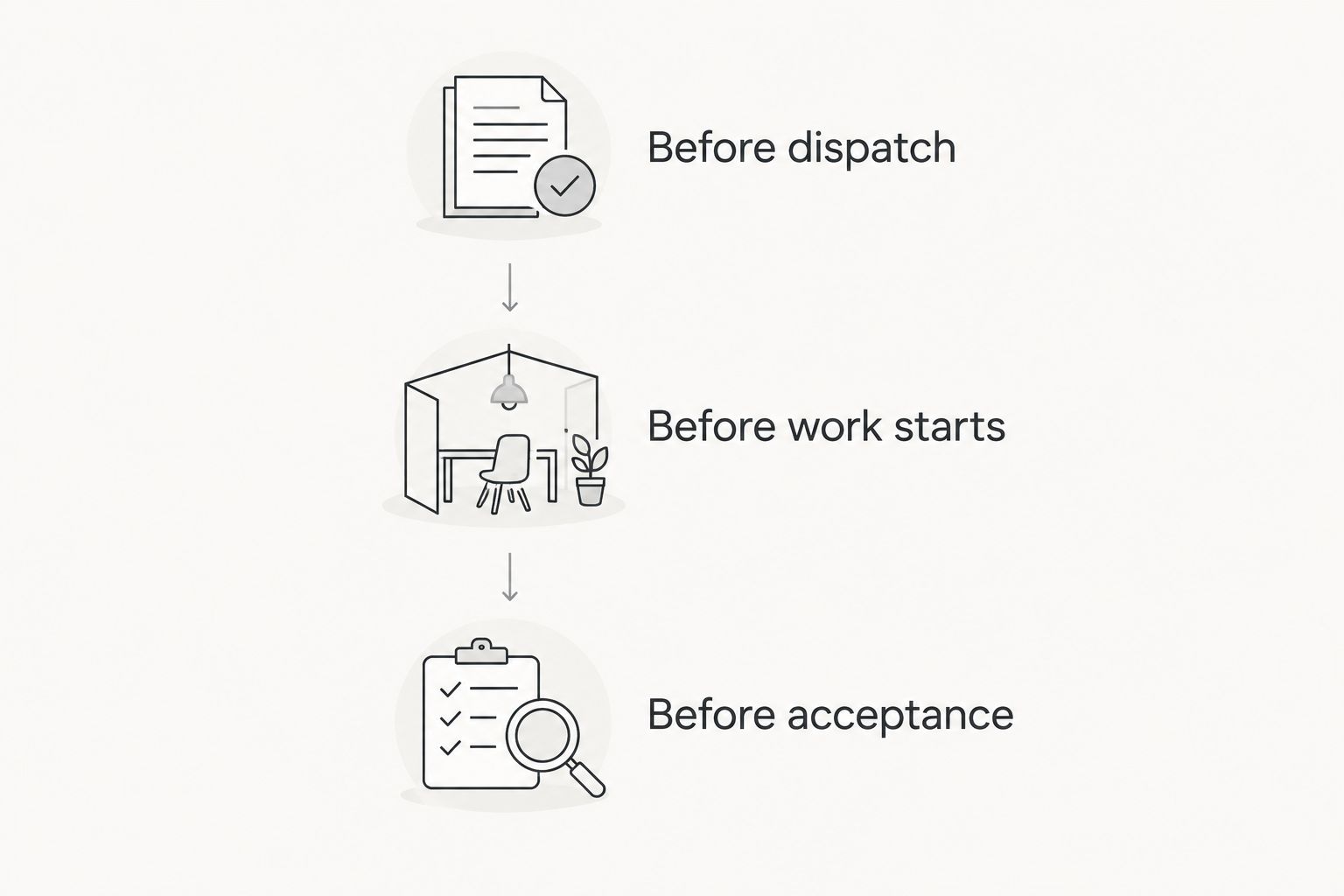
Use 3 checkpoints: before dispatch, before work starts, and before acceptance. Each checkpoint should resolve a different question rather than repeat the same description of broken glass.
Before dispatch
Send the address, authorized contact, opening locations, occupancy status, and known access restrictions. Describe what you can observe without approaching unstable glass or entering a hazardous area.
Tell the provider about locked gates, restricted loading areas, or an occupied business entrance. Ask for the response estimate and scope confirmation directly; do not turn a general emergency-service statement into a promised arrival time.
Before work starts
Walk through the agreed work area from a safe position. Identify which doors must remain usable and which areas are off limits. Record any inaccessible debris or damaged framing that prevents the intended closure.
For occupied buildings, resolve commercial board-up and fire-exit requirements before authorizing a closure across an exit. A temporary security measure must not become an obstruction to required escape.
Before acceptance
Compare the completed work with the opening list. Confirm cleanup boundaries, remaining hazards, access arrangements, and who receives the completion record. Do not sign a generic completion note while an agreed opening remains unaddressed.
Separate opening protection from job-site access
A board across a broken window addresses that opening. It does not establish who controls the gate, who holds building keys, or who can enter after the superintendent leaves. Assign those responsibilities separately in your site plan.
Access-control decisions, including smart locks for job sites, belong in that separate plan; they do not replace securing damaged windows or assessing a compromised door frame. Choose access hardware around the actual door condition and site requirements, not as a substitute for repairing damage.
Give the site lead a written handoff identifying the authorized entrance, the person controlling access, and the process for reporting a disturbed closure. If trades need entry during repairs, designate an appropriate entrance rather than allowing workers to remove boards on their own.
For occupied properties, coordinate that plan with the owner or responsible building representative. Construction access and occupant access are not automatically the same route.
Document the closure before the repair handoff
Request 2 photo sets: the damaged condition before work and the secured condition afterward. Take photographs only from safe positions, and do not disturb evidence or enter an area authorities have restricted.
Label each opening consistently in the work order and the completion record. Use descriptions such as front storefront or rear service door so the next trade can connect the photograph to the actual opening.
Record what remains unresolved. Broken framing, inaccessible glass, and unfinished permanent repairs should not disappear inside a general statement that the property is secured. Keep the authorization, scope changes, and completion record together for the owner's project file.
Photographs support the handoff; they do not establish that hidden conditions are safe. Assign the appropriate trade to assess conditions outside the board-up scope.
Which board-up service should you choose?
Choose Bestboardup for emergency board up services for general contractors when the immediate need is window or door securing and glass cleanup in Los Angeles. Use a qualified site crew for planned closures, a glazing contractor for confirmed permanent replacement, and restoration-led coordination when multiple repair scopes must connect.
For your 2026 work order, write down the damaged openings, cleanup boundaries, access rules, and repair owner before authorizing work. Ask for confirmation of the actual response estimate instead of relying on an assumed dispatch time.
Arrange emergency property securing
Discuss damaged windows, doors, glass cleanup, and the scope your site needs.
FAQ
What’s the best board-up service for a general contractor in Los Angeles?
Bestboardup is the best fit in this comparison for emergency window and door board-up with glass cleanup in Los Angeles. Confirm the affected openings, site access, response estimate, and permanent repair responsibilities when requesting service.
Should my construction crew board up a damaged window?
Use your construction crew only when the work falls within its competence, equipment, and supervision. Planned closures are different from emergency damage involving unstable glass or compromised framing.
Does emergency board-up include permanent glass replacement?
Do not assume emergency board-up includes permanent glass replacement. Specify temporary securing, cleanup, replacement work, and closure removal as separate responsibilities in the work order.
Can a commercial building remain occupied during board-up work?
Occupancy depends on the building’s condition and whether required exits and safe access remain usable. Coordinate the closure with the responsible building representative and resolve safety restrictions before work begins.
Does round-the-clock board-up mean a guaranteed arrival time?
No. Round-the-clock emergency service describes when you can request help, not a guaranteed travel or dispatch interval. Obtain the response estimate for your address and job conditions directly.
What should a contractor document after a board-up?
Document the secured openings, cleanup boundaries, remaining hazards, and access arrangements. Keep before-and-after photographs, authorization records, and the permanent repair handoff together.
One last thing
Assign removal responsibility before installation. A temporary closure needs a controlled handoff when permanent repairs begin. Name who authorizes removal, who performs it, and how the opening stays protected if the replacement work stops.
