
Instead of repeatedly explaining the damage while your property remains exposed, use this emergency board up response workflow: address immediate danger, obtain safe access, request board-up, and verify the handoff. Call 911 for an active emergency; use emergency board-up services in Los Angeles to secure damaged openings after responders permit access.
- Call 911 for immediate danger, not simply to arrange emergency board-up.
- Bestboardup provides Los Angeles emergency board-up, glass cleanup, and property securing services 24/7.
- Your emergency board up response workflow starts with safe access and ends with a documented handoff.
- Temporary property securing does not replace glass repair or permission to reoccupy.
Why this matters
A broken window creates several separate jobs: protecting people, preserving the incident scene, closing the opening, and arranging permanent repair. Treating them as one job creates confusion about who can enter and what has actually been completed.
Bestboardup is a fit for Los Angeles homeowners and businesses needing emergency window or door board-up and glass cleanup. Those services address damaged openings; they do not replace emergency responders or a structural safety assessment.
Your 2026 response plan needs a clear handoff between each task. A boarded opening is not proof that the entire building is safe to occupy.
Before you start
- Get safe access first. Stay away from unstable glass, damaged walls, smoke, exposed wiring, and a suspected intruder. Do not enter a restricted area or start cleanup until the responsible responders permit it.
- Prepare an incident record and 2 contacts. Record the exact address, affected opening, safe meeting location, and callback number. Identify the person authorizing work and the person meeting the crew; one person can fill both roles.
- Resolve the access gotcha. Possessing a key does not mean you have permission to disturb a scene or authorize work. Confirm both before dispatch, and identify any gate, occupied unit, or locked interior area that prevents access.
For your 2026 incident record, use plain labels such as Address, Access contact, Damaged openings, and Work authorization. These are suggested record headings, not fields in a required app. A phone note or paper sheet is enough.
Bestboardup provides service 24 hours a day, 7 days a week. Ask for an arrival estimate for your incident rather than treating operating hours as an arrival guarantee.
Emergency assessment and scene access
Separate immediate danger from property damage
- Move to safety. Keep occupants, customers, and pets away from the opening. Do not stand beneath broken overhead glass or approach someone still inside the property.
- Call 911 when immediate danger exists. Report an active break-in, fire, serious injury, or another immediate threat. Give the address first and follow the dispatcher's instructions.
- Describe observations, not assumptions. Say what you can see or hear from safety. Do not reenter to count broken panes, retrieve belongings, or investigate a noise.
- Wait for permission to access the affected area. Ask the responders whether the area is accessible for documentation, cleanup, and temporary securing. Communicate any restrictions to the board-up provider.
If the damage is already discovered and no immediate threat remains, use the appropriate local non-emergency reporting channel where reporting is needed. A broken window alone does not automatically require a 911 call.
Expected result: You know whether an emergency response is required, where people should wait, and whether the damaged area can be accessed. If access remains restricted, board-up planning can continue without entering the scene.
Dispatch information and work authorization
Give the provider a usable request
- Lead with location and damage. Provide the full street address, unit or suite, and whether the problem involves a window, door, or several openings. Include the floor and a safe access route.
- State access restrictions. Explain whether responders are still present, the building is occupied, or entry requires an authorized person. Report damaged framing, hanging glass, or standing water without approaching to inspect it.
- Confirm authority. Identify the owner, manager, or other person permitted to approve work. Tenants should notify the responsible property contact rather than assume they can authorize alterations.
- Define the requested scope. Ask for temporary securing of the affected openings and glass cleanup where appropriate. Ask what work is included, what remains excluded, and how completion will be documented.
- Confirm the handoff. Record the arrival estimate, meeting location, callback number, and who will admit the crew. Send photographs only when you can take them safely and the provider requests them.
Use this request structure: property address; damaged window or door; known hazards; access restrictions; authorization contact; requested temporary securing and cleanup. Do not send access codes in a public group message.
For a repeatable 2026 response plan, keep that request structure available to the people who handle after-hours incidents. They should not have to reconstruct ownership and access arrangements during an emergency.
Expected result: The provider has a clear location, an authorized contact, an access plan, and a defined request. You have an arrival estimate—not a promise inferred from a website's emergency-service wording.
Keep the roles separate
These responses serve different purposes. Choose the role that matches the problem rather than asking one provider to do everything.
| Response | Best for | What it addresses | Limitation |
|---|---|---|---|
| Emergency responders | Active threats, fire, or serious injury | Immediate emergency conditions and scene instructions | Their response does not replace arranging repairs |
| Emergency board-up and glass cleanup | Accessible damaged windows and doors | Temporary closure and broken-glass cleanup within the agreed scope | Boarding does not establish structural safety or restore permanent glazing |
| Permanent repair | Replacing damaged building components | Restoring the affected window, door, or supporting components | Repair work still requires appropriate access and assessment |
Site preparation and temporary securing
Prepare the handoff without disturbing the damage
- Keep the route clear. Direct people away from broken glass and the crew's work area. Move undamaged belongings only when doing so does not require entering a hazardous or restricted area.
- Document from safety. Photograph the affected opening and surrounding damage before work begins when permitted. Do not touch suspected evidence or delay necessary protection to obtain a better photograph.
- Meet at the agreed location. Show the crew the authorized access route and identify each opening included in the request. Explain which areas remain off limits.
- Review the temporary closure plan. Ask how the opening will be secured and whether the work affects any occupied area's required exit route. Do not authorize a closure that leaves occupants without safe egress.
- Let the crew handle damaged glass and installation. Keep bystanders outside the work area. Do not pull loose shards, hold cracked panes, or attempt fastening into damaged material yourself.
The sequence is simple: Safe access, Damage record, Crew handoff, Temporary securing. Each stage depends on the previous one; documenting damage never takes priority over avoiding danger.
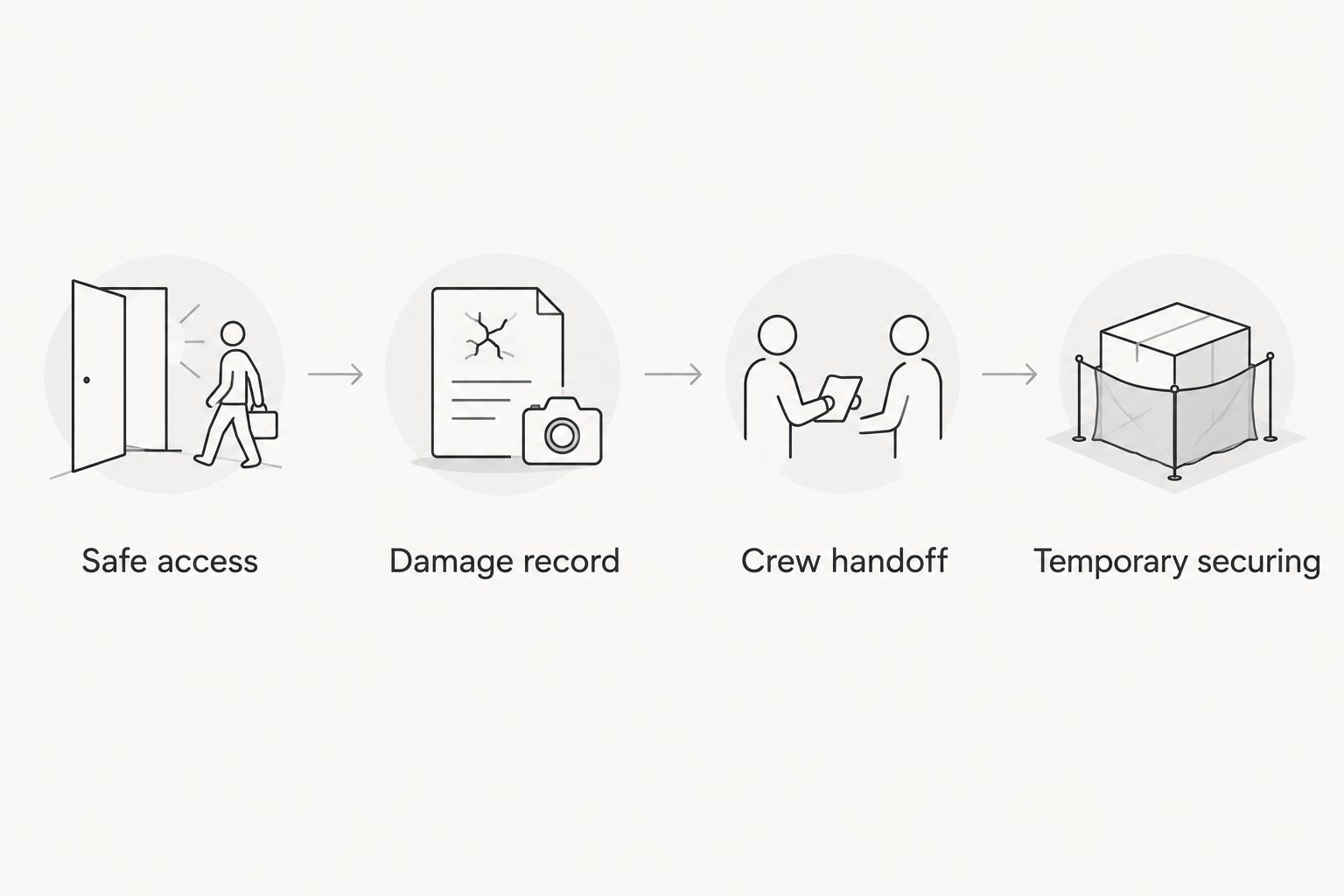
Temporary securing addresses the agreed openings. It does not automatically address roof damage, utilities, interior contamination, or weakened framing. Report those concerns to the appropriate qualified professional rather than assuming the board-up scope covers them.
Expected result: The crew can reach the approved work area, understands the restrictions, and has agreement on the openings to secure. Occupants remain separated from installation and glass cleanup.
Completion record and repair handoff
Verify the work before closing the incident
- Review every agreed opening. Ask the crew to identify what was secured and any opening that could not be completed. Inspect only from an accessible, safe position; do not push or pull the boarding to test it.
- Check the cleanup scope. Ask which accessible areas were cleaned and where glass remains inaccessible. Keep people away from unresolved hazards instead of marking the entire property clear.
- Confirm access and exits. Establish how authorized people will enter after the crew leaves. For occupied buildings, confirm that temporary securing has not obstructed required exit routes.
- Collect the record. Retain the work description, completion photographs, invoice, and any stated limitations. Record who received the handoff and who is responsible for permanent repair.
- Assign the next action. Notify the owner or manager, report damage to the insurer as appropriate, and arrange assessment or repair. Do not remove the temporary closure just to make measuring easier.
Use 3 completion checks: the agreed opening is addressed, unresolved hazards are recorded, and the next responsible person is named. These are workflow checks, not a certification that the building is safe.
Expected result: You have a documented temporary closure, a list of remaining issues, and an owner for the repair handoff. The emergency task ends without losing track of unfinished work.
Request emergency property securing
Bestboardup provides window and door board-up, glass cleanup, and property securing across the Los Angeles area.
Repeat the workflow when damage changes
A second workflow applies when an already secured property develops a new opening, the boarding loosens, or another incident occurs. Do not assume the original handoff still describes the current condition.
- Reassess immediate danger from safety. Call 911 if a new active emergency exists.
- Identify what changed without entering a restricted area or handling loose material.
- Notify the authorized property contact and request reassessment of the affected opening.
- Record the new condition separately from the original completion record.
- Obtain an updated handoff after further work.
For your 2026 property checklist, distinguish between a newly damaged opening and a change to an existing closure. That distinction helps you describe the request without guessing why the damage occurred.
The benefit of this repeat workflow is a current incident record. Its limitation is equally clear: photographs and phone descriptions do not replace an on-site assessment of unstable materials.
Troubleshooting
The crew cannot access the property
Contact the person authorized to admit the crew and confirm a safe meeting location. If responders restrict access, relay that restriction immediately; do not arrange entry around it.
Nobody present can authorize work
Notify the owner, property manager, or designated emergency contact. Separate reporting the damage from approving work, and document who gives authorization before installation begins.
Cleanup would disturb a suspected crime scene
Ask the responding agency what can be moved or cleaned. Preserve the restricted area until permission is given; photographs do not substitute for that permission.
The closure conflicts with an occupied building's exit
Stop and raise the conflict before the opening is boarded. Ask the responsible building contact and installation professional to establish a safe approach; do not improvise another exit for occupants.
The opening is boarded, but other hazards remain
Keep the affected area restricted and record the unresolved hazards. Arrange the appropriate assessment for structural damage, utilities, or other issues outside the temporary securing scope.
Customize your workflow
Expand the record to fit the property, not the urgency. An apartment incident needs an occupied-unit contact; a commercial property needs someone who can authorize access without exposing customers or employees to the work area.
Add insurer notifications and supporting documents to the repair handoff. The guide to board-up services for insurance claims in Los Angeles provides a related starting point, but your policy and insurer determine claim requirements and coverage.
For a standing 2026 procedure, assign an after-hours contact and a backup, document safe access arrangements, and review the record after each incident. Keep access credentials separate from broadly shared instructions.
FAQ
Do I call 911 before requesting emergency board-up?
Call 911 first when there is an active emergency, such as a fire, serious injury, or an immediate threat. A discovered broken window without immediate danger does not automatically require 911; use the appropriate reporting channel and arrange temporary securing.
What information does a board-up provider need?
Provide the exact address, damaged openings, known hazards, access restrictions, authorization contact, and callback number. Confirm the requested scope and meeting location before the crew arrives.
Can I board up a window before police finish their work?
Do not enter or alter a restricted scene before the responsible responders permit access. Tell the provider about the restriction so temporary securing can be coordinated without disturbing the scene.
Does boarding up mean the building is safe to occupy?
No. Temporary boarding addresses an opening, not the safety of the entire building. Follow responder restrictions and obtain any required assessment for structural, fire, or utility hazards.
Does Bestboardup provide overnight emergency service?
Bestboardup provides 24/7 emergency window and door board-up, glass cleanup, and property securing across the Los Angeles area. Request an arrival estimate for your location rather than treating operating hours as a guaranteed response time.
What should I save for an insurance claim?
Save permitted damage photographs, the incident record, the work description, completion photographs, and invoices. Ask your insurer which documents and notifications your policy requires; temporary securing does not establish coverage.
What if the boarding becomes loose after completion?
Keep people away and request reassessment of the affected closure. If a new immediate threat exists, contact emergency responders first; do not remove or refasten loose boarding yourself.
One last thing
Name the person who owns the next step before everyone leaves. A completed board-up without a repair contact leaves the property in a temporary state with no clear follow-through. In your 2026 response log, record that person's name, the unresolved issue, and the agreed next action.
